



Almost everyone starting Georgian for beginners makes the same three opening moves. Buy a textbook. Print an alphabet chart. Search for Georgian on Duolingo and discover, confused, that it is not there. My own false starts were built from the same instincts, and they cost me years, so this post is the plan I wish someone had handed me instead: the first 30 days, in order, with the traps marked.
For context on the traps: I moved from Denmark to Tbilisi in 2021 and then spent about three years not really learning Georgian. I tried teachers, tried Anki, got by on survival phrases, and quietly gave up more than once. The learning that stuck started in 2024, with a completely different order of operations. That order is what follows.
Where to start (and where not to)
The instinct is to start with rules, because that is what school trained us to do. Learn the alphabet perfectly, then the cases, then the verb tables, then, someday, speak.
For Georgian this order is close to backwards. The language runs on patterns that are genuinely hard to memorize from charts and surprisingly easy to absorb by ear. So the beginner plan is built on a different spine: get reading ability fast and roughly, then spend your daily effort listening to and saying real Georgian sentences out loud, and let the rules come later, once they have something to attach to.
The full version of that argument lives in the complete guide to how to learn Georgian. This post is just the on-ramp: the first month.
Day 1: the alphabet is an afternoon, not a wall
The Georgian script looks like the hardest part. It is actually the easiest win in the whole language. There are 33 letters, no capital forms, and the spelling is fully phonetic. Every letter makes one sound, every sound has one letter, and once you know them you can read anything, correctly, forever. English spelling is far crueler.
Treat it as one focused afternoon. Not a week of drills, not a wall chart you circle for a month. Rough recognition is the goal: you see ღ and something in your head says gh, slowly. Reading speed comes free later, from all the reading you will do anyway.
There is a longer argument about whether to learn the Georgian alphabet first, but the practical answer for a beginner is yes, fast and imperfectly. EasyGeorgian’s free 56-minute alphabet video does it contextually, hiding Georgian letters inside English words until your brain infers them, and ends with you reading real Tbilisi street signs. Watch it once, same day you decide to start.
One warning while you are in there: five Georgian letters come in pairs that sound almost identical to an English ear at first (the ejectives, written with apostrophes like p’ and t’ in transliteration). Do not stop to perfect them. Nobody gets them right in week one, they lock in over months of audio, and beginners who stall here drilling minimal pairs are misallocating badly.
Your first week: a small core, spoken out loud
Here is the principle that separates beginners who end up speaking from beginners who end up with notebooks: a small core mastered in depth beats a wide pile of words on the surface.
The words that run through your daily life are few. Hello, thanks, yes, no, I want, where, how much, I don’t understand, can you repeat that. If those are reflexive, you can function. If they are things you recognize on a flashcard but have never said out loud, you cannot. So week one is not about volume at all. It is about taking a tiny set of phrases and repeating them out loud until they come out of your mouth without a loading pause.
Out loud is the part people skip. Reading a phrase silently and being able to say it are different skills stored in different places, and only one of them helps you at a counter in Tbilisi.
Your first phrases
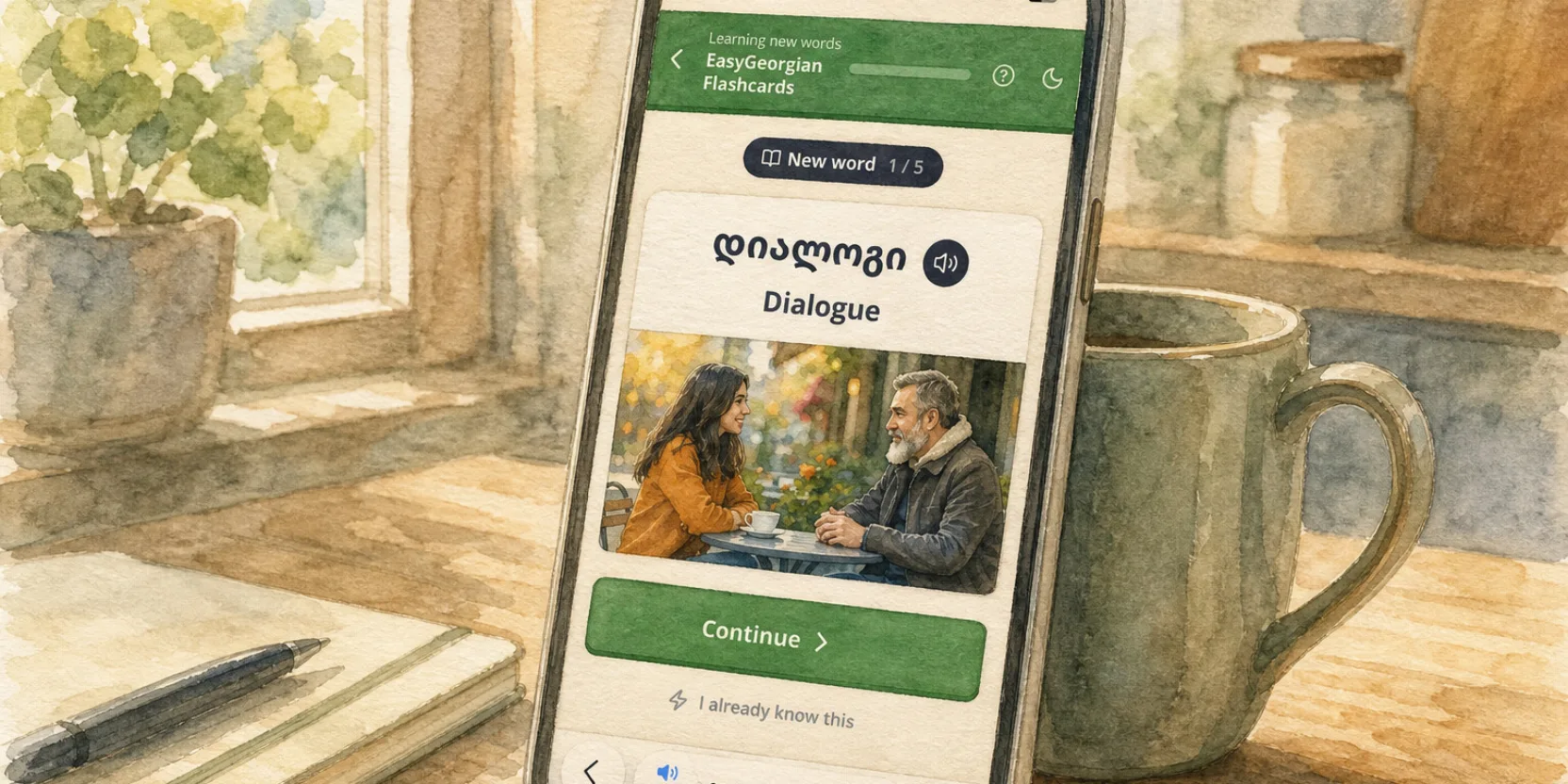
These three are from the EasyGeorgian audio course deck, with the same native audio learners hear in the course. Play each one, then say it back, matching the rhythm rather than the individual letters.
That third one is worth learning early precisely because it is a whole sentence. Saying it to a Georgian does two things: it explains your level, and it announces that you are trying. The response to that announcement, in my experience, is warmth entirely out of proportion to the effort.
Weeks 2 to 4: the daily audio habit
After the alphabet afternoon, the engine of the first month is one structured audio lesson a day. Not passive listening, and not podcasts in the background. A structured lesson makes you retrieve: it prompts you in English, gives you a beat of silence to produce the Georgian, then a native speaker confirms and you repeat. That retrieval under mild time pressure is what turns recognition into speech.
This is the format EasyGeorgian’s audio course (Speak Georgian in 50 Days) is built on, and I will be honest about what it demands. A lesson is around 30 minutes of full attention, ideally with headphones in a quiet room. It is work, and it often leaves you tired. It is also about $1.60 a lesson, against $10 to $35 an hour for a tutor, and in the beginner phase it does more, because 100% of the half hour is you hearing and producing Georgian rather than discussing it in English.
Two habits to attach to the daily lesson. First, say everything out loud, even alone in your kitchen. The mouth needs the reps as much as the ear. Second, when flashcards come with your course, review them daily in small doses rather than weekly in binges. Ten minutes a day beats an hour on Sunday, every time.
If money is the constraint this month, there are genuinely usable free Georgian resources, and the honest trade-off is that you assemble the structure yourself.
The three beginner traps
The alphabet wall. Spending two or three weeks drilling letters, feeling unable to move on until recognition is instant. It never becomes instant from drilling. It becomes instant from reading real words, which happens in every lesson anyway. One afternoon, then move.
Pronunciation perfectionism. The ejective consonants take months to settle, and they settle by ear. Beginners who treat p’ versus p as a gate they must pass before starting real sentences are stuck at a gate that does not exist.
Grammar front-loading. Georgian grammar has a fearsome reputation, and the verb system eventually earns it. But charts memorized in week one attach to nothing and evaporate. The same rules read as common sense months later, when they name patterns your ear already knows. If the difficulty question is what is holding you back, read how hard Georgian actually is, because the honest answer is uneven: hard verbs, but no articles, no grammatical gender, phonetic spelling, and an easy alphabet.
All three traps share a shape. They convert a language, which is a thing you do, into a subject, which is a thing you study. Adults who acquire Georgian do it the way they acquired their first language, patterns first and names for the patterns later, just faster and with better tools.
What to leave for later
A beginner’s first month has no room for everything, so here is what deliberately waits.
A teacher. Genuinely useful, at the right moment. In week one, half the lesson happens in English and the money mostly buys you a spectator seat. A few months in, when your ear can keep the lesson in Georgian, a good teacher becomes one of the best purchases in the language. Later, not first.
Writing by hand. Lovely script, entirely optional skill. Typing covers modern life.
The verb tables. They are real, and they are a month-four revelation rather than a week-one requirement. How long the whole journey takes is its own honest question, answered in how long Georgian takes, but the short version is that the first month’s job is not speed. It is building the daily habit that everything else compounds on.
Thirty days from now, the realistic outcome looks like this: you read Georgian slowly but correctly, you have a few dozen phrases that come out without thinking, you have said them to real people, and the language has stopped being a wall of unfamiliar squiggles and started being something you do for half an hour a day. That is a real foundation, and it is more than I had after my first three years of false starts.
The first audio lesson is free, takes about 20 minutes, and is the fastest way to find out whether this way of learning fits you. Day 1 is the alphabet video and lesson 1. Everything else follows from those two.