


There are dozens of Georgian alphabet flashcards sets online, and almost all of them are the same set. A Georgian letter on the front. A Latin letter on the back. Thirty-three cards, made by a learner, uploaded to Quizlet or Brainscape or sold as a printable PDF.
The problem with that deck is not the front of the card. It is the back. A Latin letter tells you what a Georgian letter roughly corresponds to, and for a language whose whole difficulty at the start is sound, roughly is not good enough.
What a Georgian alphabet flashcard has to carry
Three things, in order of importance.
The sound, played by a native speaker. Georgian is fully phonetic, one letter, one sound, always. That is wonderful news, and it means the letter and the sound are the same piece of knowledge. Learn the sound and you have learned the letter. Learn only a Latin approximation and you have learned a rumor about the letter.
The letter itself, big and clear. Obvious, but the user-made sets often show it small, in whatever font the site defaults to, and Georgian letterforms vary more across fonts than Latin ones do. A beginner needs to see the same clean shape every time until it is familiar.
A real word the letter lives in. A card for ღ that only says “gh” teaches nothing your memory can hold. A card for ღ that plays ghvino (wine) gives the letter a job. The Georgian alphabet guide is built on this idea, letters inside words you already half-know, and it is the same reason our free alphabet tool hides each letter inside a familiar word before it ever shows you a chart.
Get those three onto a card and the deck works. Miss the first one and it mostly does not.
Why most free sets fall short
I want to be fair to the people who made them. A Quizlet set with 33 cards is a generous thing to upload, and for a language with a Latin-adjacent alphabet it would be plenty.
Georgian is a different case for one reason, and it is the same reason I keep coming back to in the post on why most Georgian flashcards fail: the sounds cannot be inferred from the writing. A text-only card can teach you that ტ is “t”. It cannot teach you that it is a different t from თ, or what that difference sounds like, and that difference is the entire reason the alphabet has both letters.
The printable sets have the same ceiling with a nicer finish. A PDF can show a picture of a tomato next to the letter. It cannot say the word.
The five letters that make or break a deck
Georgian has a set of consonants called ejectives, made with a small catch in the throat, that English does not have at all. Five of them come in pairs with a plain letter that sounds, to an English ear on day one, identical. They are not identical, and telling them apart is most of what the alphabet phase is really about. The Georgian pronunciation guide goes deep on how they are made. Here they are as a deck should present them, letter and sound together, from the free alphabet deck.
There is a sixth ejective, ყ, with no plain twin, which is its own small adventure. Play each pair a few times and you will hear it: the ejective is tighter, shorter, with a tiny pop. Now imagine trying to learn that from a card that says “k” on the back. That is the whole argument for audio in one listen.
One honest caveat that a deck cannot fix. Hearing the difference is quick. Producing it reliably takes months, and it locks in over the audio course, where you say these sounds inside hundreds of real sentences, not by drilling the letter. Anyone spending two weeks on flashcards trying to get their p’ perfect has misallocated the time.
How to use an alphabet deck without getting stuck on it
The alphabet is where a surprising number of Georgian learners quietly give up, not because it is hard but because they treat it as a wall to be climbed perfectly before anything else is allowed to start. I wrote a whole post on whether you should learn the alphabet first, and the short version is yes, in one afternoon, roughly, and then move on.
So the way to use a deck is with a timer, not a target. One focused afternoon. Go through the 33 cards with the audio on until you can look at most letters and hear the sound in your head. Do not wait for all 33 to feel solid. Rough recognition is the finish line, because the letters that stay shaky will fix themselves over the next months every time you read a sign or a subtitle, and the sounds will fix themselves every time you hear a native speaker say them in a sentence.
After that, the deck is a thing you open for five minutes when a letter slips, and otherwise ignore. The language is not in the alphabet. The alphabet is the door.
The free EasyGeorgian alphabet deck
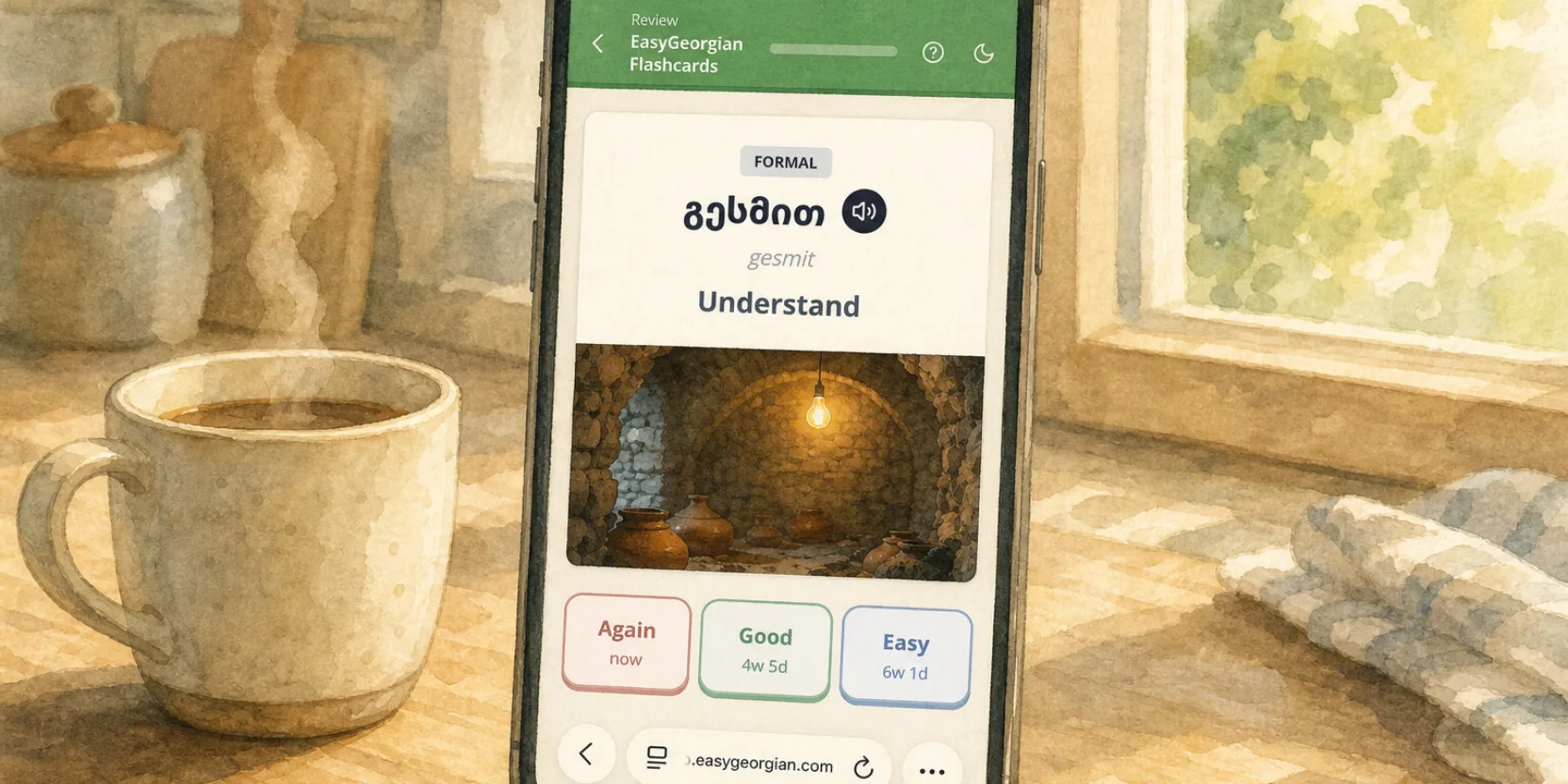
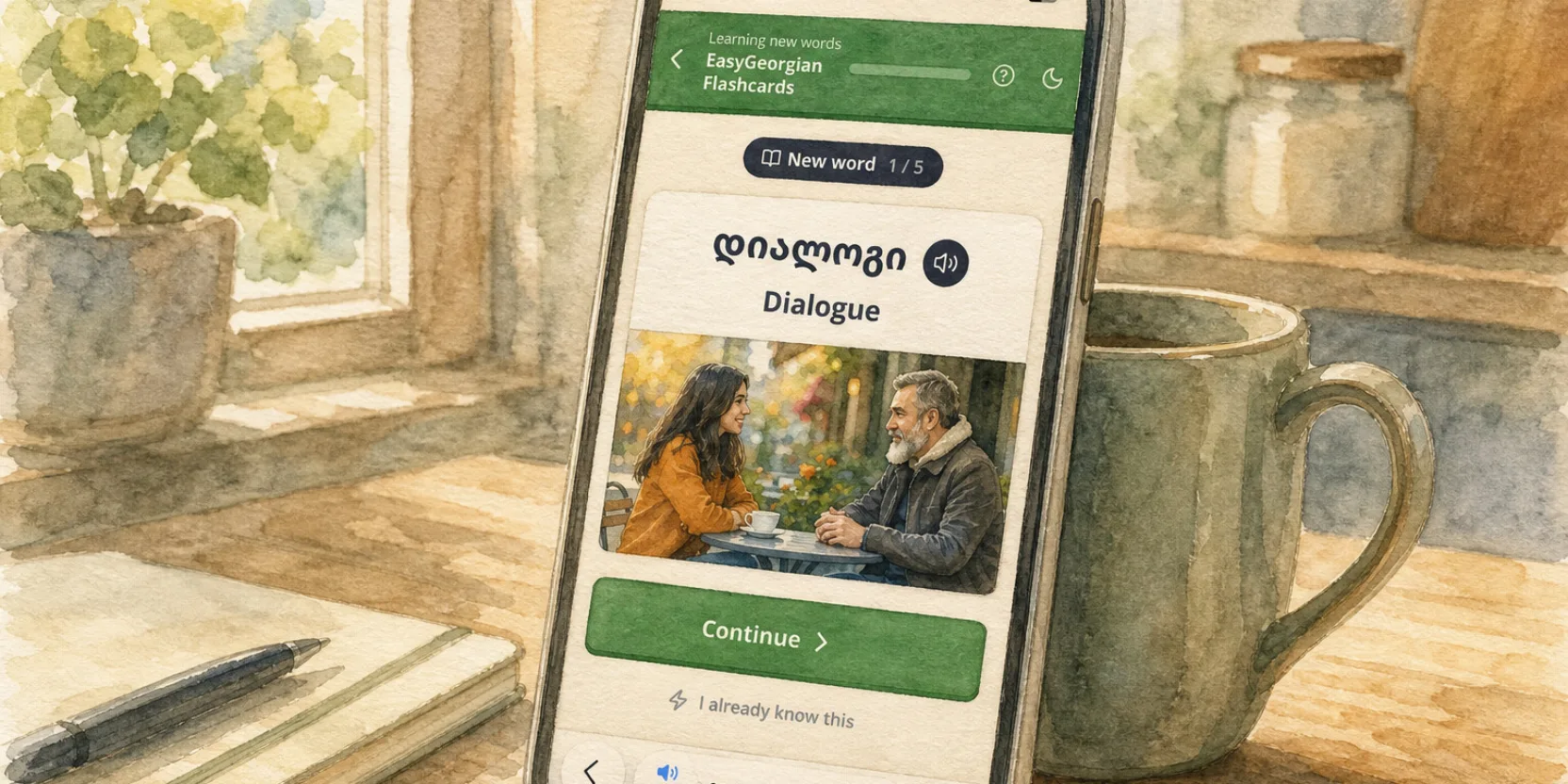
The deck the audio above comes from lives inside the EasyGeorgian app. Thirty-three cards, one per letter, each with the letter, its name, and a native speaker saying the sound. It sits next to the 56-minute alphabet video, which teaches the letters by hiding them inside English sentences and then inside real Georgian street signs, and next to the free alphabet tool on this site, which does the same with photos of actual Tbilisi signs and needs no account at all.
Both the deck and the video are free for anyone who signs up. There is no card required and nothing to buy to use them.
The reason we made it free is not generosity, or not only. The alphabet is the one part of Georgian that should cost nobody anything, in money or in weeks, and a learner who has spent an afternoon with real audio arrives at the first proper lesson ready to hear it rather than still decoding it.
Print or app?
If you like paper, or you are making cards for a child, print away. A printed deck is fine for the shapes, and it has the small advantage that it cannot distract you with anything else. Just pair it with something that can make the sounds, whether that is our video, the alphabet tool, or a Georgian friend with patience.
For an adult learning on their own, the app version wins for one reason only, and by now you can guess it. The card that plays the sound teaches the letter. The card that does not teaches a shape, and Georgian has enough beautiful shapes to keep you busy for a very long time without ever learning to hear them.