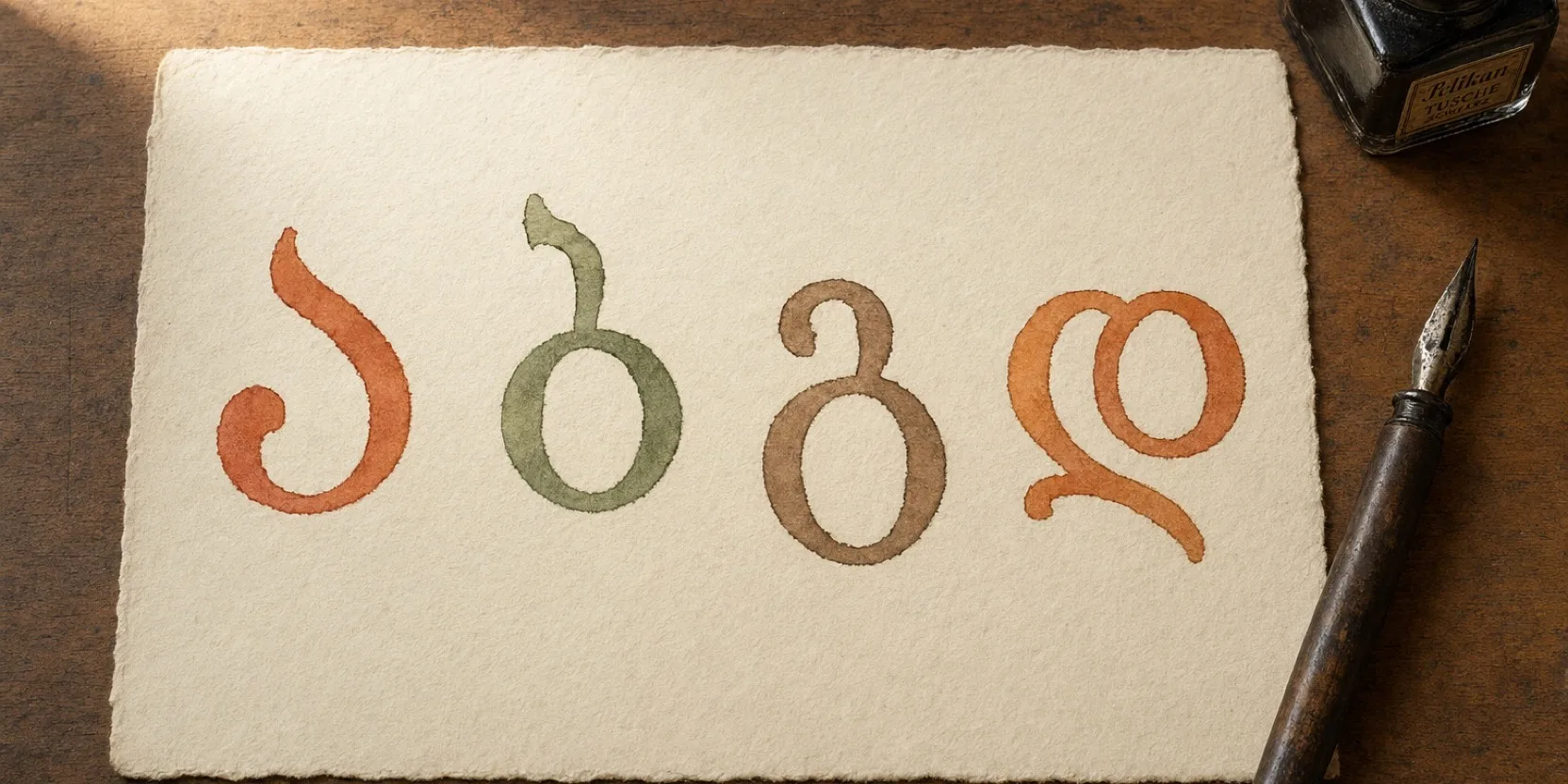





Georgian pronunciation has a fearsome reputation, mostly earned by how the language looks on paper rather than how it sounds in the air. You read about consonants that pop, a letter with no English equivalent, words opening with 3 consonants in a row, and you quietly conclude your mouth was not built for this. Then you hear actual spoken Georgian: 5 clean vowels, no tones, a steady rhythm, mostly sounds you already own. The genuinely new material is 6 popped consonants (1 of them properly difficult), 2 throat sounds, and a habit of stacking consonants. This guide walks through that list with native audio on every sound, because reading about sounds is like reading about swimming.
One scope note: this post is about producing Georgian, not reading it. The letters themselves, and how to learn them in an afternoon, live in our Georgian alphabet guide. Here we care about what your throat and tongue are doing. If you want these sounds drilled rather than described, that is what happens when you learn Georgian by ear from the first lesson.
Why Georgian pronunciation is easier than it looks
Georgian spelling is fully phonetic. One letter, one sound, almost always. Once you can read the 33 letters, every word tells you how to say it. No silent letters, no though-through-tough ambushes, no long-or-short vowel guessing (Georgian has no long vowels at all).
The 5 vowels (a, e, i, o, u) are short and pure: a as in hat, e as in pet, i as in hit, o as in hot, u near the oo in hook. Every vowel is its own syllable. No diphthong soup, no reduced mumble vowels.
Most consonants are plain English sounds. The b, d, g, v, z, l, m, n, s, sh, j crowd behaves as you’d hope, and the r is rolled, as in Spanish.
What is actually new for an English speaker is a short list: 6 ejectives, 2 throat sounds, consonant clusters. That list is the rest of this post. For perspective, sounds sit near the bottom of this language’s difficulty ranking and verbs at the top, as covered in is Georgian hard and our walk through Georgian grammar.
Aspirated vs ejective: the distinction English doesn’t have
Say pot with your palm a few centimeters from your lips. A puff of air lands on the p. Now say spot. The puff is nearly gone. English p, t, and k are breathy (aspirated) at the start of words and unaspirated after s. No English speaker notices, because the difference never changes a word’s meaning.
In Georgian it does. Stops come in 3 rows: voiced (b, d, g), aspirated (p, t, k, plus the affricates ts and ch), and ejective (p’, t’, k’, ts’, ch’). The apostrophe row is the new one.
Here is what an ejective physically is. Put your mouth in position for the consonant. Close your vocal cords for a beat, as if about to hold your breath. Let pressure build, then release consonant and throat together. Out comes a short, dry pop. No breath, no hiss. You already own the throat move: it is the catch in the middle of the cockney bottle. An ejective is that catch released through a consonant.
Hear the pair before you try to make it:

To a fresh English ear the two letters sound almost identical. That is normal. The ejectives are the headphone test of Georgian: mishearing them is a big part of why beginners catch one word in three at full speed. I could not hear the difference at first either. The fix is volume of real native audio. Hearing comes first, production later, and nobody needs to wait for perfect before speaking.
The six ejectives, with audio
Georgian has 6 ejectives. Five of them are popped twins of sounds you already make:
- პ (p’) pairs with ფ (p)
- ტ (t’) pairs with თ (t)
- კ (k’) pairs with ქ (k)
- წ (ts’) pairs with ც (ts, as in pits)
- ჭ (ch’) pairs with ჩ (ch, as in church)
The 6th, ყ (q’), has no plain twin and gets its own section below.
A useful cheat: the closest English gets to an ejective is the p, t, k after s in span, Stan, and scan, where the puff disappears. A Georgian ejective takes that puffless consonant and adds the throat pop.
Now hear them inside real words:
Ejective k’ up front. Daily vocabulary, mostly inside k’argad, madloba (fine, thanks).
Plain aspirated k up front. Same spot in the mouth as the k’ above, breath instead of pop.
Plain ch, exactly the English ch in church.
Ejective ch’. Drier and tighter than the ch in chai.
Two ejectives in one small word: p’ and t’.
A loanword rebuilt with Georgian sounds: ejective t’ at the front, plain p in the middle.
Ejective ts’ up front, one of the most used words in daily life here.
One spelling note: in transliteration, the apostrophe always marks the popped version. Every transliterated word tells you which family each consonant belongs to.
The letter ყ, the hardest sound in Georgian
Ask learners of Georgian which sound broke them and the answer is usually ყ.
It belongs with the ejectives, which is why it is written q’. But where k’ pops at the back of the mouth, ყ is made further back still, tongue against the soft palate, same brief throat closure, often with a rough edge of friction on release. No English sound will anchor it. This is the one sound where the honest answer is: it takes months, and that is fine.
Georgian has a classic tongue-twister built almost entirely out of this letter: ბაყაყი მყაყე წყალში ყიყინებს (baq’aq’i mq’aq’e ts’q’alshi q’iq’inebs), “the frog is croaking in the stagnant water.” Four words, seven q’ sounds. Nobody expects it in month 1. It exists as a finish line: once you can say this, no Georgian word will scare you.
Meanwhile, practice recognition on two daily words:
Day-1 vocabulary in any Tbilisi cafe. Listen for the deep pop before the first a.
The q’ hides in the middle, straight into a v. More on this word in how to say I love you in Georgian.
Tag ყ every time it goes past in listening, attempt it on q’ava, and let it be bad for a while. Recognition first, production over months.
The two throat sounds: ხ and ღ
Neither of these is an ejective, and neither is as hard as its reputation.
ხ (kh) is the ch of Scottish loch or German Bach, a rough exhale at the back of the mouth. You already attempt it every time you order khachapuri or khinkali.
ღ (gh) is the same spot with the voice switched on, close to a French r. If you can hum while making kh, you have found it.
The menu spelling hides two lessons: kh at the front, and a mid-word ejective k’ that most visitors flatten into a plain k.
gh straight into v with no vowel between. A preview of the next section.
Khachapuri is a triple: kh at the front, plus an ejective ch’ and an ejective p’ in the middle (ხაჭაპური).
Consonant clusters: words that look unpronounceable
Every write-up of Georgian eventually shows off gvprtskvni (გვფრცქვნი), 8 consonants before a single vowel, meaning “you peel us.” It is a real verb form, and you will never need it. Words like that live in linguistics articles, not conversations.
The everyday clusters are far shorter. Georgian happily opens a word with 2 or 3 consonants where English would demand a vowel between them. The capital starts with one:
tb with no vowel between, the cluster most of the world flattens into Tuh-bilisi.
The formal you. Three consonants, tkv, then the vowel.
ts, kh, and r in one quick run before the vowel.
Water opens with ts’ straight into q’, two ejectives back to back. The two words also pack in a plain ts and an ejective t’.
The technique is the opposite of instinct. Instinct pads clusters with helper vowels (tikveni, tibilisi), which is exactly what sounds foreign. Say the cluster slowly as one connected movement, then speed the whole word up. At speed it stops being an obstacle course and becomes a single sound.
Stress, the part you can stop worrying about
Two pieces of good news. Georgian has no tones, nothing like Chinese or Thai to memorize. And word stress is low-stakes.
The working rule: in words of 2 or 3 syllables, lightly stress the first syllable. In longer words stress drifts toward the third syllable from the end, with enough variation that reference grammars decline to state a complete rule. It rarely distinguishes one word from another, so this is a corner of pronunciation you can absorb purely by imitation.
If you catch yourself hammering syllables English-style, flatten them out and copy the audio. Georgian is forgiving here.
How to actually train Georgian pronunciation
The opinion this post has been circling: pronunciation perfectionism is a trap. The learners who stall decide they must nail p’ against p before moving forward, then spend 2 weeks drilling the alphabet to perfect one letter. What you need at the start is rough recognition: know the two families exist and hear the difference some of the time. Producing something in the right neighborhood is enough to begin speaking.
The order that works is ear first, mouth second. You cannot reliably produce a sound you cannot hear, and you learn to hear it by meeting it inside real words hundreds of times. That is the argument for training through the audio course rather than a chart. Every new word in Speak Georgian in 50 Days is built up from the back, piece by piece, with you repeating after a native speaker:
It arrives as vad, then ravad, then k’atsravad, then the whole word, each piece said aloud. By the full word, the k’ is already in your mouth.
Do that across 50 lessons and pronunciation rides along for free. The voices are native throughout (the female half of the dialogues is Tamar, my Georgian co-founder and wife), and your one job on every line is to sound like them.
I learned Russian and Spanish by audio before Georgian, and both times native speakers took me for one long before I could hold a real conversation. Not because my grammar was good (it was not), but because I had never seen the words written down. There was no English-flavored reading to unlearn.
Georgia is a kind place to have an imperfect accent. Say one halfway-broken sentence with a decent k’argad and a Tbilisi taxi driver will tell you your Georgian is excellent. He is wrong, but he keeps you talking.
The first lesson of the audio course is free, no signup needed, and it will put a dozen of the sounds from this post in your mouth this evening.