


When two Georgians meet, the last name does quiet work in the first few seconds. Georgian last names carry geography in their endings, and we read them without thinking, roughly the way you might read an area code. A -dze leans west. A -shvili leans east. An -ia usually points to Samegrelo, an -ani high into Svaneti. None of it is certain, families have been moving for centuries, but the map is real, and I place the name before I place the face.
First names are a separate story, and we have covered Georgian names in their own post. This one is about the family name: what the endings mean, where they came from, which surnames are the most common, and how to read the ones around you.
How Georgian last names work
The Georgian word for a surname is gvari (გვარი), and full names run in the order you already know, given name first, family name after: Nino Beridze, Giorgi Gelashvili. Almost every Georgian surname is built the same way: a root plus a suffix, where the root is an ancestor’s given name, trade, nickname, or home place, and the suffix says what the root is to you. Child of. Son of. From.
So the system is less like a list of names and more like a small grammar. Once you know maybe eight endings, an unfamiliar Georgian surname stops being a wall of letters and becomes two readable parts. Gelashvili is Gela plus shvili, Gela’s child. Giorgadze is Giorgi plus dze, Giorgi’s son. Mchedlishvili is mch’edeli (მჭედელი), the blacksmith, plus shvili. Somebody in that family, centuries ago, worked iron.
Two things make Georgian surnames unusually easy for a learner, and both are structural.
First, a Georgian surname never changes shape. Georgian has no grammatical gender, so there is no masculine or feminine form of a name. A brother and a sister are both Beridze. Compare Russian, where Ivanov’s sister is Ivanova. Georgian skips all of that.
Second, the endings are few and they repeat. Georgia’s civil registry holds an enormous variety of surnames, but a handful of suffixes covers the overwhelming majority of people you will actually meet. Learn -shvili and -dze and you can parse most of a Tbilisi apartment building’s doorbell panel. Learn the regional endings on top and you can often guess where a family started.
The two endings you hear everywhere: -shvili and -dze
-shvili (-შვილი) means child. A surname ending in -shvili reads as “child of” whatever comes before it, whether that is an ancestor’s name (Gelashvili, Gela’s child), a trade (Mchedlishvili, the blacksmith’s child), or something older and stranger that the family itself may no longer remember.
The word is not an archaic fossil. Shvili is still the ordinary, everyday Georgian word for one’s child, and you hear it constantly in the first questions Georgians ask each other about family. რამდენი შვილი გყავთ თქვენ? (ramdeni shvili gq’avt tkven?), how many children do you have, is about as common as questions get at a Georgian table. Every Ananiashvili and Melikishvili is carrying a living word around.
-dze (-ძე) is an old word for son. It works exactly the same way, attached to a name, a trade, or a nickname. Beridze is usually parsed as beri (ბერი), the monk, plus dze. Lomidze carries lomi (ლომი), the lion. Giorgadze is Giorgi’s son. Unlike shvili, dze has mostly retreated from daily speech and survives inside names, which gives -dze surnames a slightly older, stonier feel to a Georgian ear.
Here is the part most write-ups state too confidently, so let me state it the way Georgians actually experience it. Both endings exist everywhere in the country. But the balance tilts, and the tilt is real. In the west, -dze dominates. In the east, in Kartli and Kakheti, -shvili takes over. I grew up in Adjara, in Georgia’s far west, where the -dze endings are thick on the ground, and moving through Tbilisi’s mixed crowd you can still hear the two halves of the country talking to each other in the endings.
If you want a rule of thumb: a -dze probably has western roots, a -shvili probably eastern. If you want the truth: probably is doing honest work in that sentence, and no Georgian would bet a supra on it.
A map in a name: the regional endings
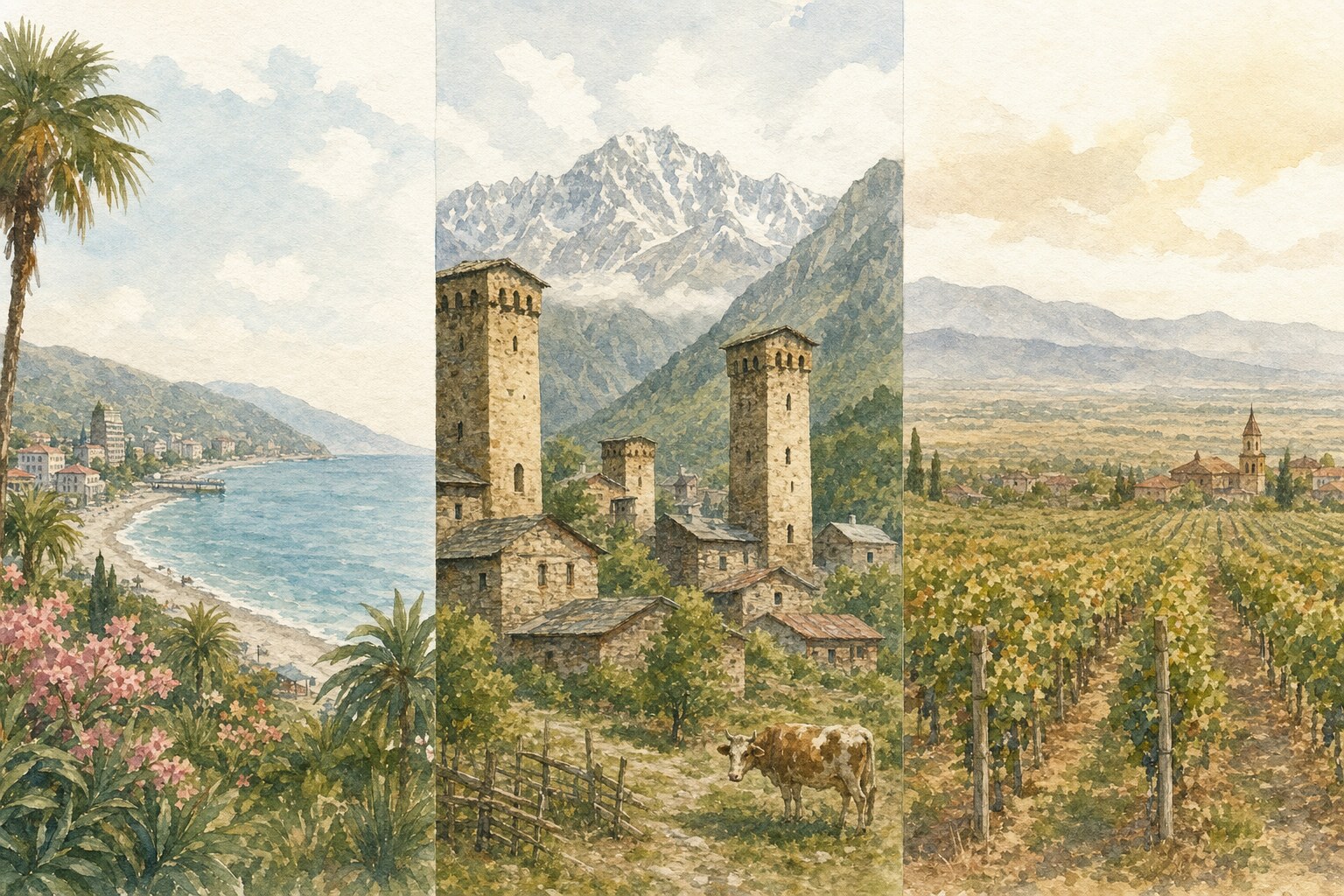
The -dze and -shvili tilt is only the beginning. Several endings are much more specific, because they come from the other Kartvelian languages and from mountain communities that kept their own naming habits. Megrelian and Svan are separate languages, not dialects of Georgian, and their name endings traveled with their speakers. These are the endings that let a Georgian place a stranger within one region, sometimes within one valley.
| Ending | Georgian | Usually points to | Examples |
|---|---|---|---|
| -shvili | -შვილი | Everywhere, densest in the east (Kartli, Kakheti) | Gelashvili, Ananiashvili |
| -dze | -ძე | Everywhere, densest in the west (Imereti, Guria, Adjara) | Beridze, Giorgadze |
| -ia, -ua, -ava | -ია, -უა, -ავა | Samegrelo, Megrelian families | Kvaratskhelia, Melua, Eliava |
| -ani, -iani | -ანი, -იანი | Svaneti, Svan families | Kipiani, Ioseliani, Dadeshkeliani |
| -uri, -uli | -ური, -ული | The eastern mountain communities (Khevsureti and its neighbors) | Tsiklauri, Gigauri, Burduli |
| -eli | -ელი | A place, “of” or “from” somewhere | Rustaveli, Tsereteli |
| -shi | -ში | Laz families, the far southwest | Tugushi, Khalvashi |
A few notes that the table cannot hold.
The Samegrelo endings, -ia, -ua, and -ava, belong to families of Megrelian heritage, and they are instantly recognizable to every Georgian. When football commentators across Europe learned to say Kvaratskhelia, Georgians also heard something the commentators did not: a western name, from the lowlands near the Black Sea.
The Svan endings, -ani and -iani, come from the highest inhabited corner of the country, the land of stone towers. Names like Kipiani and Ioseliani carry that altitude with them.
The mountain -uri and -uli names, Tsiklauri above all, come from the eastern high country, Khevsureti and the valleys around it. You will meet plenty of them in Tbilisi, because the mountains have been sending people down to the city for generations.
And -eli is the oldest layer of all, a simple “of” attached to a place. It is the ending of medieval notables, the most famous being Rustaveli, and it survives in names like Tsereteli. There is also a scatter of old names that use no surname suffix at all, Meskhi and Glonti among them, and the dynastic -ioni in Bagrationi, small threads back to older regional layers.
One caution, though. This is a map of origins, not of addresses. A century of moving to Tbilisi, Batumi, and abroad has shuffled everyone. The Megrelian -ia in your yoga class may never have seen Samegrelo.
The most common Georgian last names
Ask Georgia’s civil registry and the answer is clear. These are the ten most common Georgian surnames in the official count, the names you will meet again and again on clinic lists and wedding invitations.
| Rank | Surname | Georgian | Ending | Note |
|---|---|---|---|---|
| 1 | Beridze | ბერიძე | -dze | usually parsed as beri, the monk |
| 2 | Kapanadze | კაპანაძე | -dze | etymology debated |
| 3 | Gelashvili | გელაშვილი | -shvili | Gela’s child |
| 4 | Maisuradze | მაისურაძე | -dze | name dictionaries link it to maisura, a shirt |
| 5 | Giorgadze | გიორგაძე | -dze | Giorgi’s son |
| 6 | Lomidze | ლომიძე | -dze | lomi means lion |
| 7 | Tsiklauri | წიკლაური | -uri | the mountain -uri name in the top ten |
| 8 | Bolkvadze | ბოლქვაძე | -dze | one more for the -dze column |
| 9 | Kvaratskhelia | კვარაცხელია | -ia | Megrelian, concentrated in Samegrelo |
| 10 | Nozadze | ნოზაძე | -dze | meaning uncertain |
Beridze holds first place, and a 2008 registry count put the number of Beridzes just under 20,000, in a country of under 4 million people.
Look at the endings column and you will see the whole system in miniature. Seven of the ten end in -dze, one in -shvili, one in -uri, one in -ia. Eight of the ten are plain patronymics of the child-of and son-of type, one is a mountain name, one is Megrelian. The top of the list leans west, which surprises people who assume Tbilisi sets the tone.
Notice also what is missing. There is no toponymic -eli anywhere near the top. The of-a-place names of medieval notables are hopelessly outnumbered by the child-of and son-of names of everyone else.
Georgian last names you already know
You probably know more Georgian surnames than you think, and they make a good tour of the system.
Rustaveli. Every visitor to Tbilisi walks Rustaveli Avenue within a day of arriving. It is named for Shota Rustaveli, the 12th-century poet of Georgia’s golden age, and his name is the toponymic type in its purest form: Rustaveli, “of Rustavi,” his home village in Meskheti in the south. Not the modern industrial city of Rustavi near Tbilisi, an easy mix-up.
Paliashvili. Zakaria Paliashvili composed the operas that became the sound of Georgian classical music, and the Tbilisi opera house on Rustaveli Avenue has carried his name since 1937. A -shvili at the top of the national culture.
Chavchavadze. The name of Ilia Chavchavadze, the great 19th-century writer, and another name you will meet on Tbilisi street signs. A -dze, from an old noble family.
Balanchivadze. George Balanchine, the founding choreographer of American ballet, was born Georgiy Balanchivadze, son of the Georgian composer Meliton Balanchivadze. The surname got trimmed for Western stages, but the -dze was there all along.
Melua. The singer Katie Melua was born in Kutaisi, and her -ua is one of the western, Megrelian-associated endings from the table above.
Ananiashvili. Nina Ananiashvili, one of the celebrated ballerinas of her generation, carries a textbook -shvili, Anania’s child.
Kvaratskhelia. The footballer needs no introduction, and his surname sits in the registry’s top ten. A Megrelian -ia that sports announcers everywhere have now learned to say.
Where Georgian surnames came from
Surnames arrived early here. The earliest recorded Georgian surnames date to the 7th and 8th centuries, and those first hereditary names were mostly built from places, offices, and professions.
The patronymic wave came later. From the 13th century onward, surnames built on a father’s or an ancestor’s given name became more and more frequent, and by the 17th and 18th centuries the pattern was close to universal. That is when the country filled up with -shvilis and -dzes, ordinary families fixing an ancestor’s name in place and carrying it forward.
You can still read the older layers in today’s names.
Trades. Mchedlishvili, the blacksmith’s child, is the classic. Mdivani comes from mdivani (მდივანი), the scribe or secretary, a court official in feudal Georgia. Some family, somewhere, wrote documents for a living, and the job outlived the office by centuries.
Offices and titles. Eristavi was not originally a name at all but a feudal office, literally the head of the people, a rank usually translated as duke. The title became the surname of several noble houses. And Bagrationi, the name of the royal dynasty that ruled Georgia for roughly a thousand years, is still carried today.
The church. Beridze, the most common surname in the country, points at beri, the monk.
Arrivals. The encyclopedic name lists also include surnames built on ethnonyms, Megrelishvili, Cherkezishvili, even Prangishvili, usually read as the Frank’s child, the Western European’s child. People have been arriving and becoming Georgian for a very long time, and the names absorbed them. It is worth adding that -shvili and -dze names are also carried by Georgian Jewish families, whose surnames follow the same Georgian patterns as everyone else’s.
I like how little grandeur there is in all of this. Other traditions filled their registries with eagles and victories. Georgia’s most common surnames remember a monk, a blacksmith, a lion, a shirt. The names are a census of ordinary medieval life.
Reading the names around you
If you live in Georgia, or you are about to, the surnames start before the people do. Tbilisi’s streets and metro stops are a roll call of writers and composers, Rustaveli, Chavchavadze, Paliashvili, so you learn the shape of Georgian surnames from window seats before anyone has introduced themselves.
Our audio course leans into this on purpose. By lesson 4 you are asking where Paliashvili street is.
Later in the course a character in the dialogues introduces himself with მე ირაკლი გიორგაძე მქვია (me irak’li giorgadze mkvia), I’m called Irakli Giorgadze, and the everyday pattern for offering your own name, ჩემი სახელია (chemi sakhelia), my name is, arrives a couple of lessons after that. Street names and surnames come bundled with the language, the way they do in real life here. Once you know how to introduce yourself in Georgian, the name exchange stops being a formality and becomes the first real conversation.
One more thing catches almost every foreigner: after all this decoding, you will rarely use the surname to be polite. English instinct says formality lives in “Mr. Beridze.” Georgian politeness runs the other way. The standard respectful address pairs bat’ono (sir) or kalbat’ono (madam) with the first name, so the dentist you just met is bat’ono Giorgi, not Mr. Beridze. Our course dialogues do it constantly, ბატონო ლევან (bat’ono levan), Mr. Levan.
The surname is for paperwork and for placing people on the map. The first name, wrapped in bat’ono, is for talking to them. Knowing that one habit will make you sound years more at home here than any perfectly pronounced Kvaratskhelia.
A practical note on pronunciation, because long Georgian surnames scare people unnecessarily. Georgian spelling is fully phonetic. Every letter is pronounced, so take a name in pieces: find the ending first, because you know the endings now, then read the root syllable by syllable. Kva-ra-tskhe-lia. Chav-cha-va-dze. In our course materials that last one is transliterated ch’avch’avadze, and the apostrophes mark the sharp, ejective versions of the consonants, a Georgian specialty your ear will tune into with time.
And if you mangle one, nothing bad happens. Georgians are generous about foreigners attempting Georgian, names included.
Tracing your own Georgian last name
If the surname you are decoding is your own, you are in good company. Many of the people who land on this blog are heritage learners, a generation or two removed, holding a -shvili or an -ia and wondering what it knows that they do not.
Start with the ending, exactly as above. It will usually tell you the type of name (patronymic, trade, place) and often a region to look at first. A -ua or an -ava points your research toward Samegrelo, an -iani toward Svaneti, a -uri into the eastern mountains. That is real information, three generations of moves notwithstanding.
Expect spelling drift in the documents. The same Georgian name can surface under several Latin spellings depending on which alphabet and which era’s paperwork it passed through, Balanchivadze becoming Balanchine is the famous case, and Soviet-era records sometimes respelled -ia endings as -iya. Noble names could be reshaped wholesale: Eristavi turns up in imperial Russian records as Eristov, and in emigration as Eristoff. If the trail matters to you, the National Archives of Georgia runs a genealogy service and holds parish registers that reach back centuries, and they field exactly this kind of request.
At some point, though, the records switch to Georgian script, and the Georgian alphabet stops being optional. The good news is that it is 33 letters, fully phonetic, and honestly learnable in an afternoon. Reading your own family name in the script it was first written in is a better reason than most people ever get.
I will leave you with the habit rather than the trivia. Next time a Georgian hands you their name, read it the way we do: ending first, for the map, then the root, for the family. Beridze. Somewhere back down that line, a monk.