



The country I moved to in 2021 goes by three names. In English it is Georgia. In Russian it is Gruzia. And in Georgian, the language people actually speak here, it is Sakartvelo (საქართველო), a name with no George in it anywhere.
So why is Georgia called Georgia? Most likely because of a Persian word for wolf, passed through a dozen languages and reshaped by Europeans until it looked like a tribute to a saint. The Saint George version is the better-known story, but the wolf version is the one linguists favor. The honest version, which most explainers skip, is that after two and a half millennia nobody can be completely certain.
This post untangles the whole thing: what Sakartvelo means, where Georgia came from, why Russian says Gruzia, and how a country in the Caucasus ended up sharing a name with a US state.
Sakartvelo: what Georgians actually call their country
Ask a Georgian where they live and the answer is Sakartvelo. If you have ever wondered why Georgia is also called Sakartvelo, the answer is that Sakartvelo is not an alternative name. It is the name, the one the country uses for itself. Georgia is the label the outside world settled on.
The word comes apart neatly. At its core sits kartveli (ქართველი), a Georgian person. Georgian has a tidy grammatical wrapper, sa- at the front and -o at the end, that turns a noun into the place meant for that noun. Wrap it around kartveli and you get sa-kartvel-o: the place of the Kartvelians. Georgian names other countries with similar machinery, which is how France ends up as saprangeti (საფრანგეთი) and Turkey as turketi (თურქეთი).
Kartveli itself points back to Kartli (ქართლი), the historic heartland of eastern Georgia, the region around Mtskheta and, later, Tbilisi. The medieval Georgian chronicles trace the region’s name to Kartlos, a legendary founding ancestor. Classical Greek and Roman writers knew the same kingdom by a different name entirely, which we will get to.
Sakartvelo starts appearing in Georgian chronicles around the 9th century, and by the early 13th century, once the medieval kingdom had pulled its regions together, it had become the standard name for the whole country. In other words, Sakartvelo was in written use centuries before any European map spelled out the word Georgia.
Two sibling words are worth separating. Kartveli is a Georgian person. Kartuli (ქართული) is the Georgian language and Georgian things in general. So if you look up what language do they speak in Georgia, the answer is kartuli, spoken in Sakartvelo. The same root gave linguists the name for the whole language family. If you want to know what language family is Georgian, it is Kartvelian, and it exists almost nowhere else on earth.
Where the name Georgia comes from: three theories
Now the outside name, and the actual origin question. Three explanations for Georgia’s country name are in circulation, and they are not equally good.
The Persian wolf theory (the one linguists favor)
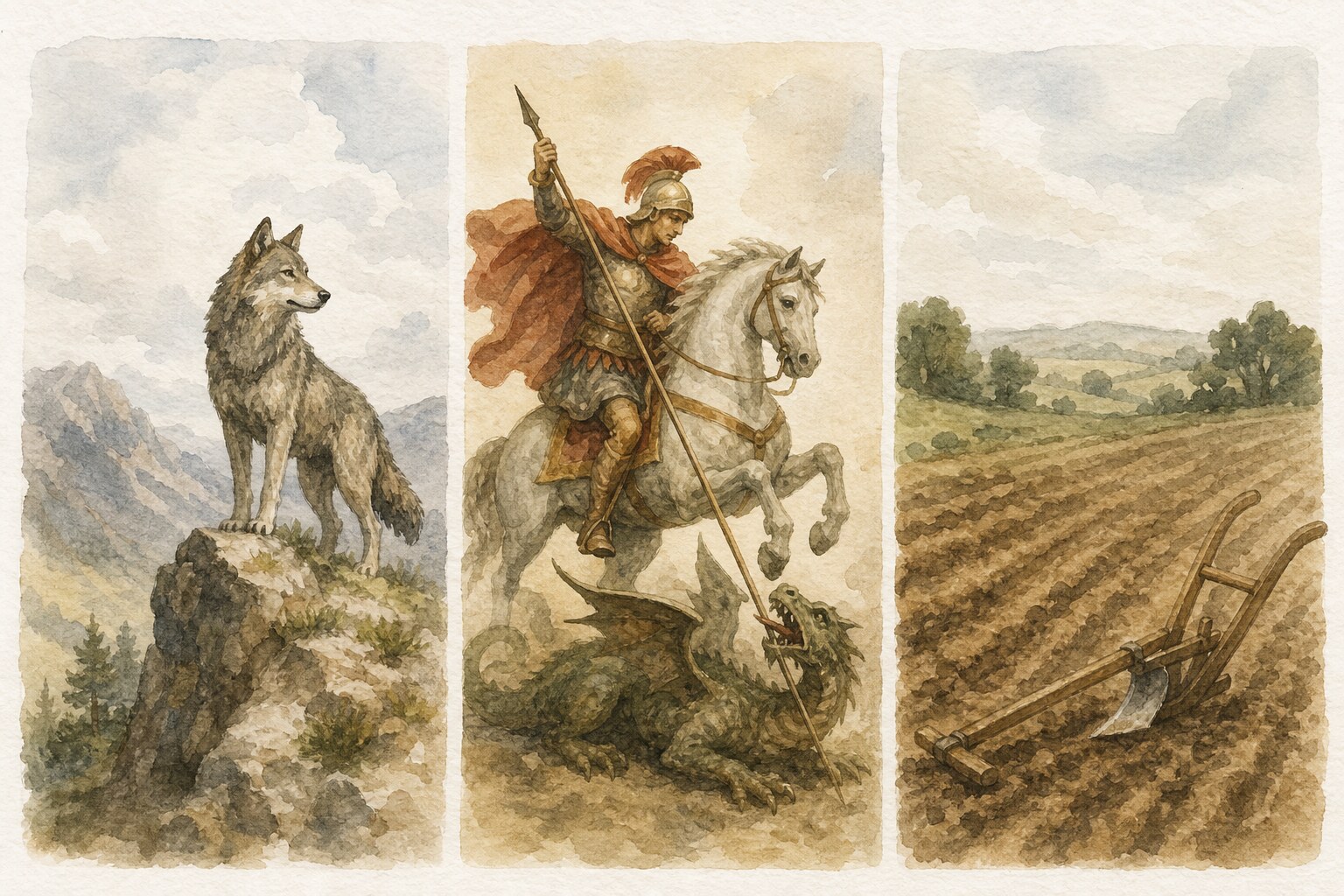
The trail starts in Persia. Persian has an old name for the Georgians, gurj, with matching names for their land, forms like gurjan and gorjestan. Linguists usually trace the family back to Old Persian vrkan: land of the wolves.
The same wolf root is still visible elsewhere on the map. The Iranian city of Gorgan, near the Caspian Sea, sits in a region the ancient world called Hyrcania, from that same Old Persian word. In modern Persian, gorg still means wolf.
From Persian, the name traveled west. Syriac and Arabic writers passed along their own versions, and by the time crusaders, pilgrims, and Italian merchants were moving through the region, the name they kept hearing sounded close enough to familiar words that they Latinized it into Georgia. The first known map to spell it that way is Italian, Pietro Vesconte’s world map of 1320. The full chain of intermediate forms is laid out in the Name of Georgia article on Wikipedia.
Linguists back this account because its steps are attested in old texts and place names. It is careful reconstruction rather than certainty, but it is the best-evidenced story on offer.
The Saint George story (the one everyone loves)
The version you will hear more often is warmer: Georgia is the land of Saint George, named for the country’s devotion to its patron saint.
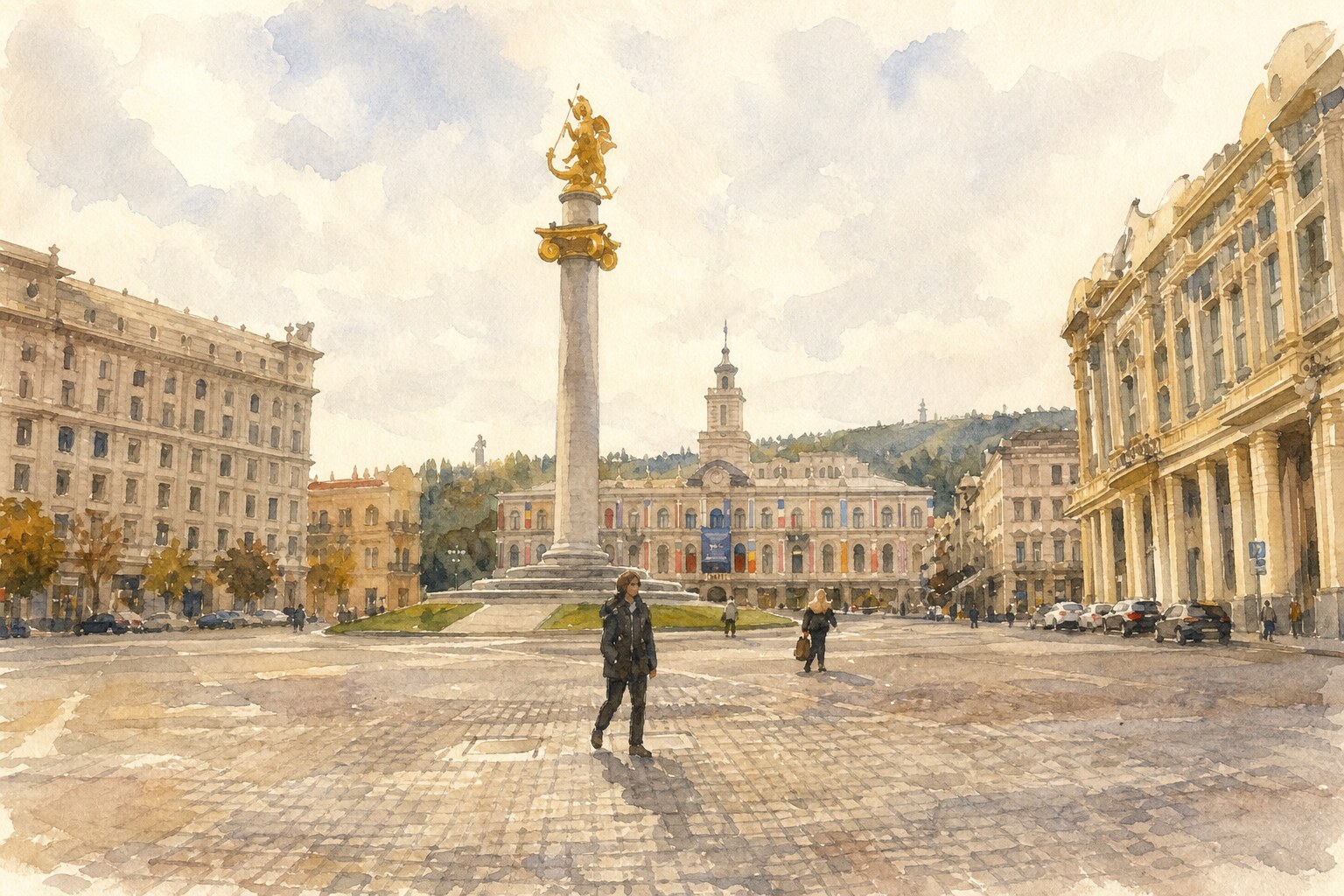
The devotion is completely real. Giorgoba, Saint George’s day, is a public holiday in Georgia on November 23, Georgians honor the saint twice a year, and Giorgi tops the list of the country’s most common male names. A gilded Saint George slaying his dragon stands on a 35-meter column above Freedom Square in central Tbilisi, unveiled on November 23, 2006, Giorgoba itself.
The naming story, though, runs backwards. Medieval European travelers, the crusade-era bishop Jacques de Vitry among them, met a fiercely Christian kingdom full of George churches and concluded the country must be named for the saint. Modern scholarship treats that as folk etymology. The Persian wolf name came first, and Europeans bent its shape toward a saint they already knew. Saint George did not give Georgia its name, but he almost certainly helped it stick.
The Greek farmer theory (the historical curiosity)
There is a third story with even older raw material. Classical writers, Pliny and Pomponius Mela among them, described farming tribes in the wider Black Sea world called the Georgi, from georgos, the Greek word for a tiller of the land. Centuries later, European writers such as the 17th-century traveler Jean Chardin connected those agricultural tribes to the country’s name.
Modern linguists treat the resemblance as coincidence. The Georgi tribes and the country’s name arrive from different directions, and the sound similarity does the rest. The theory survives anyway, since Georgia really has been farming its valleys and making wine for thousands of years.
Gruzia, Gürcistan, Georgien: one country, many names
Once the Persian root got loose, every language shaped it in its own way. That is why the same small country answers to such different names around the world.
| Language | Name for Georgia | Where it comes from |
|---|---|---|
| Georgian | Sakartvelo (საქართველო) | Kartli, the historic core region |
| English, Italian, Spanish | Georgia | the Persian gurg root, reshaped in medieval Europe |
| French | Géorgie | the same European reshaping |
| German, Danish | Georgien | the same European reshaping |
| Russian | Gruziya | the same Persian root, via Gurz- forms |
| Turkish | Gürcistan | the Persian root plus -stan, land of |
| Persian | Gorjestan | the root itself |
| Armenian | Vrastan | a different root entirely, from Virk |
| Japanese | Jojia (since 2015) | borrowed from English |
| Lithuanian | Sakartvelas (since 2018) | borrowed from Georgian |
The Danish line in that table is personal. I grew up saying Georgien, moved here saying Georgia, and now live in Sakartvelo. Same country every time.
If you have wondered about Gruzia vs Georgia, they are the same word at different stages of a very long game of telephone. Old Russian travel accounts from the late 1300s and 1400s recorded the country with Gurz- forms borrowed from the Persian family, the sounds later swapped to Gruz-, and it settled as Gruziya. Other languages across the region then borrowed the Russian form.
Over the past two decades Georgia has asked several countries to move away from Gruzia-derived names. Israel agreed to use Georgia in 2005, South Korea switched to Jojia in 2011, Japan followed in 2015, and Lithuania went furthest. Since 2018 the country is officially Sakartvelas in Lithuanian, making Lithuania the first country to adopt Georgia’s own name for itself.
Armenian is the outlier in the table. Vrastan grew from Virk, an old Armenian name for the region, so Georgia’s next-door neighbor uses a name that involves neither wolves nor a saint.
What about Georgia the US state?
A good share of the people asking why Georgia is called Georgia are really asking a different question: why do a country in the Caucasus and a US state share a name, and is one named after the other?
Neither is named after the other. The state got its name the direct way. A royal charter in 1732 established the colony and named it for King George II of Britain, who granted it, and James Oglethorpe founded Savannah the following year. The name simply carried through statehood.
The country’s name, as covered above, had by then already been on European maps for four centuries, evolving from a Persian root with no English king anywhere near it. The two Georgias reached the same spelling by completely different roads.
The one genuinely shared piece is the ending. The -ia suffix is the Greek and Latin way of stamping “land of” onto a word, which is how a Persian wolf name and a Hanoverian king’s name could end up wearing the same shape.
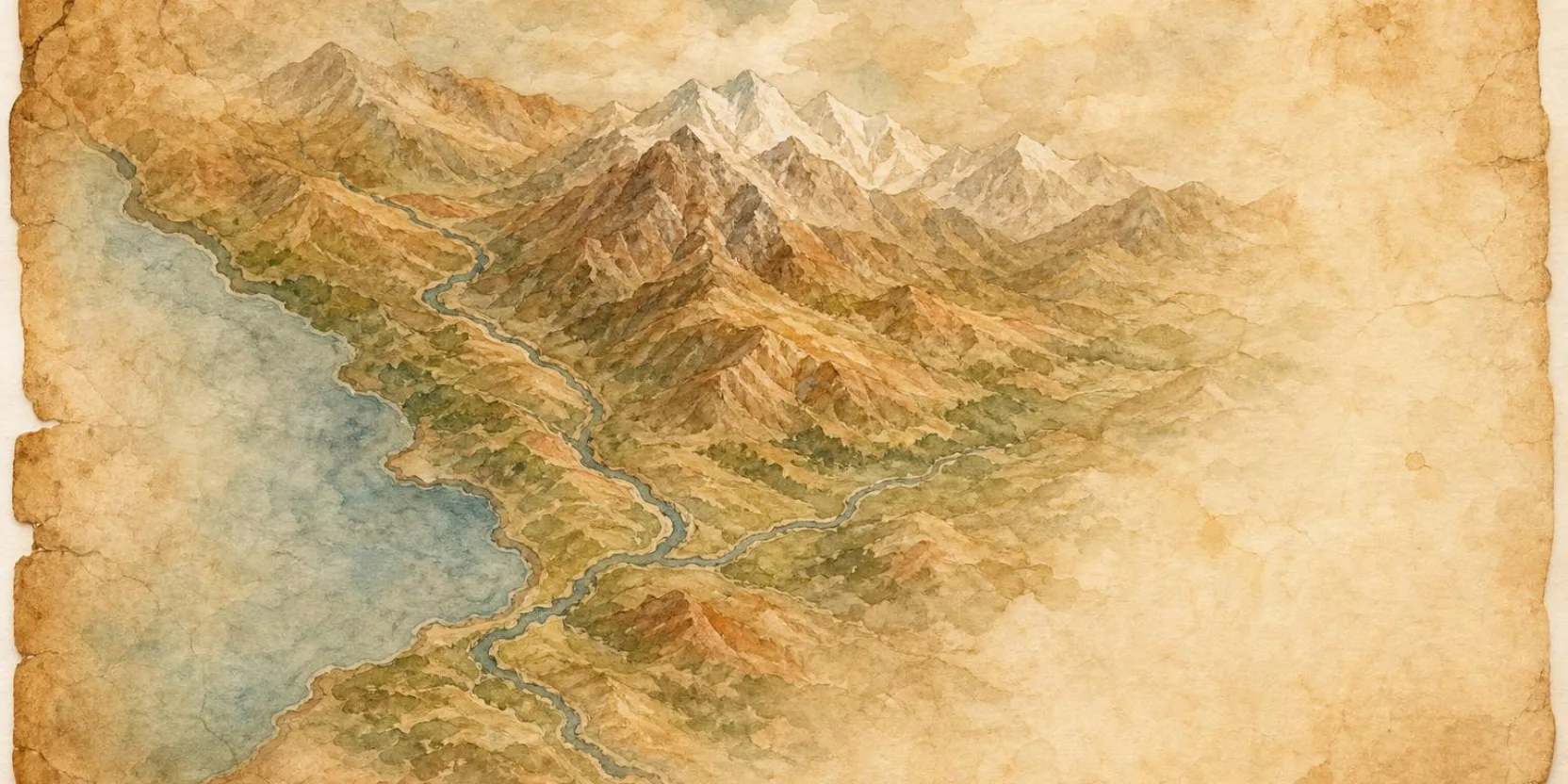
For everyday purposes: the country is in the Caucasus, between the Black Sea and the high mountains, and its capital is Tbilisi. Its main airport is TBS. The state’s is ATL. If you are booking flights, that is the pair to double-check.
What was Georgia called in ancient times?
Before either Georgia or Sakartvelo, the classical world used two other names for this land.
Greek and Roman writers knew the western half, along the Black Sea coast, as Colchis. That is the Colchis of myth, the kingdom Jason and the Argonauts sailed to for the Golden Fleece. Some scholars think the fleece itself echoes a real local technique of panning mountain rivers for gold with a sheepskin.
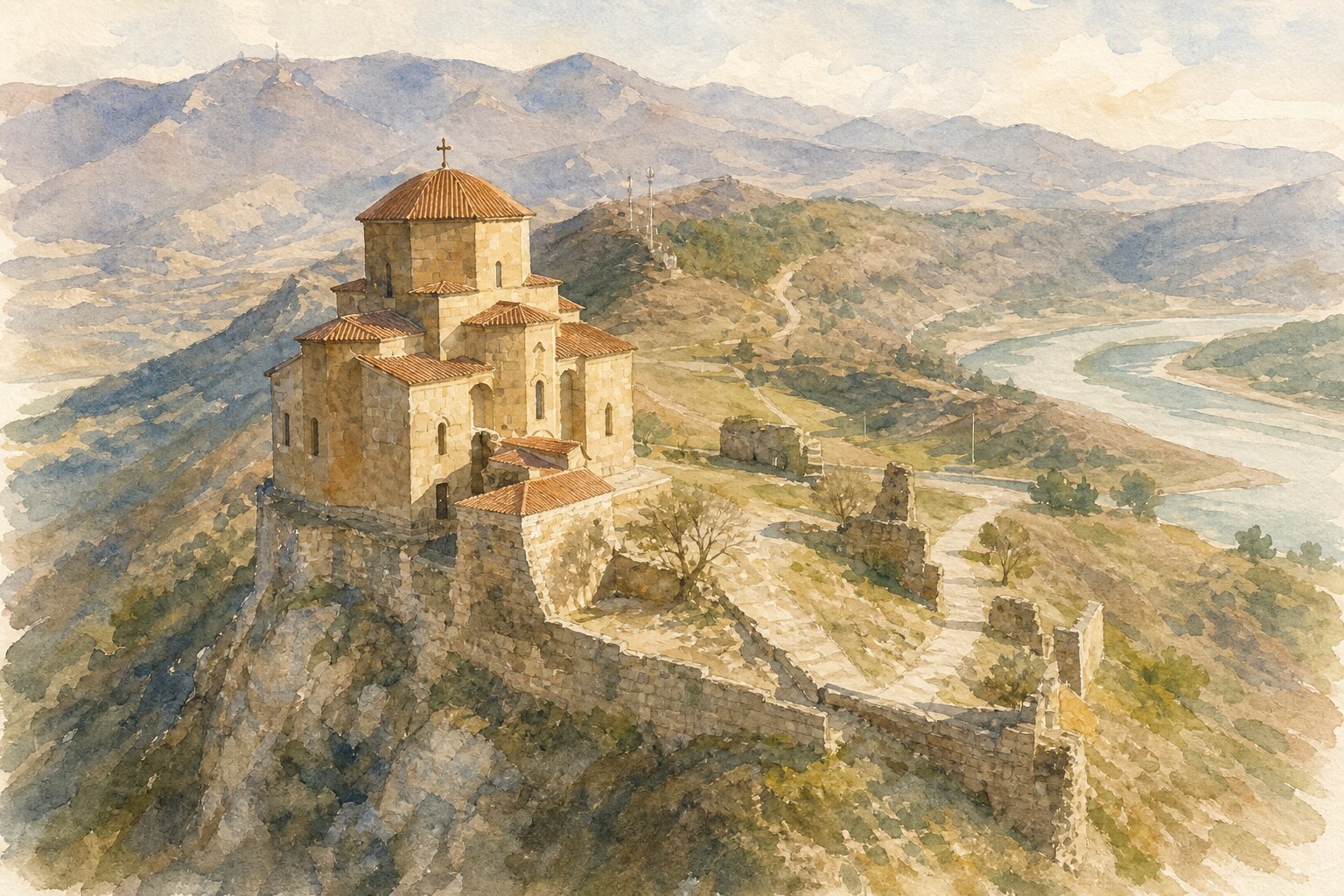
The eastern half, the Kartli heartland, was Iberia, a name it shared, confusingly, with the Spanish peninsula. Its royal capital was Mtskheta, half an hour north of Tbilisi and now a UNESCO World Heritage site. When Georgians later built the word Sakartvelo around Kartli, they were naming the country after the same region the Greeks had filed under Iberia all along.
How to say Sakartvelo
Four syllables: sa-kar-tve-lo. Georgian stress is light, so resist the English urge to hammer one syllable. Keep them even, leaning gently on kar at most, and you will be close.
Nothing in the word is difficult. Georgian is famous for its ejective consonants, the sharp popped sounds that take learners months to get comfortable with, and Sakartvelo contains none of them. Both the k and the t are the soft, breathy kind. The written form, საქართველო, also becomes readable faster than it looks once you know the Georgian alphabet: 33 letters, each with exactly one sound.
A few real forms you will hear, pulled straight from our audio course flashcards:
- sakartveloshi (საქართველოში), in Georgia. The -shi ending does the work English does with “in”.
- rat’om khart tkven sakartveloshi? (რატომ ხართ თქვენ საქართველოში?), why are you in Georgia?
- momts’ons sakartvelo (მომწონს საქართველო), I like Georgia. The simplest good answer.
The apostrophes mark ejective consonants, the popped sounds mentioned above. They live in the words around Sakartvelo, not in the name itself. These three phrases turn up in lessons 23, 31, and 32 of our audio course, Speak Georgian in 50 Days.
What to call Georgia when you’re actually here
In English, say Georgia. It is the country’s official English name, the one the Georgian state itself uses in English, and the national tourism board runs its site at georgia.travel.
In Georgian, it is sakartvelo. Georgians are generous with any foreigner making an effort in the language, the bar for being praised is famously low, one halfway-broken sentence usually does it, and the country’s own name is a good early word to know.
Gruzia is the Russian name and the standard form in several other languages. In English, the country’s name is Georgia, so that is the one to use in English sentences.
And if the name question brought you here on the way to something bigger, the case for going further is in why learn Georgian. Start with gamarjoba, hello, covered in how to say hello in Georgian. Sakartvelo makes a fine second word.