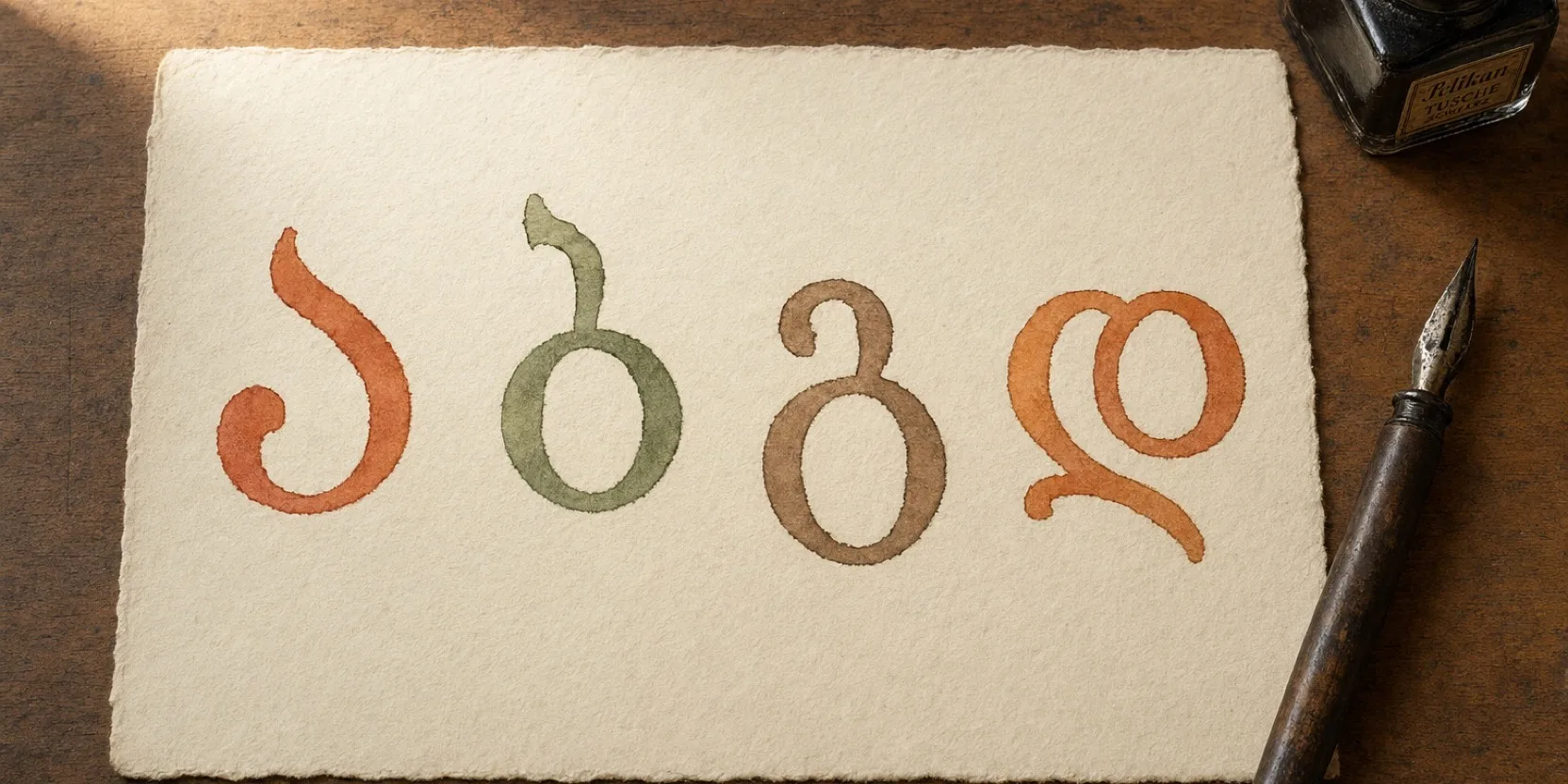





You went looking for a list of Georgian prepositions and found a small surprise: there are none. The job that in, on, from, with and for do in English exists in Georgian, obviously, but the words that do it sit at the other end of the noun. Georgian has postpositions, and once you have seen a few, the surprise turns out to be the easy kind.
This post gives you the six that cover most of daily life, shows one word wearing all of them, and then explains the machinery underneath for anyone who wants it. Every example has native audio from the course.
The short answer: they come after
English says in Tbilisi. Georgian says Tbilisi-in.
That -shi on the end is the postposition. It is not a separate word, it is glued to the noun, and it means in, to, or into depending on the verb. English says from Georgia. Georgian says Georgia-from.
Same idea, different tail. This is the entire concept, and it is the reason the post on Georgian word order could list “postpositions come after” as one of the four rules that never bend. The order is not flexible here. The ending is part of the word.
A handful of Georgian postpositions can also stand in front of their noun, and grammars will tell you so. For a learner, in your first year, it is safe to ignore that footnote entirely. Everything goes after.
The six that carry daily life
Georgian has more postpositions than six, but six of them do a very large share of the work in ordinary conversation. Learn these as tails on words you already know, not as a list.
| ending | meaning | example |
|---|---|---|
| -shi | in, to, into | tbilisshi, in Tbilisi |
| -ze | on, at (a time) | sam saatze, at three o’clock |
| -dan | from (a place or time) | sakartvelodan, from Georgia |
| -tan | at someone’s place, with | chemtan, at my place |
| -tvis | for | chemtvis, for me |
| -mde | up to, until | nakhvamdis, goodbye (up to seeing) |
Two of these carry an extra sense worth knowing early. -ze, on, is also how Georgian says at a clock time. And -tan, at, is the one that means at someone’s home, like French chez, and paired with ertad it becomes with.
One word, six tails
The fastest way to feel how this works is to watch one noun take different tails. The course uses America a lot in the early lessons, so here it is in Georgian doing two jobs.
Notice the body of the word shifts slightly between the two. Amerik’a keeps its final a in front of -shi and swaps it for an i in front of -dan. That is not random, and it is not something to memorize either. It is the case ending underneath doing its work, which the next section explains. For now, the thing to hear is that the noun stays recognizable and the tail tells you the relationship.
And the question that produces the answer above, which you will be asked in every taxi:
Sa-idan: even the question word wears the tail. Answer with your country plus -dan and var, and you have had your first postposition conversation.
That one is a favorite of mine. The people I end up talking to in Kakheti and the other regions mostly do not speak much English, and being able to trade where-are-you-froms in Georgian is where the country opens up.
What the postposition attaches to
Here is the machinery, for readers who want it. Skip this section if you do not, the tails work without it.
A Georgian postposition does not attach to the bare noun. It attaches to the noun in a particular case, and each postposition has its own case that it wants. The Georgian cases are the endings that mark a noun’s job in the sentence, and Georgian has seven of them. The postpositions ride on top.
-shi and -ze want the dative, whose ending is -s. Then Georgian drops that -s before the postposition. So Tbilisi becomes tbiliss in the dative, and tbilisshi with the tail. This is why -shi looks like it replaces the -s rather than following it.
-tvis wants the genitive, whose ending is -is, and here the ending stays: vakhshm-is-tvis, for dinner.
-dan is the odd one, historically built on yet another case, which is why the i shows up in amerik’idan and tbilisidan. Its cousin -gan, also from, is reserved for people and for what things are made of: shengan, from you. Beginners meet -dan all day and -gan much later, so file it and move on.
-mde, up to, is the only postposition that attaches to the adverbial case, and its older form -mdis survives in one word you already know. Nakhvamdis, goodbye, is literally nakhva, seeing, plus up to. Every goodbye in Georgian is a postposition.
If you want the wider map these pieces sit in, the guide to Georgian grammar has it. If you only want to say where you are from, you already can.
The people versions: chemtan, chemtvis, tkventan
Pronouns take the tails too, and they use a special stem to do it. Me becomes chem-, you (informal) becomes shen-, we becomes chven-, you (formal) becomes tkven-. If chem- looks familiar, it is the same stem as chemi, my.
These four stems with these six tails give you a surprising amount of everyday Georgian. At my place, for you, with us, from you. Once chemtan and chemtvis are in your ear, tkventvis and tkventan arrive for free, because the tail is doing the same thing on a different stem, and the informal shentvis and shentan follow the same pattern.
The ones you can leave for later
Georgian has a longer list of postpositions that behave like separate words rather than glued endings: gareshe (without), garda (apart from), shoris (among), shua (between), and others. They are real, you will meet them, and they follow the same logic, a case on the noun and the postposition after it. They are not week-one material. A learner who has the six endings above and the four pronoun stems can navigate a city, a shop, a family dinner and a taxi, and the longer list fills itself in from listening.
How postpositions actually get learned
I have laid this out as a system because you searched for one, and it is genuinely a small, regular system, which is rare and pleasant in Georgian grammar. But I did not learn it as a system. I learned tbilisshi as the word for in Tbilisi, and sakartvelodan as the word for from Georgia, and chemtan as the word for at my place, and months later, when someone showed me the table, every row in it was already something my mouth did.
That is the normal order for Georgian: the patterns arrive through hundreds of sentences you can mostly follow, and the rule names what your ear already knows. The audio course teaches every ending on this page inside real dialogues before it ever mentions a postposition, which is the design, and the argument for doing it that way is in the post on comprehensible input.
So read the table once, play the audio until the tails sound like endings rather than mysteries, and then go say where you are from to somebody. The taxi driver will tell you your Georgian is excellent. It will not be, yet, but sakartvelodan is a fine place to start.