





Look up Georgian grammar for the first time and you usually land on a wall: declension tables, a warning about something called the ergative, and the word “screeve” used without apology. Most people close the tab and quietly file Georgian under impossible.
I did roughly that for three years. I moved to Tbilisi in 2021, learned basic phrases, bounced off the grammar every time I met it, and only started learning properly in 2024, through the courses we were building for EasyGeorgian. So this post is not a linguist explaining Georgian. It is the map I wish someone had handed me at the start: what the system actually looks like, which parts are real work, which parts are easier than their reputation, and how any of it ends up in your head.
Here is the whole map in one paragraph, before the tour. Georgian grammar has 7 noun cases, verbs built from prefixes and suffixes that mark both subject and object across 11 tense-mood patterns called screeves, postpositions glued to the ends of nouns instead of prepositions, and flexible word order that leans verb-late. It has no grammatical gender, no articles, no capital letters, and no spelling ambiguity: the alphabet is 33 letters, each one sound. The verbs are where the work lives. Everything else is friendlier than its reputation.
Why Georgian grammar looks scarier than it is
Georgian is not related to Russian or Turkish, and not to anything Indo-European either. It belongs to its own small family, Kartvelian, and is spoken by roughly 4 million people. If you want the full picture of what language family Georgian belongs to, we have a separate post on it. The practical consequence for a learner is that nothing comes discounted. Spanish hands an English speaker a third of its vocabulary and most of its sentence logic for free. Georgian hands you almost nothing and asks you to build from scratch.
That is the honest part of the reputation. Here is the inflated part: unfamiliar is not the same as irrational. Georgian grammar is remarkably consistent once you see the logic. It just distributes its complexity differently than the languages most of us grew up around. English hides its difficulty in spelling and phrasal verbs. Georgian puts nearly all of it in one place, the verb, and is surprisingly reasonable almost everywhere else.
For calibration: the U.S. Foreign Service Institute puts Georgian in its hard category, around 44 weeks of full-time study for an English-speaking diplomat, alongside Russian, Hebrew, and Thai. Harder than Spanish or German, easier than Mandarin or Arabic. We took the is Georgian hard question apart in a separate post, and the short version holds: it is hard, but it is the same kind of hard as Russian, not some unique tier of impossible.
There is one more reason the grammar’s reputation runs ahead of the reality, and it has nothing to do with the language. Until recently, almost everything written about Georgian grammar was written for linguists, and almost every tool for learning it was a chart-first textbook. A system described in tables looks like a wall. The same system, met one real sentence at a time, behaves like a path. Most of the suffering people associate with Georgian grammar is the wall talking, not the path.
What Georgian grammar doesn’t have
Before the hard parts, it is worth listing what Georgian simply does not make you do. This list surprises most people.
No grammatical gender. There are no masculine and feminine nouns, no agreement tables to memorize, and he, she, and it are all the same word, is. I learned Russian before Georgian, gender included, and Georgian simply not having the category feels like being handed back a chunk of your brain.
No articles. Georgian has no “the” and no “a”. You say “bread is delicious” and context does the rest. When a speaker really needs to stress that there is exactly one of something, the word erti (one) steps in. Nobody misses articles after the first week of not using them.
No capital letters. The Georgian alphabet has 33 letters and exactly one form of each. There is no upper and lower case, and no separate cursive set to learn on top.
No spelling problem. The script is fully phonetic. Each letter is one sound, each sound is one letter, and a word is pronounced the way it is written, every time. English speakers underestimate what a gift this is because English is one of the worst offenders in the other direction.
None of this makes Georgian easy. It clears the board. The effort you would have spent on gender tables and spelling quizzes in another language is effort Georgian lets you send directly to where it is actually needed, which, as we are about to see, is the verb.
The seven cases, in five minutes
Georgian nouns change their endings depending on the job they are doing in the sentence. That is all a case is: a role marker glued to the end of a word, doing the work English does with word order and little words like “of” and “with”.
You have already used one if you have ever asked whether someone speaks Georgian. The word for the Georgian language is kartuli. Say kartulad lap’arak’obt? (Do you speak Georgian?) and it shows up as kartulad, “in Georgian”. That -ad ending is a case, the adverbial, and tourists produce it in their first week without knowing it has a name.
The word kartuli wearing its adverbial ending. One noun, one small ending, one job: turning “Georgian” into “in Georgian”.
Look at what happened mechanically, because it is the whole trick in miniature. The final -i of kartuli is itself a marker, the basic dictionary-form ending that most consonant-final Georgian words carry. When the word takes a different job, a different ending replaces it: kartul- plus -ad gives kartulad. One root, a small set of interchangeable tails. That is all declension means here, and it works the same way across nearly every regular noun in the language.
There are seven cases in total, and their jobs are refreshingly concrete:
- Nominative: the dictionary form, the subject of most sentences.
- Dative: marks objects and a few other roles, with a small -s.
- Genitive: possession, the “of” case.
- Ergative: the famous one. Marks the subject of certain verbs in past-tense storytelling, and only that.
- Instrumental: “with” or “by means of”.
- Adverbial: the one you just met in kartulad.
- Vocative: calling out to someone directly.
Three or four of these carry almost all of the everyday load. The ergative deserves one honest paragraph, because it is the case behind most of the warnings: it appears only when the sentence is a completed past action, the “she baked bread” tier of storytelling. You can speak present-tense Georgian for months before you genuinely need it, and by then you will have heard it so many times that the ending sounds right on its own.
We have a full post on the 7 Georgian cases that walks through each one with real sentences, written by Tamar, who grew up using them without ever thinking about their names. If cases are your current wall, start there. The one-line summary: they look impossible in a table and turn out to be small, regular endings your ear gets used to.
Postpositions: prepositions, but backwards
English puts relationship words in front of the noun: in Tbilisi, on the table, with Ana. Georgian puts them after, and the most common ones are not even separate words. They glue straight onto the noun.
“Tbilisi” is tbilisi. “In Tbilisi” is tbilisshi, one word, with the -shi (in) attached to the end. “In the restaurant” is rest’oranshi. Once you know -shi, you can locate yourself in any building or city in the country.
The sentence I have said more than almost any other. Note the -shi riding on the end of tbilisi.
The everyday set is small: -shi (in), -ze (on), -tan (at or by someone), -tvis (for). A few postpositions stand as separate words, but the ones you meet daily are the glued kind. Under the hood, each one quietly picks which case the noun wears before it attaches, but you do not need to manage that consciously as a beginner. You learn tbilisshi as a shape, and the pattern generalizes.
This gluing habit is the single most Georgian thing about Georgian. The language builds words the way Lego builds walls: small pieces, each with exactly one job, stacked in a predictable order. A noun picks up a case ending and maybe a postposition. A verb, as you are about to see, picks up considerably more.
The verbs, where Georgian keeps its complexity
Everything so far has been a speed bump. The verb is the mountain.
Here is the idea that makes Georgian verbs different: a Georgian verb carries its subject, and often its object, inside itself as prefixes and suffixes. The famous demonstration is that “I love you” is one word:
A complete sentence in a single word. The “I” and the “you” are both inside it, which is why Georgians rarely bother saying the pronouns at all.
That sounds exotic until you watch the pieces work. Take the root lap’arak’ (speak) and listen to who is talking:
The v- at the front of this verb means “I”. For most Georgian verbs, adding v- to the front means the speaker is talking about themselves.
Same root, no v-, and an -s on the end instead: that is the “he/she” marker. And notice anastan, “to Ana”, with the -tan postposition glued on exactly as promised.
Formal “you speak” is tkven lap’arak’obt, with a -t on the end marking the plural. And the markers combine. Watch the verb “live” from the Tbilisi sentence above:
| What you hear | The pieces | Who it says is living |
|---|---|---|
| vtskhovrob | v- + tskhovrob | I live |
| tskhovrobt | tskhovrob + -t | you (plural or formal) live |
| vtskhovrobt | v- + tskhovrob + -t | we live |
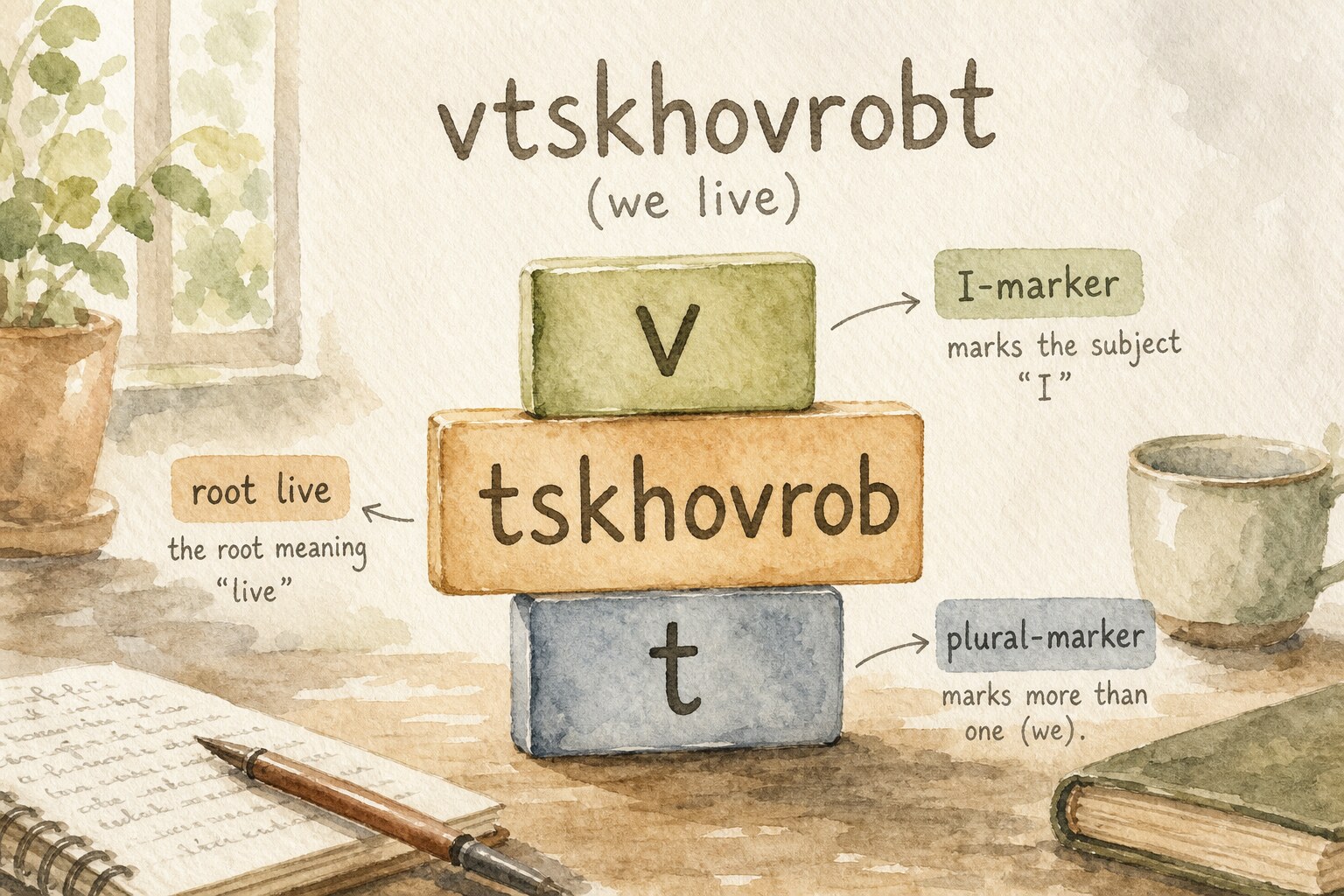
The “I” piece plus the plural piece equals “we”. That is the agglutination principle again, and it is why Georgian drops pronouns constantly. A sentence like kartulad lap’arak’obt? (Do you speak Georgian?) contains no word for “you” at all, because the verb already says it.
Then there is time. Georgian does not really have tenses in the English sense. It has screeves, which is the word the textbooks use for a conjugation pattern that sets time, aspect, and mood all at once. Screeve sounds like something you would buy at a hardware store, but the concept is tame: “I speak”, “I was speaking”, “I will speak”, “I spoke”, “may I speak” are all separate screeves. There are 11 in total, organized into three series, and several of them are rare or archaic. A learner meets a handful in the first year, not all 11.
Here is the same lap’arak’ root wearing a past-tense screeve:
Still recognizably the same root, now wrapped in a different set of pieces for completed past. Your ear starts spotting the root through the wrapping surprisingly quickly.
Three more features complete the honest picture. First, preverbs: small prefixes that glue onto the front of a verb to form the future and the past, a dozen or so in common use. Some carry direction, and swapping one preverb for another can shift a verb’s meaning the way English “take” shifts across take in, take out, and take up. Second, Georgian verbs come in a few broad conjugation types with different habits, which is the textbook’s way of saying that “run”, “want”, and “build” do not dress identically. Third, one of those families, the indirect verbs, flips the usual roles entirely: want, love, and their relatives treat the person who feels them as a receiver. That is why “I want” is me minda and why miq’varkhar is built the way it is (literally closer to “you-are-loved-by-me”). You learn these as vocabulary, not as a rule to compute.
Add it up and you get the true source of Georgian’s difficulty: the same verb root surfaces in dozens of shapes depending on who, whom, when, and how. Nobody absorbs that from a chart. It takes months of hearing the shapes in real sentences before they become predictable, and that is with daily listening. I want to be straight about that timeline, because the people who quit Georgian are usually the people who were promised it would be quick.
The other thing to be straight about is how little of this a beginner actually needs at once. Everyday conversational Georgian runs overwhelmingly on the present tense, and that is where a sane course keeps you at the start. You order food, ask directions, talk about where you live and what you do, all in present-tense forms whose person markers you have just seen. The past tenses, the ergative that comes with them, and the rarer screeves join the party gradually, after the core patterns already sound normal to you.
What I can also tell you from the learner’s side: you do not need to conjugate from first principles to start speaking. You learn whole sentences that already carry the right forms, your mouth gets used to them, and the pattern-spotting happens underneath.
Word order: flexible, with habits
Because the endings and verb markers carry the grammar, Georgian word order is largely freed up for emphasis. The most common shape puts the verb late, subject-object-verb, but subject-verb-object sentences are completely normal too. Our audio course teaches “How are you?” in both orders, tkven rogor khart? and rogor khart tkven?, because Georgians genuinely say both.
The working rule: whatever you move toward the front of the sentence gets the spotlight. English does this with stress (“I bought the bread yesterday” vs “Yesterday, I bought the bread”). Georgian does it by rearranging freely, and the case endings make sure nobody loses track of who did what to whom.
A few habits recur. The verb likes to sit late, though it is not chained there. Time words like to lead: the past-tense question you heard earlier, gushin kartulad ilap’arak’et?, opens with gushin (yesterday), which is where a Georgian sentence tends to put its when. Treat these as tendencies you will absorb, not rules you must enforce. Even the apologetic sentence every learner leans on, “I don’t speak Georgian very well”, shows up in our course in two different orders, verb early and verb last, both of them natural Georgian.
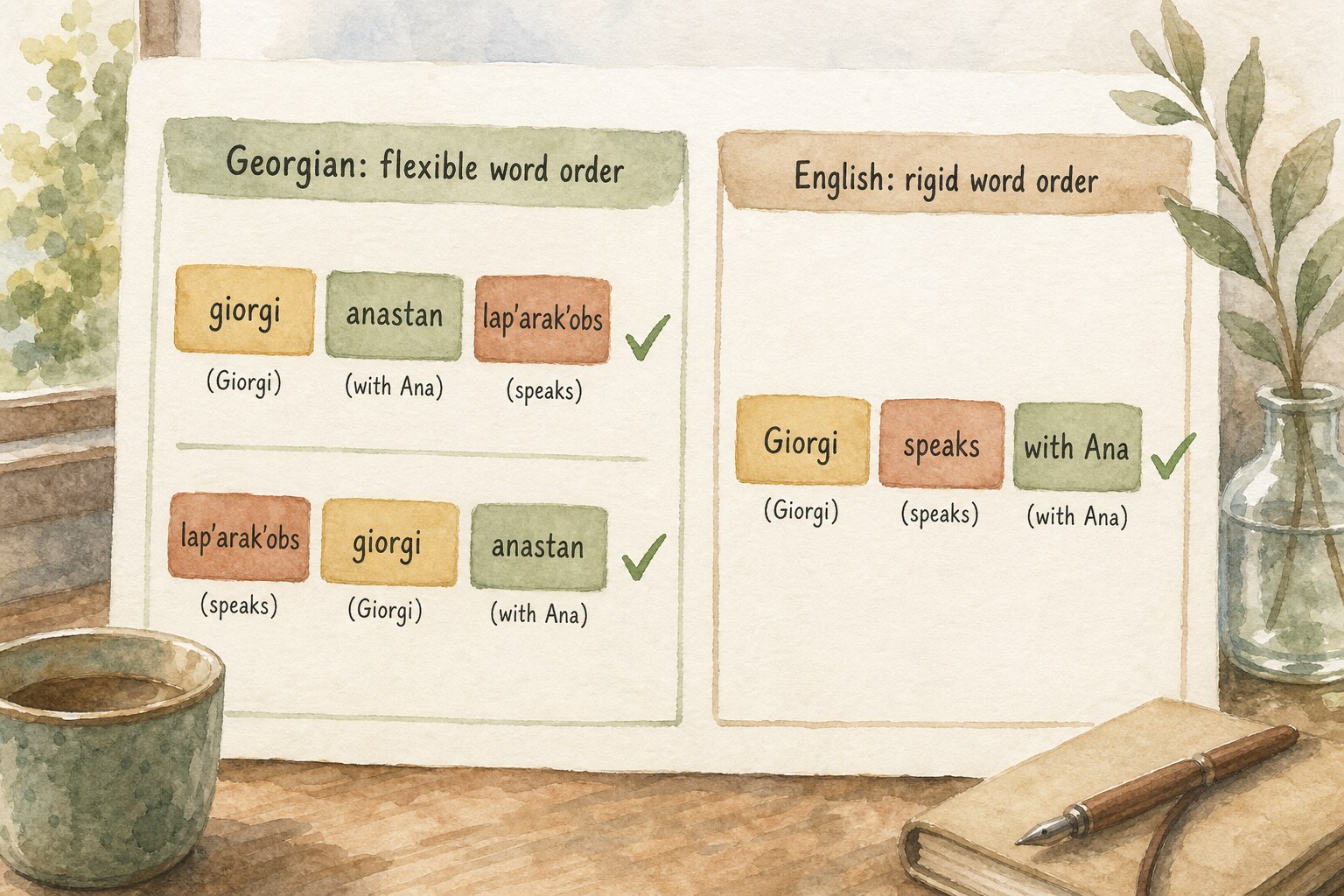
Two anchors of familiarity survive for English speakers. Adjectives come before their nouns, as in English. And questions are easy: there is no word-order inversion and no “do”-style helper word. You keep the sentence exactly as it is and raise the intonation. Kartulad lap’arak’obt is a statement or a question depending entirely on your voice.
What actually trips learners up (and what doesn’t)
After two years inside this language, my honest audit.
What trips you up:
- The verb system, over time. Not because any single form is hard, but because full coverage of the screeves and verb classes takes sustained exposure. This is the multi-month part, and there is no shortcut through it, only through the fear of it.
- Hearing the sounds. Georgian has a set of letters pronounced with a small catch in the throat, the ejectives, that sound nearly identical to their plain twins at first. They are the main reason beginners catch one word in three at full speed. We cover them properly in our Georgian pronunciation guide.
- Vocabulary from scratch. No cognate discounts. Modern borrowings exist, you will recognize keshi (cash) instantly, but the core of the language shares nothing with English. Every word is earned.
What doesn’t, despite the reputation:
- The alphabet. 33 phonetic letters. A focused afternoon, not a rite of passage.
- Spelling and reading. Fully phonetic. Once you read the script, you pronounce everything correctly forever.
- Gender and articles. Absent. Entire chapters of other languages’ textbooks simply do not exist here.
- The cases, eventually. They arrive by ear long before you could recite them, and the endings are short and regular. The table is scarier than the reality.
- Word order. Hard to get wrong in a way that matters. The endings carry the meaning, so a beginner’s clumsy ordering still lands.
The things that trip you up are the ones that need time and input.
How Georgian grammar actually goes in
Which brings me to the part I actually have authority on, not as a Georgian expert but as the test subject.
My first attempts at this language went through teachers who, with the best intentions, kept front-loading grammar my brain had nothing to hang on yet. Week-one grammar charts, before I could say ten sentences. It reads as logical, grammar first, sentences second. It is also, in my experience and in the experience of nearly every learner I have met here, exactly backwards. The chart means nothing when none of the words in it are yours yet.
What worked was flipping the order. Get real Georgian sentences into your ear daily, at a level you can mostly follow, and speak from day one, badly. That is the acquisition route: the patterns go in through use, the way you absorbed English grammar before anyone showed you a diagram. The audio course we built, Speak Georgian in 50 Days, is this method in structured form, one intense lesson a day that makes you retrieve and say Georgian out loud rather than nod along to it. The first lesson is free if you want to feel the difference. After it, the engine is volume: months of comprehensible input, listening that sits just above your level, plus whatever reading you can find.
And then, somewhere around month three, do the thing that sounds like heresy in week one: open a grammar reference. This is the famous grammar reveal, and it is genuinely one of the best moments in the whole journey. The ergative stops being a warning label and becomes “oh, that ending I keep hearing in stories.” The screeve table stops being a wall and becomes a list of names for shapes your ear already sorts automatically. Grammar read at month three is a map of a city you have been walking around in. Grammar read in week one is a map of a city you have never seen, and nobody remembers those.
Month three is also when a teacher starts being worth the money, if you want one. With the patterns already in your ear, the lesson can run mostly in Georgian, and the grammar questions you bring finally have something to attach to. The same teacher who would have drawn case tables at you in week one becomes, at that point, exactly the right person to sharpen what you have absorbed.
Start with the sentences. Open the table around month three, when kartulad is already a sound in your mouth instead of a row in a table.