
How many Georgian words do you need? About 1,000 gets you three quarters of ordinary spoken Georgian, and the first 100 alone get you close to half. Those are not borrowed figures from English or Spanish. We measured them against a corpus of actual Georgian speech, because until recently nobody had, and the answers floating around for this language were guesses dressed up as data.
There is a catch, and it is a big enough one that the flat number is almost misleading. I will get to it after the curve.
The short answer
Here is what each vocabulary milestone actually buys you. The left column is how many base words you know. The other two are the share of all words you would meet in each kind of Georgian.
| Words known | Spoken Georgian | Written Georgian |
|---|---|---|
| 10 | 20.5% | 16.3% |
| 100 | 47.2% | 36.4% |
| 500 | 68.1% | 56.6% |
| 1,000 | 76.2% | 64.8% |
| 2,000 | 82.9% | 73.0% |
| 5,000 | 88.6% | 81.5% |
| 10,000 | 90.2% | 85.8% |
To be clear about what those percentages are counting, because it changes what they mean: they are the share of every word in the corpus, not the share of some shortlist. If you knew the top 1,000 base words and nothing else, roughly 76 words in every 100 you heard would be ones you had met. Names, numbers and the occasional English word are all still in that denominator, so this is the conservative version rather than the flattering one.
Two things jump out of the table.
The first is how fast the early gains come and how quickly they stop. Going from 0 to 100 words buys you 47% of everything you will hear. Going from 5,000 to 10,000, a job fifty times larger, buys you another 1.6%. Vocabulary learning is front-loaded to a degree that is hard to believe until you see it laid out.
The second is that spoken Georgian is consistently easier to cover than written Georgian. At every milestone the spoken column is ahead, because conversation recycles a small set of words relentlessly while writing reaches for a much wider vocabulary. If your goal is talking to people rather than reading Georgian newspapers, the curve is on your side.
The catch nobody mentions
Every number above counts base words, the dictionary form. In English that distinction barely matters, because walk, walks, walked, and walking are four forms of one word and you learn them almost for free.
Georgian does not work like that. Georgian nouns decline through 7 cases. Georgian verbs run through 11 screeves and carry markers for who is doing the action and who it is being done to, sometimes both in the same word. One verb produces dozens of surface forms, and they do not always look like relatives.
So “1,000 Georgian words” is not the same unit of work as “1,000 Spanish words”. It is considerably more.
I can put a floor under how much more but not a ceiling, and it is worth being precise about why. Our published dataset records the surface forms it collapsed into each base word, but that column stops at 8 entries. Of the 10,000 entries in the list, 2,186 hit that ceiling, and unsurprisingly the ones that hit it are the common verbs. So the honest statement is that the average common Georgian verb generates at least 8 forms you will meet in ordinary use, and the real figure is higher than our own data can show.
The practical consequence: do not treat a Georgian word count as a comparable score against a language you have learned before. If someone tells you they know 1,000 words of Georgian and 1,000 words of Italian, those are not the same achievement.
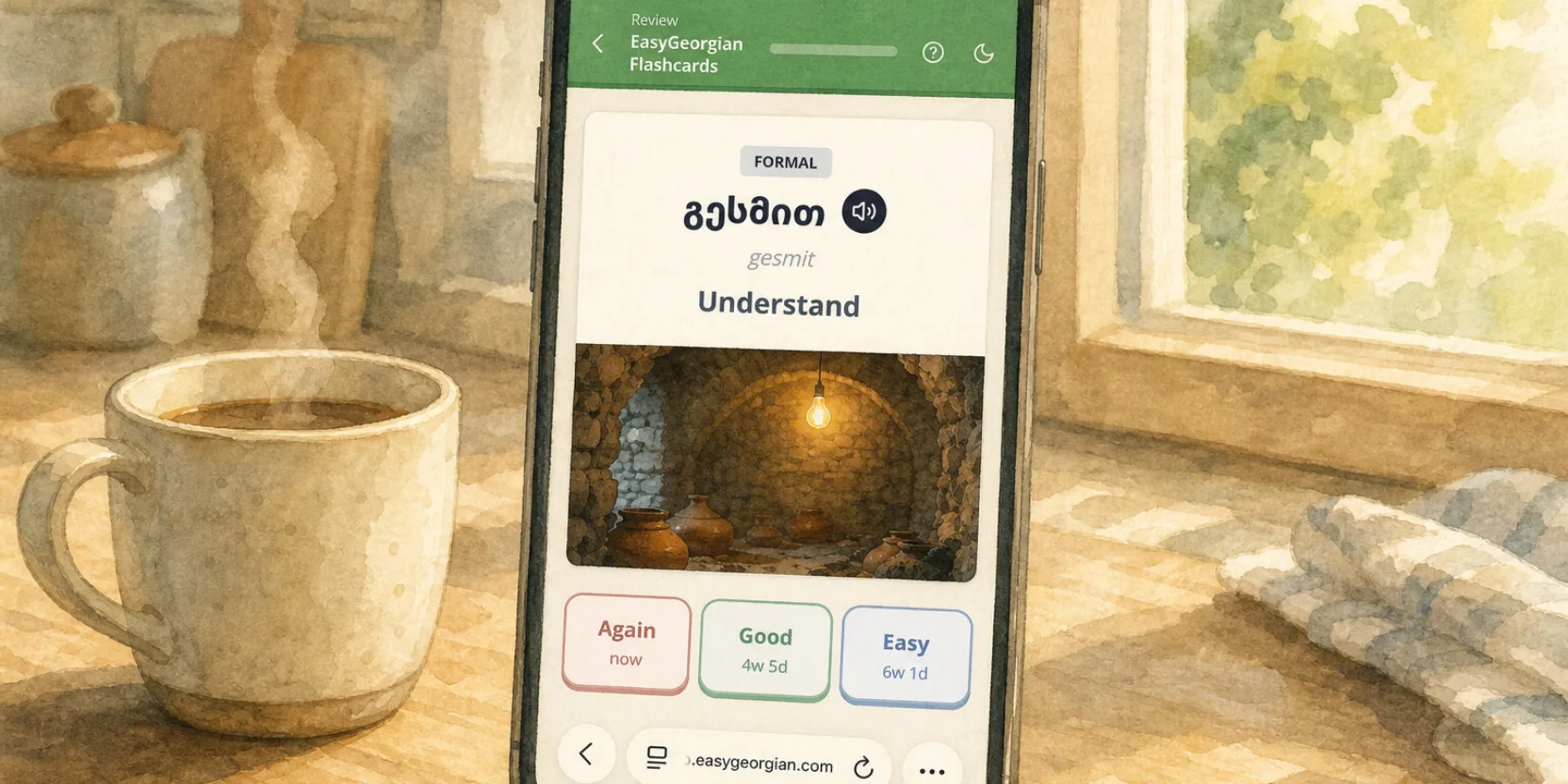
This is also the reason the flashcards-only route to Georgian tends to stall, and why Georgian flashcards that show one form of a word in isolation leave you unable to recognize the same word in a sentence.
Where these numbers come from
We built the corpus that the table is computed from.
There was no openly available frequency list of colloquial Georgian, so EasyGeorgian Research made one and published it free. It draws on two registers that sit close to speech: film and television subtitle dialogue, and conversational forum writing. After cleaning, that is 68 subtitle documents totaling 268,785 words, and 184,209 forum posts totaling 5,454,689 words. Word forms were reduced to base words by a language-model pipeline that we then measured, scoring 96.5% on blind re-annotation, with the errors documented rather than hidden.
The coverage figures in the table are computed straight from the per-word frequencies in that dataset, summed in rank order. They were run for this post, so if you want to check the arithmetic yourself, the full list is downloadable and licensed for reuse. The spoken Georgian frequency list has the whole methodology, including the parts we got wrong on the first pass.
The first 100 words are the best trade you will ever make
Half of spoken Georgian for 100 words is the single most useful fact in this post, and it changes how the first month should look.
Those first 100 are not exciting. They are the machinery: and, to be, this, that, not, I, you, what, very, already. Almost nobody wants to spend their first week on them, because they feel like nothing, and every phrasebook opens with greetings and food instead.
Look at the shape of the top 1,000 and the priority gets clearer. It splits roughly into 350 nouns, 278 verbs, 136 adverbs, 96 adjectives, and 60 pronouns. The verbs and the small connecting words are doing most of the work, and they are exactly what a vocabulary list is worst at teaching, because their meaning lives in how they combine rather than in a translation.
Why the usual word lists point you at the wrong words
If you go looking for a Georgian frequency list, you will find one, and it will send you somewhere strange.
Every published list for this language was built from written text, mostly news reporting and official documents, because that is the Georgian available in bulk. The result reads like a description of parliamentary journalism. In the standard written list, shemidzlia, meaning “I can”, ranks 9,599th. In our spoken data it ranks 30th. Albat, meaning “probably”, ranks 9,603rd in writing and 130th in speech. Meanwhile words like “electoral” and “opposition” sit comfortably inside the written top 150.
A beginner following that list studies the vocabulary of political reporting in month one and does not meet “I can” until year three. There is a longer version of this story, including a discovery about the most widely circulated Georgian frequency list that we did not expect to make, in what Georgians actually say.
What to do with this
Three things follow from the curve, and none of them is “go memorize a list of 1,000 words”.
Front-load the core and go deep, not wide. The first few hundred words are worth more than the next several thousand, so they deserve to be over-practiced rather than ticked off. A small core you can produce without thinking beats a long list you half-recognize. The words for yes, no, please, how much, I want, I don’t understand, and can you repeat that need to be reflexive, and the 300th rare noun does not.
Learn forms in context, not lemmas in isolation. Given what Georgian does to a verb, meeting a word inside a real sentence with real endings is worth several times what meeting it on a card is. This is the argument for audio and for reading over vocabulary drilling, and it is why the number in the title is a poor target to aim at directly.
Then use a list as a check, not a plan. Once you have a few months behind you, running your eye down a frequency list is a genuinely useful audit of what you are missing. As a curriculum it is close to useless, because it has no idea which words teach each other. If you want the practical version of the core, we built the 5,000 most common Georgian words into a deck with audio and images on every card, sequenced rather than dumped.
Early on I tried to do this with Anki. The user-made Georgian decks cap out around 1,000 cards, audio was patchy, none had images, and I ended up recording my own audio for the cards I cared about before quitting a month later. The irony is that 1,000 was roughly the right target and the format was the thing that beat me.
The number is 1,000 for three quarters of the language. The reason people still cannot speak after learning 1,000 words is almost never the count. It is that they learned them lying flat on a card instead of moving inside a sentence. If you want the realistic timeline attached to all this, how long it takes to learn Georgian has the brackets.