




You moved here for someone, or you met someone here, and now you want to learn Georgian for your partner. Years in, you can order coffee, say thank you, and follow maybe one word in ten at their parents’ table. Your partner switches to English for you, out of love, and the switch is so smooth that you barely notice it has happened again.
If that is you, the first thing to know is that it is not a character flaw. It is a setup problem, and the setup is one that almost everyone in a relationship with a Georgian ends up in. I was in it for three years.
Why years next to a native speaker produces so little
The intuition is that living with a Georgian speaker should be the best possible way to learn Georgian. Immersion, free, all day. And yet the people who learn Georgian slowest, in my experience, are often the ones with a Georgian partner, because the setup quietly removes every reason to push through the hard early part.
Three things are going on.
Native speech is not beginner input. Your partner talks to their mother at full speed about a cousin’s wedding and the price of tomatoes. To your ear that is one continuous sound. Learning happens from language you can mostly follow, not from language you cannot follow at all, and a home full of fast adult Georgian is, for a beginner, a home full of noise. Being around it is not the same as being taught by it, which is the whole point of the post on comprehensible input.
English is always available. The moment a conversation matters, about money, about feelings, about which of you forgot to pay the gas, it happens in the language you both actually share. This is correct. Nobody should run a relationship in a language one of them barely speaks. But it means Georgian at home is permanently optional, and optional things lose to tired evenings.
Your partner cannot be your course. Native speakers do not know why their language works, any more than you could explain English tense to a beginner without preparation. Ask why it is midis here and mivdivar there and you get a shrug, or worse, a twenty-minute lesson at the kitchen table that neither of you enjoyed. Lessons from a partner strain the relationship and rarely stick. That is not a Georgian thing, it is a couples thing.
Put the three together and you get the classic outcome: years of exposure, a stable plateau of survival phrases, and a growing feeling at family dinners that you are a permanent guest.
What your partner can do, and what they cannot
I want to be precise here, because “don’t learn from your partner” is easy to hear as “your partner is useless for this”, and the opposite is true.
What a partner cannot be is the source of structure. The sequencing, the small core of words introduced in the right order, the audio at a speed you can follow, the being made to produce a sentence before you feel ready. That is a course’s job. Your partner will not do it well, and you should not ask them to.
What a partner is, uniquely, is the best conversation partner you will ever have. Patient, invested, available every day, and possessed of a whole family who will react to your Georgian the way nobody at a language school ever will. That is a resource no learner without a Georgian partner can buy, and most people with one leave it completely unused, because they never got the structure that would let them use it.
The fix is to separate the two jobs. Structure from a course. Practice from your partner. Trying to get both from your partner is why it has not worked.
The three years I did not learn Georgian
I should say how I know all this. I moved from Denmark to Tbilisi in 2021, not for the language, for the adventure of it. I met a Georgian woman, married her, and for the better part of three years I lived with a native speaker and did not learn Georgian beyond basic phrases.
I tried. I tried a few teachers who spent most of the lesson in English or wanted me to write out letters by hand. I tried Anki decks and recorded my own audio for the cards. I gave up more than once. And through all of it I had, in the next room, someone who spoke the language perfectly, which somehow made it worse, because it meant every day I could have been learning and was not.
What actually changed was early 2024, when I started building EasyGeorgian and, in the process, finally had the thing I had been missing: structured daily audio that made me speak, at a level I could follow, in an order that built. The learning started then. Not in 2021 when I arrived, not when I got married, but when the structure showed up. I now speak Georgian with my wife’s family, real Georgian around a real table, and the years before that were not wasted so much as waiting for the missing piece.
If you are in year two or year five of the same wait, the missing piece is the same one.
The plan that actually works with a partner
Everything below assumes you have a Georgian in your life. It is the general how to learn Georgian plan with the partner slotted in where they belong.
Alphabet in an afternoon. Rough recognition, not perfection. Your partner can sit next to you for this one and it will be fun rather than fraught, because there is nothing to explain, only sounds to make.
A daily structured audio lesson, alone. This is the structure your partner cannot give you. Thirty minutes a day, full attention, headphones, native speakers carrying a dialogue and you being prompted to answer. Do it alone. Do not do it with your partner in the room, because you need to be allowed to sound terrible without an audience. This is where the language actually gets built.
Short Georgian-only slots at home, from week one. Not immersion. Slots. Breakfast is in Georgian. The walk to the shop is in Georgian. Twenty minutes where the rule is Georgian only, mistakes welcome, and English is banned even when it would be easier. The rest of the day stays in whatever language your relationship runs in, which protects the relationship.
The reason this works where full immersion fails is that a slot has an end. Nobody has to sustain broken Georgian through an argument about the electricity bill. And because you are doing the audio course in parallel, each week the slot gets slightly less broken, which your partner notices, which keeps both of you going.
Volume listening after the course. Once the audio course is done, the family table stops being the only place you hear Georgian at speed. The podcast course and whatever Georgian you can find to listen to build the ear that lets you follow a toast. This takes months, not weeks, and there is no shortcut through it, but it is also the phase where the partner advantage finally pays off, because you get real conversation every single day while it happens.
What to ask your partner for (and what not to)
Ask them to stay in Georgian during the slots even when you struggle. This is the hardest thing for a loving partner to do, because the reflex is to help by switching. Tell them in advance that the help you want is patience, not English.
Ask them to answer the question you asked, in Georgian, simply, rather than correcting how you asked it. Corrections during a conversation kill the conversation. The course will fix your grammar over time. What you need from your partner is someone to talk to.
Ask them to tell you when you have said something that a Georgian would never say, later, once, without a lecture. My wife reads everything I write for EasyGeorgian and catches the words that are off-register or the framings that would not read right to a Georgian. That single skill, knowing what sounds wrong, is worth more than any explanation of why.
Do not ask them to explain grammar. Do not ask them to make you a study plan. Do not ask them to test you. All three turn a partner into a teacher, and you did not marry a teacher.
The family table
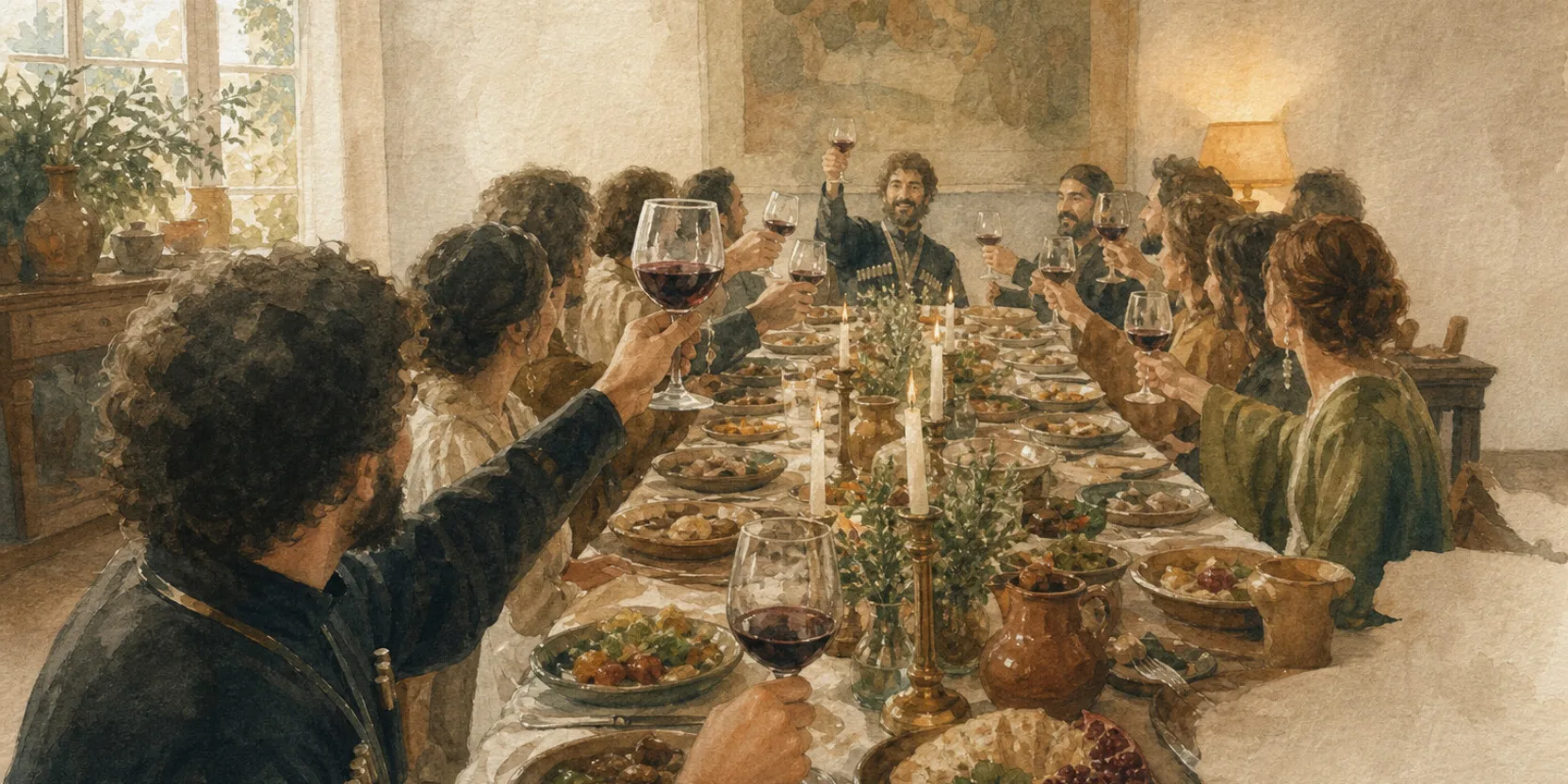
The thing you are really learning Georgian for is the table. Sunday lunch at their parents’. A birthday. The supra where you have spent years smiling, nodding, and waiting for someone to explain the toast.
Here is what changes, and it changes earlier than you expect. You do not need to follow the whole conversation to stop being a guest. You need to say one thing, in Georgian, that is not a phrase from a book. Ask the grandmother what is in the dish. Tell the uncle his wine is good. Answer the question about where you are from without your partner translating. A few broken sentences and the table turns toward you, and it keeps turning every time you try again.
Use tkven with the parents and the older relatives until they tell you otherwise, which many of them will. The register question is its own small art and I wrote about it in the post on formal and informal Georgian. And if the whole institution of the supra is still a mystery to you, the guide to your first supra covers the questions you will be asked before you are asked them.
The moment it changes
Learning Georgian for a partner is different from learning it for a job or for travel, and the difference is that the payoff is not abstract. It is a specific room full of specific people who have been kind to you in a language you could not answer in.
The first time you hold a real conversation in that room, however badly, the feeling of being a permanent guest goes. It does not come back. What replaces it is not fluency, that takes years, but membership, and membership turns out to be what you wanted all along.
The structure is the missing piece. Your partner is the rest. The first lesson is free, and the next family lunch is coming whether you are ready or not.