




The most common piece of Georgian listening practice advice is also the least useful: put on Georgian radio, leave the TV on, let it wash over you. For a beginner, that is an hour of pleasant noise. You will catch k’i and ara and the occasional madloba, and the rest goes past like traffic.
Listening does build Georgian, and it is the engine of almost everything that works. But it only teaches when you can follow most of what you hear. So the real question is not whether to listen. It is what to listen to at your level, and that changes a lot between your first month and your first film.
The one rule: follow most of it
Your brain learns new words from context. If you understand eight words in a sentence, the ninth has somewhere to hang, and after enough of those moments it sticks. If you understand two, there is no context to guess from, and nothing sticks at all. That is the mechanism behind comprehensible input, and it has a floor.
We can put a number on where the floor sits for real Georgian, because we built a frequency list from real spoken Georgian, including the dialogue of 68 Georgian films and TV programs. The 100 most common words cover about 47 percent of what is said on screen. The 1,000 most common cover about 76 percent, and the 5,000 most common about 89 percent. The full curve is in our post on how many Georgian words you need.
Read that as a listener. With a few hundred words, native-speed Georgian is mostly gaps. With a thousand of the right ones, you recognize roughly three words in four, which is where films start to become input instead of noise. Everything before that point needs material built to sit inside what you know.
From zero to A1: short, slow, and with English nearby
In the first weeks, the best listening is listening that asks something of you.
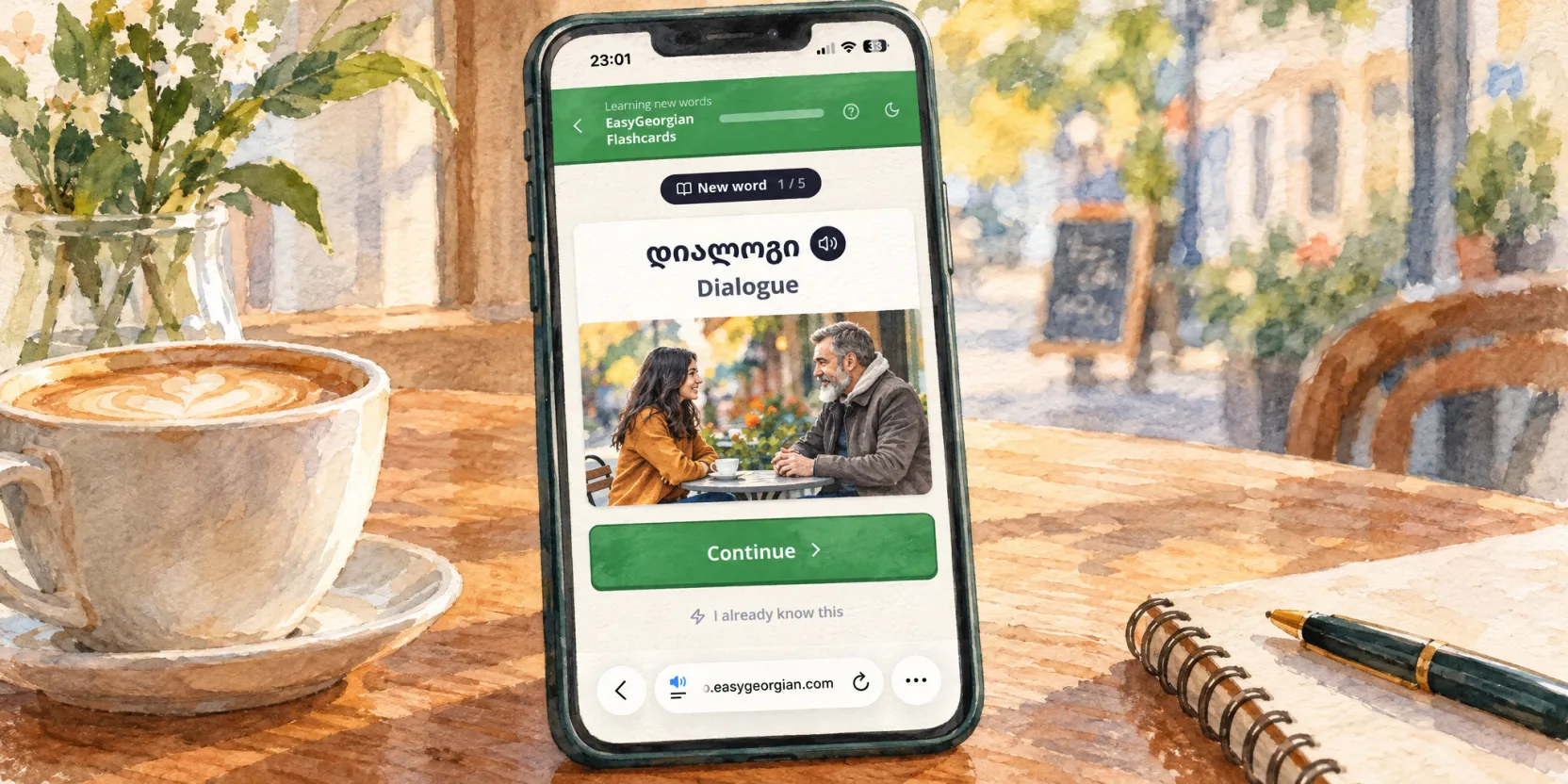
A structured audio lesson is the strongest version. You hear a real Georgian conversation that you cannot follow yet, the new words get built up a piece at a time, and then you are prompted to say them yourself before the native speaker does. By the end of the lesson, the conversation from the start makes sense. That loop trains your ear and your mouth together, and it is why audio first works so well for a language like Georgian, where the sounds are half the battle.
It is also not background listening. A lesson like that wants your full attention, ideally with headphones in a quiet room, and many people finish one tired. That is the effort doing its job.
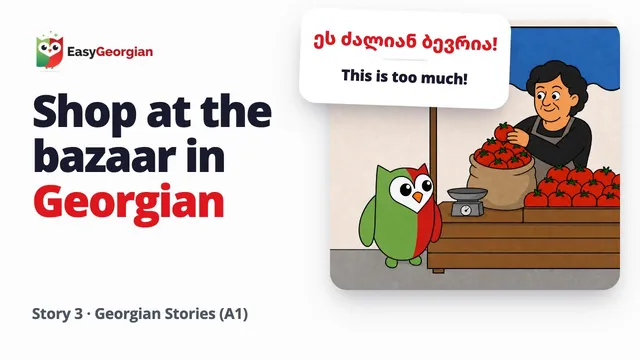
The lighter option at this stage is short stories. Our free Georgian stories for beginners follow Buko the owl around Tbilisi in simple A1 Georgian. Each one is told twice: first with Georgian and English under every line, then again with Georgian captions only. Here Buko tries to buy a single kilo of tomatoes and runs into a market seller with other plans.
 4:31
Stories work for the evening, after the day’s lesson, when you still want Georgian but not effort. Watch one, then watch it again the next day. The second viewing is where you notice the progress.
From A1 to A2: slow Georgian, all in Georgian
Once you have a beginner course behind you, the job changes. You can follow simple speech, but your vocabulary is small and your ear is used to careful, clear voices. What you need now is volume: hours of Georgian that are slow enough to follow and just a little above your level.
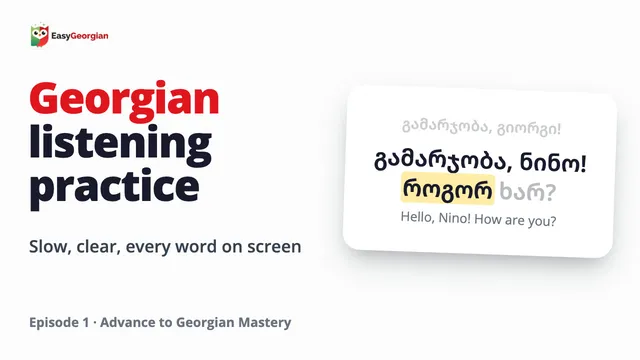
This is the stage our podcast course, Advance to Georgian Mastery, was built for. Each of its 100 episodes is a short dialogue in slow, clear Georgian, a discussion of the new words in simple Georgian, and the dialogue again a little faster, with a full transcript you can follow along with and translations you can turn up or down. Here is episode 1, start to finish.
 9:29
Something useful happens at this stage. Listening can finally become partly passive. A podcast pitched at your level is something you can play on a walk or on the metro and still learn from, because you are following most of it. The audio course needed your whole attention. The podcast is meant to fit into your day.
From A2 to B1: real Georgian at real speed
Somewhere past a thousand words, native material opens up. Not all of it, and not comfortably, but enough to learn from.
Films are the obvious next step, and they work best when you treat them as a rewatch rather than a single viewing. Our post on how to learn Georgian with movies has the films to start with and a method for using them. Sitcoms come next. Their vocabulary is small and repetitive, which helps, and their delivery is fast, which does not.
Georgian television is the other big source. The public broadcaster puts a share of its programming online, and the news is a good stretch exercise because the topics repeat for days and the announcers speak clearly. Music helps too, as long as you look up the lyrics. A song you know by heart is a few hundred words of Georgian you will never forget.
None of this replaces the earlier stages. It adds speed and variety on top of a foundation that already holds.
How to listen so it counts
A few habits make the same hour of listening worth more.
Match the mode to the material. A structured lesson is active work. A story or a podcast episode at your level can be lighter. Native-speed material is active again, because you are reaching. Trouble starts when you treat hard material as background and easy material as homework.
Repeat the same piece. Five passes through one episode teach more than one pass through five. The first time you get the story, the second time the phrases, and by the third you start hearing the endings on the words, which is where Georgian grammar lives.
Read along, then let go. Use the transcript or the captions to follow the first time. Then drop them and listen again. Reading while you listen attaches the sound to the word, and listening without it checks that the attachment held.
Say it back. Pick one line you liked and say it out loud the way the speaker did, rhythm first, words second. Listening builds an understander. Saying it back starts building a speaker.
Little and daily. Thirty minutes a day beats three hours on Sunday. Your ear adjusts to Georgian the way your eyes adjust to the dark, slowly and only while you stay in the room.
A week of listening at each level
A rough shape, to adapt rather than follow:
| Level | Every day | A few times a week |
|---|---|---|
| Zero to A1 | One structured audio lesson, out loud | A Buko story, watched twice |
| A1 to A2 | One podcast episode, with the transcript | The same episode again, without it |
| A2 to B1 | A podcast episode or a TV segment | A film scene, three times |
The table is less important than the direction of travel. Month by month, the material should get a little faster and a little less familiar, and you should notice that it does not feel any harder than the last thing did. That feeling, of Georgian getting easier without the Georgian getting easier, is what listening practice is for.