



Most people learn Georgian vocabulary the way they learned school vocabulary. A list, a column of translations, a quiz on Friday. With Spanish or German that half works, because half the words look like English ones. With Georgian it barely works at all. P’uri is bread, ts’q’ali is water, sakhli is house, and none of them give you anything to hold on to.
So the honest starting point for how to learn Georgian vocabulary is that effort is not the bottleneck. Method is. Four habits make the difference between words you recognize on a list and words that come out of your mouth when you need them, and none of them is complicated.
Why Georgian words are hard to keep
Georgian is not related to English, Russian or any other language most learners know. It belongs to its own small family, so almost no vocabulary is shared by descent. A few borrowed words help (t’aksi is taxi, and modern life brings plenty of English), but the core of the language, the words you need on day one, is new from scratch.
Then there is the sound. The ejective consonants, written with apostrophes in transliteration like p’ and t’, are separate sounds from their plain cousins, and they change meaning. A word learned from spelling alone often gets stored with the wrong sound attached, which is why audio is not an extra for Georgian vocabulary. It is part of the word.
And Georgian words are often long, because they carry their grammar on the outside: prefixes and endings stacked on a root. That sounds like bad news. It turns into good news once you learn words inside sentences, because the endings start to repeat.
Habit 1: learn the words that do the most work
Not all words are equal. In real spoken Georgian, a small set of words carries a startling share of every conversation. We measured it on the dialogue of 68 Georgian films and TV programs: the 100 most common words make up about 47 percent of everything said, and the 1,000 most common cover about 76 percent. Our post on how many Georgian words you need has the full curve.
The practical rule: learn in order of frequency, at least for the first thousand. And use a spoken list, not a written one. The two disagree more than you would expect. Shemidzlia, I can, is the 30th most common word in Georgian speech and sits near the bottom of the standard written list, because people say it constantly and rarely write it. The research behind that is in what Georgians actually say.
Habit 2: learn words inside sentences
A word on its own is a fact. A word inside a sentence is something you can use. The difference shows up the first time you try to say anything: if you learned minda as “want”, you still have to assemble a sentence around it under pressure, and that is where beginners freeze.
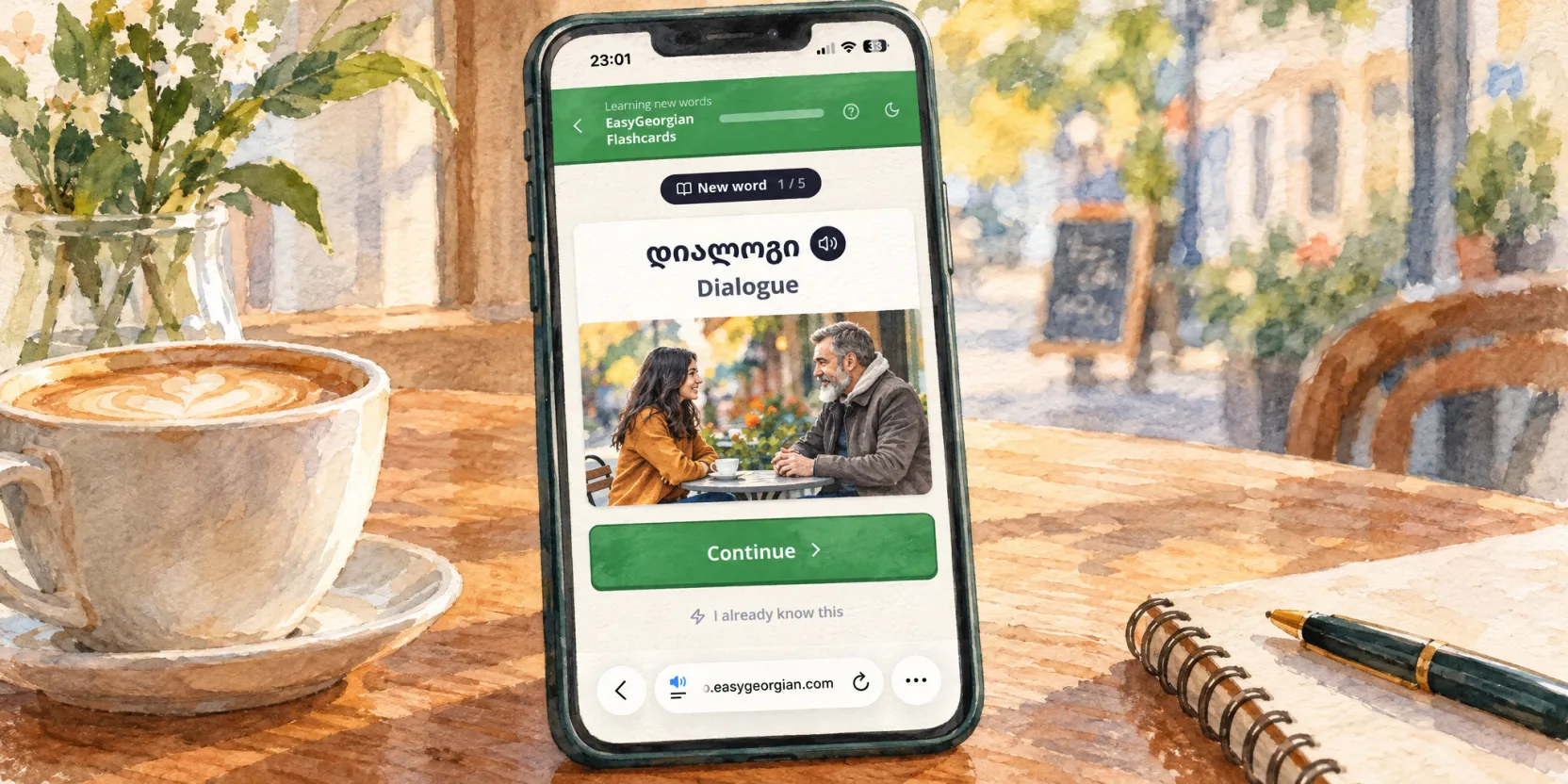
So learn the chunk, not the word. Here is the same verb, first as a phrase and then doing a job.
The second card teaches four words, and it teaches the order they go in, which no list ever will. Learn enough sentences like it and the grammar starts arriving for free, because you have heard the right ending so many times that the wrong one sounds wrong.
This is the principle our audio course is built on: a small core of phrases, mastered in depth, inside real conversations. It is also why the flashcards that come with it are drawn from the sentences in the lessons rather than from a dictionary.
Habit 3: say it before you see it
There is a large gap between recognizing a word and producing it. Recognition is what happens when you see ts’q’ali and think “water”. Production is what happens when you are thirsty in a cafe and need ts’q’ali to arrive in your mouth. Most vocabulary practice trains the first and hopes for the second.
The fix is retrieval. Look at the English, say the Georgian out loud, and only then check. It is harder and slower than flipping cards, and it feels worse, which is exactly why it works. Every successful retrieval makes the next one easier.
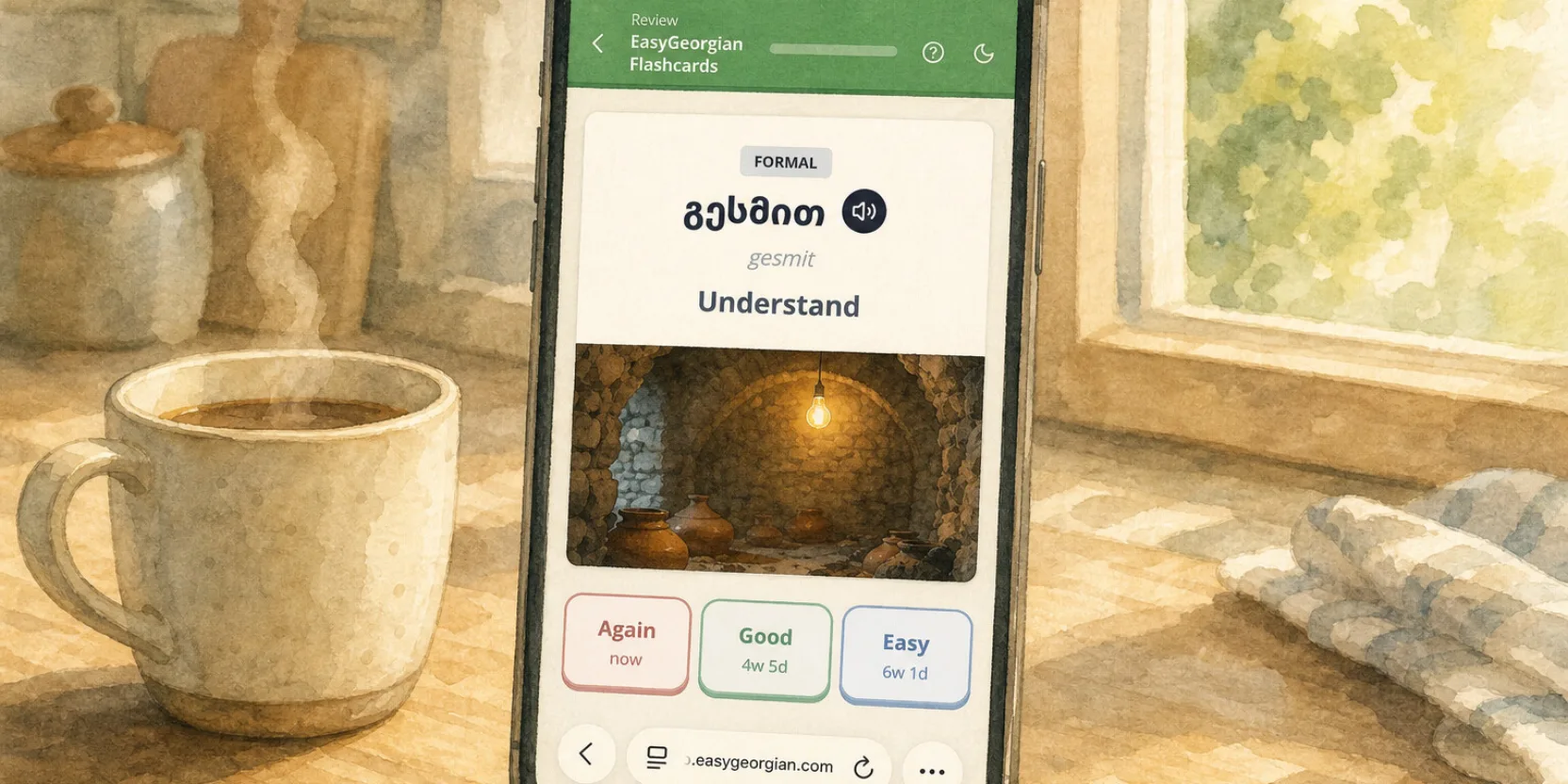
Our flashcards offer three ways to answer: multiple choice when a word is brand new, then your choice of self-rated recall or typed answers when it comes back for review. The typed mode accepts reasonable variations, such as a dropped pronoun, so you do not get marked down on a technicality. The point of all three is the same: make your memory do the work before the answer appears.
Habit 4: let spacing do the remembering
You forget on a curve. A new word fades within days, a reviewed word fades more slowly, and a word reviewed several times at growing intervals can last for months. Spaced repetition simply schedules each review for the moment just before you would forget, which is when a review does the most good.
You can do this with any good flashcard tool. The algorithm is not the hard part. The hard part for Georgian is the deck. Before we built ours, I tried the shared Georgian decks on Anki. The algorithm was excellent. The decks stopped at around a thousand cards, the audio was patchy, and there were no images, so I recorded my own audio for the cards I cared about and quit a month later anyway. That experience is most of why our flashcards carry a picture and audio on every card.
How many words a day
Fewer than your ambition suggests. A handful of new words a day, reviewed every day, is a pace you can keep for months. A big batch on Sunday is a pace you keep for about two Sundays.
The trap is counting new words instead of words you can use. “Three hundred words a week” sounds productive and usually produces a long list you recognize and a short list you can say. Protect your review time first, add new words with whatever is left, and judge progress by what comes out of your mouth, not by the size of the deck.
Putting it together
A routine that covers all four habits fits into a normal day:
- A lesson puts new words in your ears inside real sentences, and makes you say them.
- A flashcard review brings back the words that are due, with retrieval and spacing doing their work.
- Some listening, a story or a podcast episode, lets you meet the same words used by someone else.
- One real use of a new phrase, at a counter or in a message, turns it from a card into a word you own.
If you want a free place to start, the first 100 cards of our 5,000 most common Georgian words deck are free, in frequency order, with audio and an image on each. And if you would rather have the words come to you, the Georgian word of the day email sends one each morning, with its script, pronunciation, an example sentence and the audio.