



Search for Memrise Georgian and you land on a page that looks promising: a flag, a Learn Georgian heading, 80 million learners. Read the second line and the promise shrinks. “Learn vocabulary with word lists made by users.” That sentence is the whole answer, and it deserves unpacking, because it is doing a lot of quiet work.
So, plainly: Memrise does not have a Georgian course. It has Georgian word lists that other learners typed in. Whether that is useful depends entirely on what you already have.
The short answer: word lists, not a course
Memrise’s own pricing page spells out the distinction. Its Pro plan advertises official courses for 23 languages, the ones with the video clips of native speakers saying phrases on the street, the thing Memrise is genuinely good at. Georgian is not on that list. Never has been.
What Georgian gets instead is the community layer: lists of words and phrases that any user can create and share. Some are long, some are three items and a typo. Some have audio a user uploaded, most do not. None of them is a course in the sense of lessons that build on each other, dialogues, or anyone prompting you to speak.
That is not a criticism of Memrise. A word list is exactly what its page says it is. The problem is only that a beginner searching for a Georgian course reads “Learn Georgian with Memrise” and assumes the course exists.
What happened to the Memrise Georgian course
If you remember a proper-looking Memrise Georgian course from a few years ago, you are not imagining it. Community courses were once a big part of Memrise, and a user-made “Georgian basics” course lived there for years.
Then, in March 2024, Memrise removed every community course from its app and main website and parked them on a separate login-only site with no long-term promise attached. For most of 2024 and 2025, Georgian on Memrise effectively did not exist unless you knew where the side door was. Since then the company has been bringing community content back into the main app in a new form, as word lists, which is why the Learn Georgian page reappeared and why it says what it says.
The practical upshot: the Georgian that lives on Memrise today is vocabulary lists, of variable quality, made by learners rather than by Memrise. Some are decent for review. What none of them do is teach.
What a word list can and cannot do for Georgian
Here is the honest case for word lists. Spaced repetition of vocabulary works, Memrise’s engine does it well, and for a language like Spanish, where you can already hear and read the words, a good list is a fine supplement from week one.
Georgian is a harder case for one specific reason: at the start you cannot hear it yet. Georgian has a set of consonants, the ejectives, that English does not have, and a written word on a card cannot tell your ear what they sound like. A list entry for ghvino (wine) teaches you a string of letters. Without audio behind it, and without that word arriving inside a sentence you have heard a native speaker say, it floats. I wrote about this ceiling in the post on Georgian flashcards, because it is the same ceiling on every user-made deck: patchy audio, no images, no course underneath.
The other thing a list cannot do is make you produce Georgian under any kind of pressure. You see a word, you recall it, you move on. Nobody asks you a question in Georgian and waits. That prompted retrieval, in a real sentence, with a native voice confirming it, is the mechanism that turns vocabulary into speech. A list is the opposite of that by design: it isolates words so they can be counted.
The principle that matters for a beginner is small core, mastered in depth, not a wide pile of words on the surface. Three hundred words you have retrieved out loud in sentences beat two thousand you have tapped past on a list.
What I used Memrise for, and where it stopped
I should say that I used Memrise for Georgian myself, back in the community-course era, before EasyGeorgian existed. It had two things Anki could not do natively: written input that checked your answer automatically, and multiple choice for the days when willpower was thin. Both were genuinely good, and both are features I later insisted on having in our own flashcards.
Where it stopped was exactly where every vocabulary tool stops. I had words. I did not have a way to say them to anyone, and I did not have anything teaching me the sentences the words lived in. That is not a Memrise problem, it is a category problem: I was trying to use a vocabulary tool as a course because, for Georgian, there was no course to pair it with.
What to use instead
The gap the big platforms left is why EasyGeorgian exists, so a disclosure: I moved from Denmark to Tbilisi in 2021, looked for the Georgian version of the modern tools I had used for Russian and Spanish, found nothing, and eventually built it together with my Georgian wife.
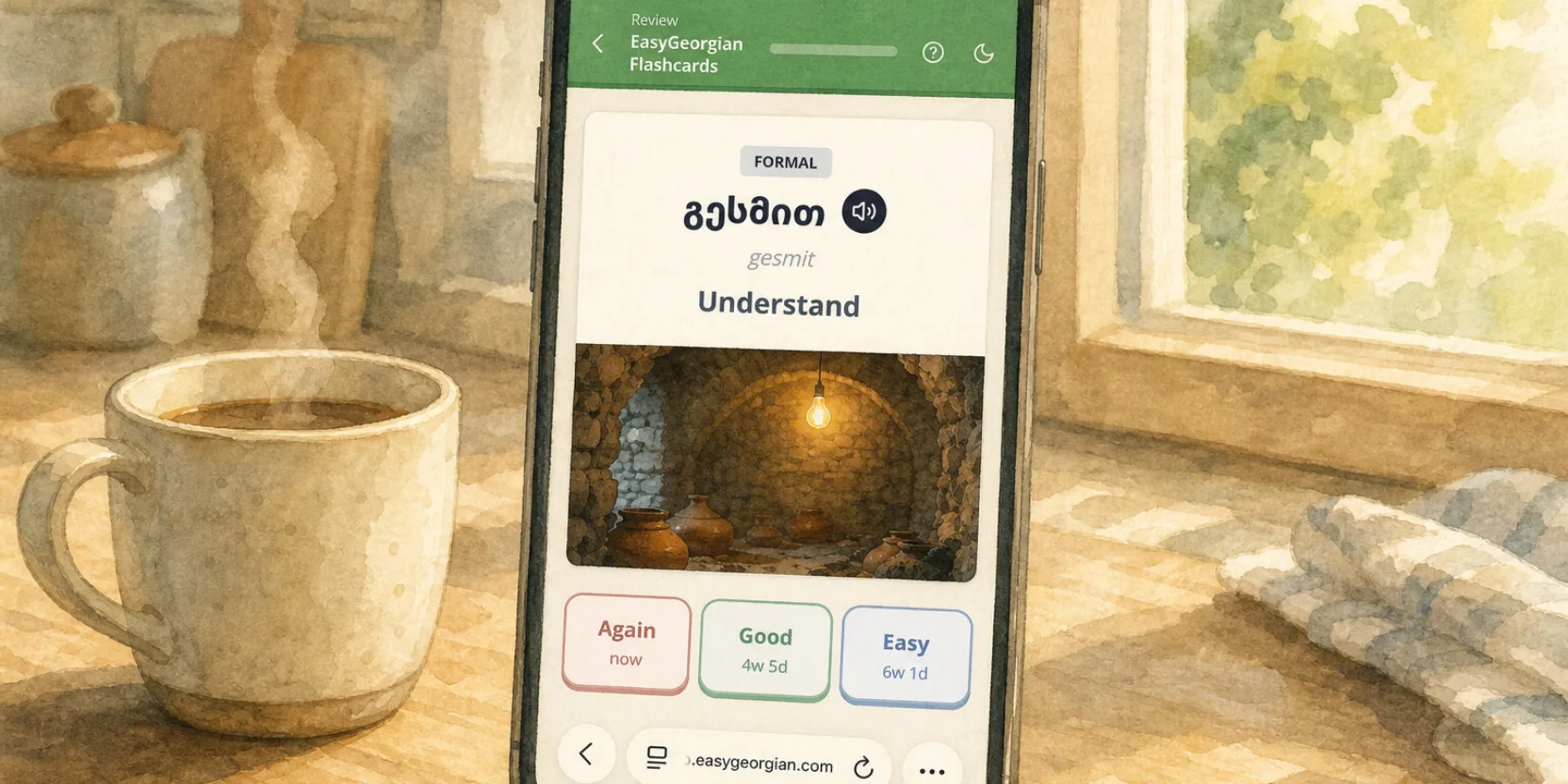
The shape of it follows from everything above. A structured audio course, Speak Georgian in 50 Days, where native speakers carry a dialogue and you are prompted to speak back from the first lesson. A 100-episode comprehensible-input podcast course for the volume-listening phase after that. And 9,000+ flashcards, with audio and an image on every card, paired to the lessons so a word never shows up on a card before you have heard it in a sentence. The vocabulary tool sits under the course instead of pretending to be one. The reasoning is laid out in why audio-first wins for Georgian.
It is not the only thing out there, and honest shopping beats brand loyalty in a market this small. The full field, with what each tool does well, is in the roundup of the best apps to learn Georgian. And if the Memrise search was one stop on a tour of the big platforms, the story is the same at each of them, which I covered in why Duolingo doesn’t teach Georgian.
Where Memrise still fits
None of this means delete the app. Once you have a course teaching you the language, a user-made list of, say, Georgian food words or the vocabulary from a film you are watching is a perfectly good way to review, and the Memrise engine will schedule it sensibly. Treat the lists as what the page calls them, supplements built by other learners, and check any list against a source you trust before you memorize a typo.
What a list cannot be is the place you start. For that you need something that teaches, and the sequence that works, alphabet in an afternoon, daily audio lessons, then volume listening, is in the guide to how to learn Georgian.
So the final answer to the search you came in with: Memrise lists Georgian, Memrise does not teach Georgian, and that turns out to be a useful distinction to have learned early. The first real lesson costs nothing to try.