



Search for Rosetta Stone Georgian and the internet hands you a granite slab in the British Museum, a university library blog post from 2014, and a roadside monument in the American state of Georgia. What it will not hand you is the thing you actually wanted, so let me be the page that finally says it: Rosetta Stone does not offer Georgian. It never has.
The reason the results are so strange is that no page answers the question, and Google is improvising. This post is the straight answer, plus the more useful part: what the instinct behind your search gets right, and where immersion-style Georgian learning actually lives.
The short answer: no Georgian on Rosetta Stone
Rosetta Stone’s catalog covers about 25 languages. It is a list built around the biggest markets: the Romance languages, German, the East Asian majors, Arabic, Russian. Georgian, with its roughly 4 million speakers, has never made the cut, and there is no sign it ever will.
If it softens the blow at all, you did not pick the one unlucky platform. None of the majors support Georgian. Not Duolingo, which I have covered in why Duolingo doesn’t teach Georgian, not Babbel, not Memrise, not Pimsleur. The entire boxed-and-app language industry looked at Georgian and quietly moved on.
Why every big platform has the same gap
The pattern is the same everywhere, and it is economics rather than malice. Georgian is spoken by a small population concentrated in one country. It uses its own alphabet, shared with no other language on earth. Its grammar belongs to the Kartvelian family, related to nothing European, so none of the content, voice work, or course design built for other languages can be reused. Supporting Georgian means building everything from scratch for one of the smallest audiences on the menu.
Every platform with shareholders makes the same call. The people left holding the gap are the ones with real reasons to learn: people who moved to Georgia, people who married into it, heritage speakers who grew up hearing it, and the occasional language romantic pulled in by the script. Small market. Extremely motivated market. Nobody built for it, for years.
What immersion means for Georgian specifically
Here is what your search got right. The idea Rosetta Stone is famous for, learning from context and exposure rather than from grammar charts, is the correct instinct. Adults can genuinely acquire a language rather than study it, and the acquired kind is the kind that comes out of your mouth at a dinner table. The approach has a proper name, and the case for it is laid out in the guide to comprehensible input.
But immersion for Georgian has to be built differently than for Spanish, for two stubborn reasons.
First, the script. Matching pictures to written words is a reasonable on-ramp when the words are in an alphabet you already read. Georgian’s 33 letters are beautiful, fully phonetic, and completely unfamiliar, which means text-led immersion stalls until you can read. (The fix is cheap, one afternoon, but it has to come first.)
Second, the sounds. Georgian has a set of consonants, the ejectives, that English simply does not have and text cannot convey. No amount of looking at pictures teaches your mouth the difference between p and p’. Only your ear does that, through volume of native speech.
Put those together and the conclusion writes itself: immersion in Georgian is audio-led or it does not happen. Hours of spoken Georgian at a level you can mostly follow, with you prompted to speak back from the first session. That is the argument made properly in why audio-first wins for Georgian, and it is the design principle behind everything that follows.
What exists for Georgian instead
The market the big platforms skipped did eventually get filled, and I should disclose my role before describing it: I moved from Denmark to Tbilisi in 2021, had learned Russian and Spanish with modern tools, went looking for the Georgian equivalent, and found a shelf that was effectively empty. That gap is why EasyGeorgian exists, built together with my Georgian wife.
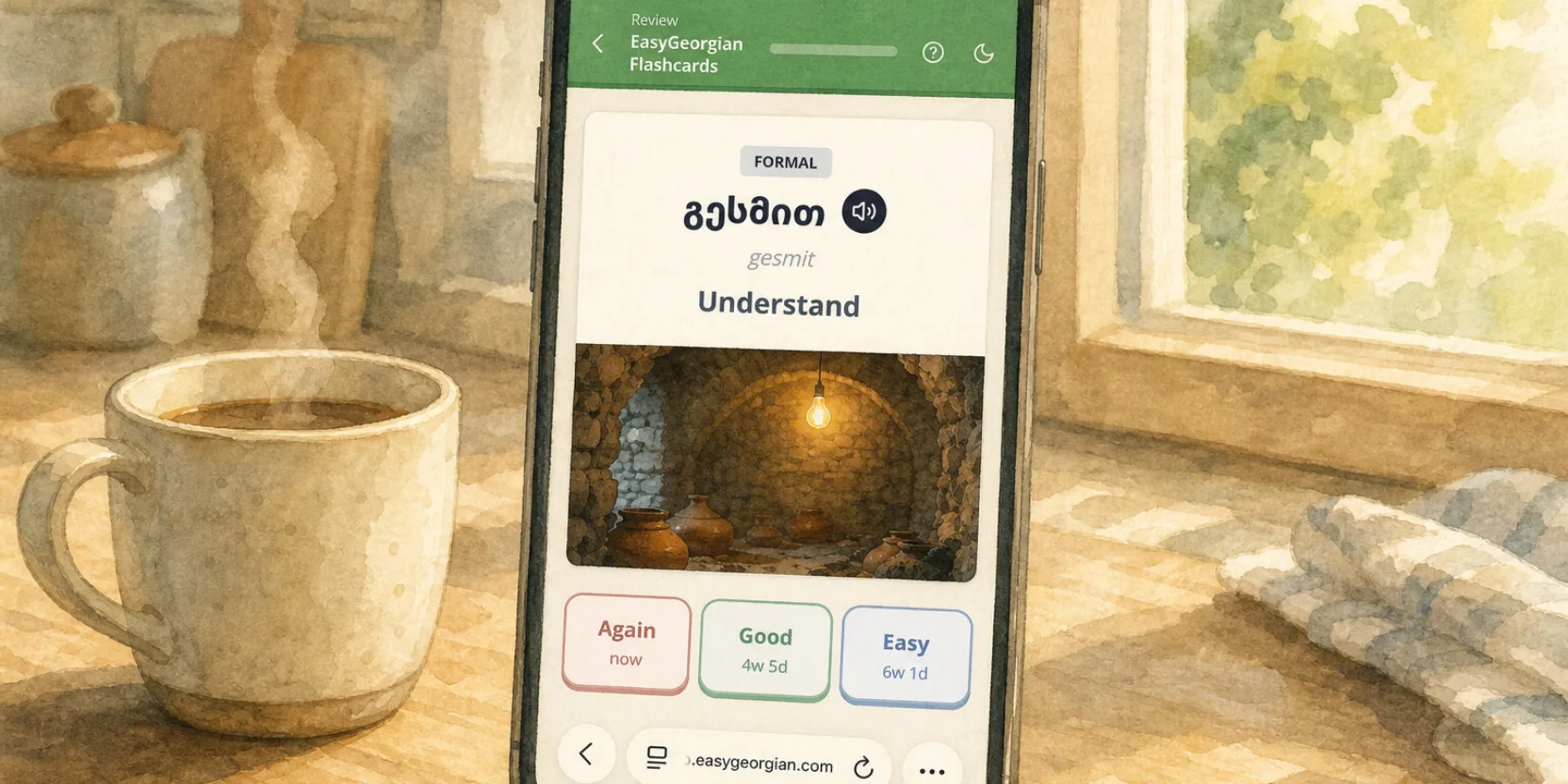
It is a platform dedicated entirely to Georgian: a structured audio course (Speak Georgian in 50 Days) where native-speaker dialogues and prompted speaking do the immersion work, a 100-episode comprehensible-input podcast course for the volume-listening phase that follows, and 9,000+ flashcards with audio and images on every card. The learning is acquisition-shaped from the first minute: real sentences, real voices, patterns before rules.
It is also not the only option, and honest shopping beats brand loyalty in a market this small. The full field, with the strengths and the gaps of each tool, is in the roundup of the best apps to learn Georgian.
A note on the lookalike products
While searching, you may have run into products with immersion in the name, most commonly Instant Immersion Georgian. To be clear about what that is: a budget software line that ships basic word-and-phrase content for dozens of languages, with no affiliation to Rosetta Stone. For Georgian it is a vocabulary tool, not a course, and it will not take you to conversations any more than a phrasebook will. As with the mysterious download links that circulate for other brand names, the rule of thumb holds: if a famous platform does not list Georgian in its catalog, a product wearing a similar coat is not the missing course.
The plan that replaces the box
Strip away the brand question and what a Georgian beginner needs is a sequence, not a logo.
- The alphabet, in one afternoon. Rough recognition, not perfection. It unlocks everything else.
- A daily structured audio lesson for the first two months. Native voices, prompted speaking, full attention. This is the immersion phase that actually builds a speaker.
- Volume listening from month two or three. Podcast-style comprehensible input, where the language starts arriving on its own.
- Real conversations early and often. Georgians reward every attempt warmly, and the reward is addictive in the best way.
The complete version of that plan, with the reasoning and the traps, is in how to learn Georgian.
So, the final answer to the search you came in with: no Rosetta Stone for Georgian, no big-platform cavalry coming, and genuinely good news anyway. The immersion instinct that brought you here was the right one. The tools that deliver it for Georgian just were not built by the company you expected, and the first lesson costs nothing to try.