



Most people deciding where to live in Tbilisi are choosing between four or five names they have already seen in a dozen articles. Vake. Vera. Sololaki. Saburtalo. The names are right. What is usually wrong is the picture attached to them, because a lot of Tbilisi neighborhood guides still quote rent from before 2023, and the city has moved hard since. Rent in the central districts has roughly doubled in dollar terms since 2022. A guide with old numbers sends you apartment-hunting with the wrong budget.
Here is what each Tbilisi neighborhood actually is in 2026, what it costs, and how to pick. I have lived here since 2021, in more than one part of the city, so this is the version I would give a friend planning the move.
How Tbilisi is laid out
Tbilisi sits in a river valley. The Mtkvari runs through the middle, the city climbs the hills on both sides, and almost everything an expat cares about is on a fairly compact stretch of the western and central side.
The historic center is around Freedom Square: the old town, Sololaki, and across the river Avlabari. Rustaveli Avenue runs northwest from Freedom Square as the city’s main spine. Vera sits just off Rustaveli, Vake continues west of Vera, and Saburtalo spreads northwest beyond that. The big outer districts, mostly Soviet-era apartment blocks, ring the city further out: Gldani and Didi Dighomi to the north and northwest, Isani, Samgori, and Varketili to the east.
One practical fact shapes a lot of decisions: the metro. Tbilisi has two lines, and they run from Saburtalo through the center and out to the eastern districts. The metro does not reach Vake. That single gap explains part of why Vake leans toward people who can absorb the cost of taxis, and why Saburtalo appeals to anyone who wants to commute without one.
Vake: the upscale default
Vake is the neighborhood most expats picture when they picture living well in Tbilisi. It is leafy, calm, and prestigious, built around Vake Park, with the embassy district nearby, wide tree-lined streets, and the highest concentration of international residents in the city.
The day-to-day in Vake is easy. Good cafes, international and Georgian restaurants, gyms, salons, well-stocked supermarkets, and a general sense of order. The streets are quiet and well-lit at night. If you want a version of Tbilisi that feels like a comfortable, green European city district, Vake is it.
The trade-offs are two. First, price. Vake is the most expensive part of the city to rent in. Second, the metro does not come here, so you will rely on walking, buses, scooters, and Bolt or Yandex rides. Neither is a dealbreaker, but both are real, and they push Vake toward the people whose budget has room for them.
Vake is also the easy answer for families. The parks, the calm residential streets, several of the international schools, and the general orderliness all line up for anyone arriving with children. It is the neighborhood where the fewest things will feel like friction, which is part of what you are paying the premium for.
Vera: central, walkable, creative
Vera is tucked between Rustaveli Avenue and Vake, and it has become the neighborhood I most often point people toward when they want to be in the middle of things.
It is the unofficial digital-nomad and creative hub. The streets around Vera are full of coworking spots, third-wave cafes, wine bars, small bakeries, and bookshops. It is genuinely walkable: you can be on Rustaveli in five to ten minutes, in Vake in fifteen, and the Rustaveli metro station is close. Vera has more old-Tbilisi texture than Vake and more central energy, without the full tourist density of the old town.
Vera suits a specific person well. If you work remotely, do not want a car, and want cafes and a social scene a short walk from your door, it is hard to beat. The trade-off is that Vera is small and central, so quiet is not its strength, and the best apartments get taken fast.
Sololaki and the old town: character over comfort
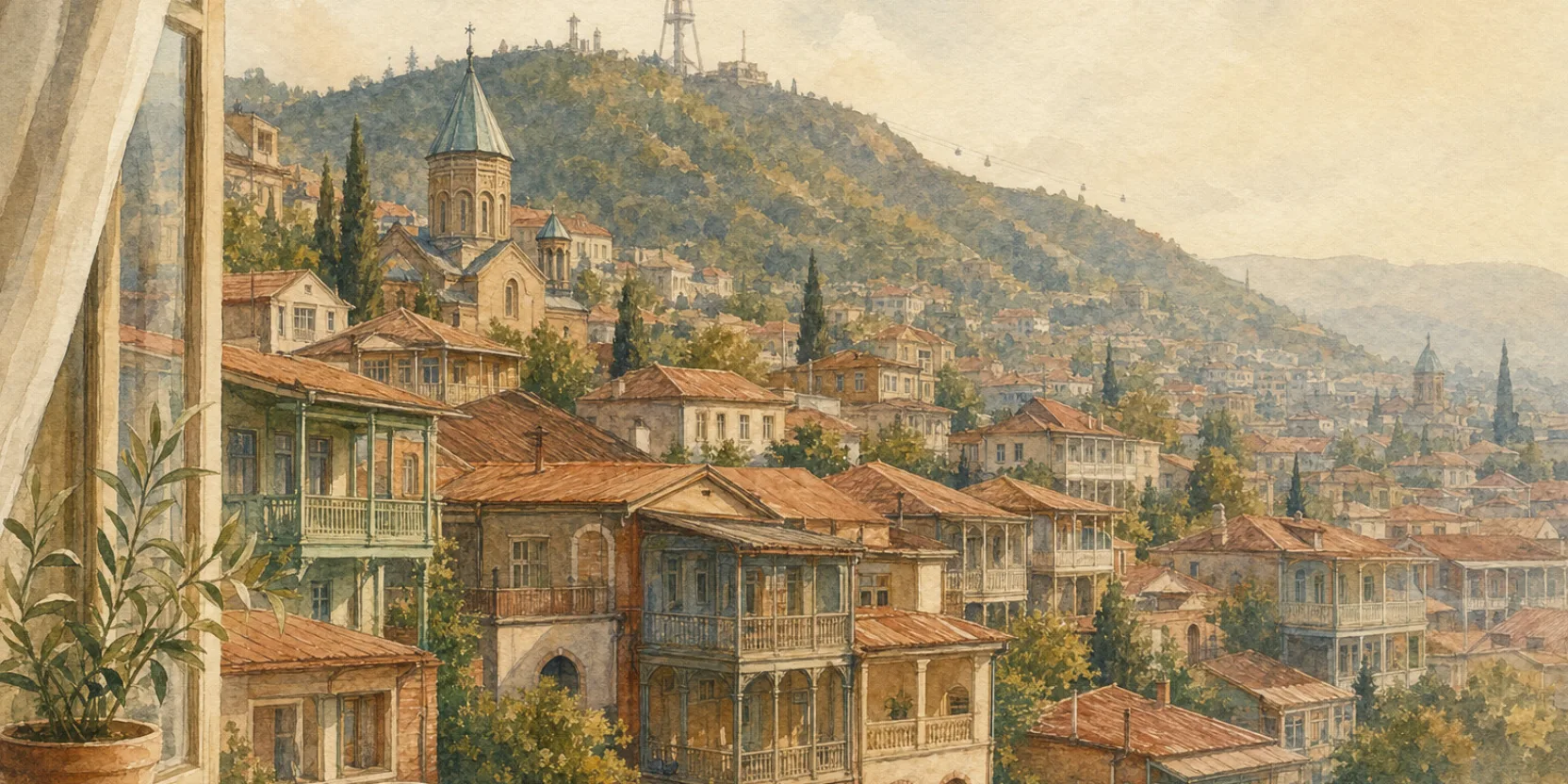
Sololaki is the oldest properly-planned neighborhood in Tbilisi, a grid of streets stretching west and up from Freedom Square toward Mtatsminda. It is the postcard version of the city: ornate nineteenth-century facades, carved wooden balconies, painted entrance halls, courtyards with grapevines.
Living in Sololaki or the surrounding old town means living inside that character, and for a lot of people that is the entire appeal. It is central, walkable, and full of the restaurants and bars that have moved into the old buildings over the last decade.
The honest caveat is the buildings themselves. Many are over a century old. That can mean beautiful high-ceilinged rooms, and it can also mean poor natural light, temperamental plumbing, thin walls, uneven heating, and stairs instead of an elevator. Two apartments on the same Sololaki street can be wildly different. The neighborhood rewards people who will go and look in person and accept some quirks for the character. It frustrates people who want everything to simply work.
Saburtalo: modern, connected, cheaper
Saburtalo is the second most popular district for long-term expats, and it is the value choice. It spreads across the northwest of the city: newer buildings, wider streets, shopping malls, universities, clinics, and a metro line running through it.
What you get in Saburtalo is convenience and modern apartments at a lower price than the center. Everything you need to live comfortably is there, the buildings are generally newer and more reliable than the old-town stock, and the metro means you can reach the center without a car or a taxi habit.
What you give up is character and centrality. Saburtalo is more standard-apartment-block than carved-balcony, and it is further from Freedom Square, so a night out in the old town is a metro ride rather than a walk. Plenty of long-term residents consider that a fair trade, especially families and anyone who would rather put the rent difference somewhere else.
It is also the most practical place to land first. Apartments in Saburtalo are easier to find, more predictable when you get there, and cheaper to get wrong, so a lot of people take a place here for the first six months while they learn the city, then decide whether the move to a pricier central district is worth it. That is a sensible way to arrive.
Mtatsminda and the rest of the center
Above Sololaki, the streets climb the hillside toward Mtatsminda, the mountain with the funicular and the park at the top. The residential streets on the way up are quieter than the old town below, with some of the best views in the city and a calmer feel, though the climb home is real and worth testing before you sign.
The rest of the broad center, places like Mtatsminda’s lower slopes, the area around Marjanishvili and Aghmashenebeli Avenue on the other side of the river, and pockets of Chughureti, are all liveable and increasingly renovated. Aghmashenebeli in particular has a restored pedestrian stretch with a strong cafe and restaurant scene. These areas trade a little of Vake’s polish for lower prices and a more mixed, local feel.
The budget districts further out
Beyond the center are the large districts where most Tbilisians actually live: Gldani, Didi Dighomi, Isani, Samgori, Varketili, and the outer parts of Didube. These are mostly Soviet-era apartment blocks, and they are where rent drops the most.
For an expat, these districts are a real option if budget is the priority and you do not need to be central. They are ordinary residential Tbilisi: markets, bakeries, schools, metro stations on the eastern and northern lines, far fewer foreigners, and far more day-to-day Georgian life. The outer parts of Isani and Didube are the most reachable, sitting closer to the center than Gldani or Varketili.
The trade-off is straightforward. You are further out, the buildings are plainer, and you will hear and use more Georgian, which depending on your goals is either the cost or the entire point.
What rent actually costs in 2026
Rent is the number that decides most of this, and it is the number guides get most wrong. Here are the 2026 ranges for a furnished one-bedroom.
| Neighborhood | One-bedroom rent (2026) | In one phrase |
|---|---|---|
| Vake | $700-$1,200+ | Upscale, leafy, priciest, no metro |
| Vera | $700-$1,200 | Central, walkable, creative hub |
| Sololaki / old town | $700-$1,200 | Historic character, variable buildings |
| Mtatsminda slopes | $700-$1,200 | Quiet, views, a climb home |
| Saburtalo | $400-$600 | Modern, metro, better value |
| Outer districts | $400-$600 | Plain blocks, cheapest, local life |
A few things the ranges do not show. “Furnished” in Tbilisi usually means fully turnkey, down to kitchenware and sometimes bedding. Renovated apartments with balconies and a Mtatsminda view sit at the top of each range or above it. Monthly Airbnb-style rentals run well above a real one-year lease for the same apartment, so anyone staying should sign a proper contract early. And these are 2026 numbers in a market that has been moving, so treat them as current ranges, not fixed figures. For the full monthly picture beyond rent, our cost of living in Tbilisi breakdown covers food, transport, and bills.
Getting around is cheap wherever you land. A Bolt or Yandex ride across town is roughly 8 to 15 GEL, the metro is about twenty cents a ride, and most expats never buy a car.
Finding an apartment
The neighborhood is only half the decision. The search itself has a few patterns worth knowing.
Most listings live in two places: the Georgian property sites, and the expat housing groups on Facebook. The property sites carry the larger inventory at closer to local-market prices. The Facebook groups are in English, move fast, and skew slightly higher and more furnished-for-foreigners. Many people use both. Local rental agents are common too, and an agent can be worth it for the access and the language help, though you should ask about the finder’s fee up front so it does not surprise you later.
Whatever a listing says, view it in person before you commit. Photographs in Tbilisi are generous, and two apartments in the same building can be very different. A short list to check on the viewing:
- Appliances. Test everything that should work: the stove and oven, the fridge, the washing machine, the water heater. Getting a broken appliance fixed or replaced after you move in usually means a slow back-and-forth with the landlord, so confirm it all runs while you are still deciding.
- Air conditioning. Tbilisi winters are cold, and most apartments are heated by their AC units rather than by a central system. Check there is a unit, that it heats as well as cools, and ideally that there is one in every room rather than a single unit meant to do the whole flat.
- Light and noise. Old-town apartments can be darker than the photos suggest, and a street-facing room in a central area can be loud. Both are easier to judge with your own eyes and ears.
- The building. The entrance, the stairwell, whether there is a working elevator if you are above the third floor. An apartment can be renovated inside while the building around it is not.
The standard lease in Tbilisi is twelve months. Renting month to month is not really an option here unless you are in an Airbnb-style short let, so expect a one-year contract. You will usually pay the first and last month upfront, and a separate security deposit is uncommon, since that last month effectively stands in for one. If you will need the address for residency paperwork, raise that with the landlord early, because not every landlord is set up for it.
How to choose, and the thing nobody tells you
Stripped down, the choice is simple. Want upscale and green, and the budget is there? Vake. Want central, walkable, and social, with no car? Vera. Want old-Tbilisi character and will accept an old building’s quirks? Sololaki. Want modern, connected, and cheaper? Saburtalo. Want the lowest rent and do not mind being out? The eastern and northern districts.
Two things narrow it further. If you have children, Vake and Saburtalo pull ahead, Vake for the schools, parks, and calm, Saburtalo for space and value, and both for being gentler than the old town. If you are single and here to work and socialize, Vera and Sololaki put you in the middle of the scene. Couples without children can reasonably pick on atmosphere alone, because none of the central neighborhoods is a wrong choice, only a different one. And if you are not sure, take a shorter lease in Saburtalo first and move once you know the city, rather than guessing at a year in the most expensive district.
Here is the thing the neighborhood guides leave out. Vake, Vera, and the central tourist-facing streets are the neighborhoods where you can run an entire life in English. Cafes, coworking, delivery apps, English-speaking landlords and agents. That ease is genuinely convenient, and it is also a quiet trap. The neighborhoods that are easiest to land in are the ones where you will hear the least Georgian and have the least daily reason to learn it.
Even a little Georgian changes which city you actually live in. It changes the relationship with the bakery, the building’s older residents, the marshrutka driver, and it changes everything once you travel outside Tbilisi, where English thins out fast. You can read more on what language Georgians speak and why Russian is no longer the shortcut some expats expect. If you are settling here for any real length of time, learning some of the language is one of the highest-return things you can do with your first months, and our guide on how to learn Georgian is where to start. We built EasyGeorgian for exactly this person: someone who has just picked a neighborhood and wants the city to open up beyond it.
Pick the neighborhood that fits your budget and your life. Then make sure the version of Tbilisi you live in is the bigger one.