


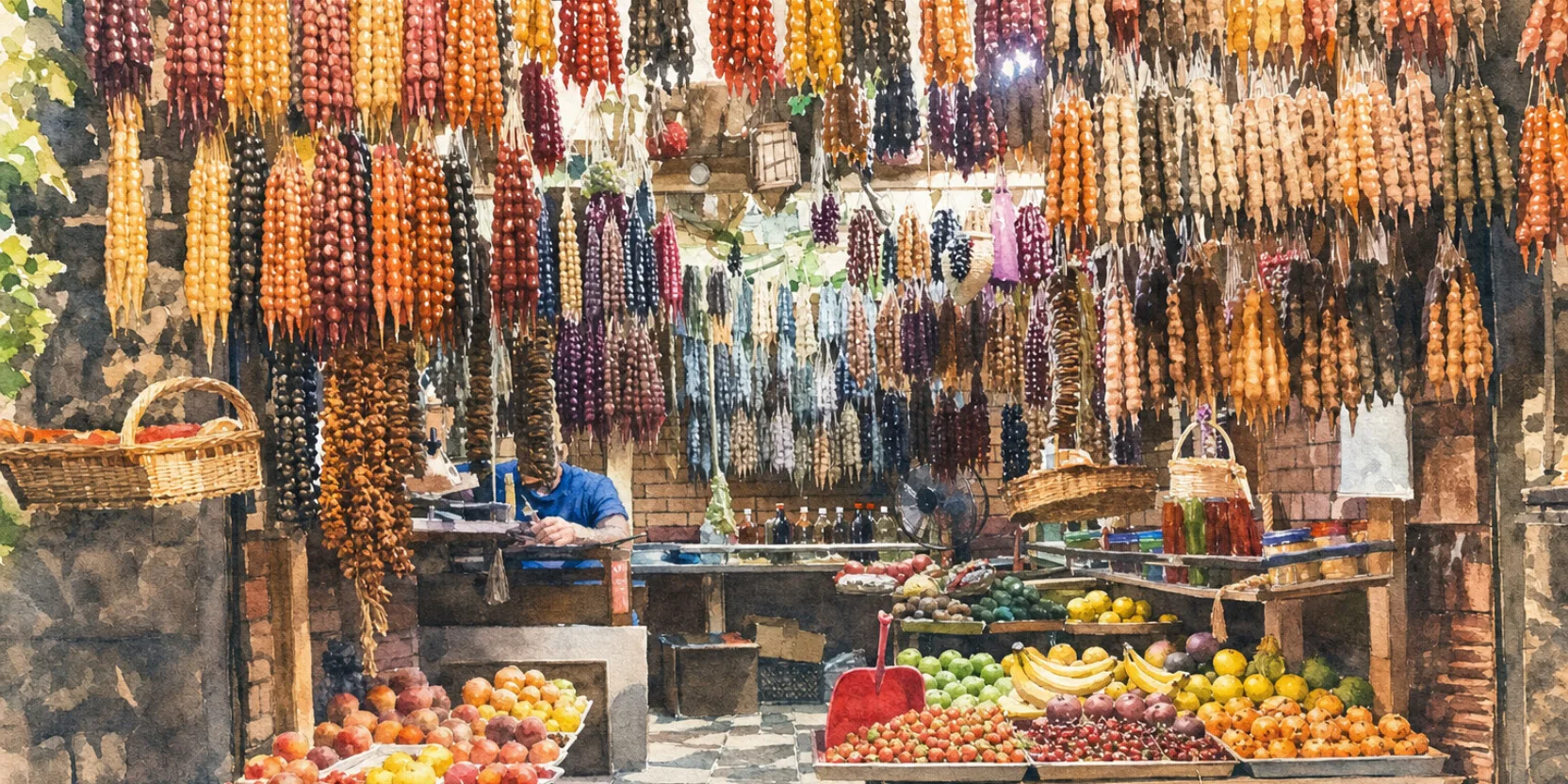

The first time you see churchkhela, you will probably not guess it is food. Strings of knobby wax candles in burgundy, amber, and purple, hanging in rows over market stalls and roadside tables all over Georgia. Everyone stops at that wall of color eventually and asks what they are looking at.
The answer is Georgia’s national sweet: walnuts on a string, dipped in thickened grape juice, dried in the sun. Here is what churchkhela actually is, what it tastes like, how it is made, and how to buy a good one.
What churchkhela actually is
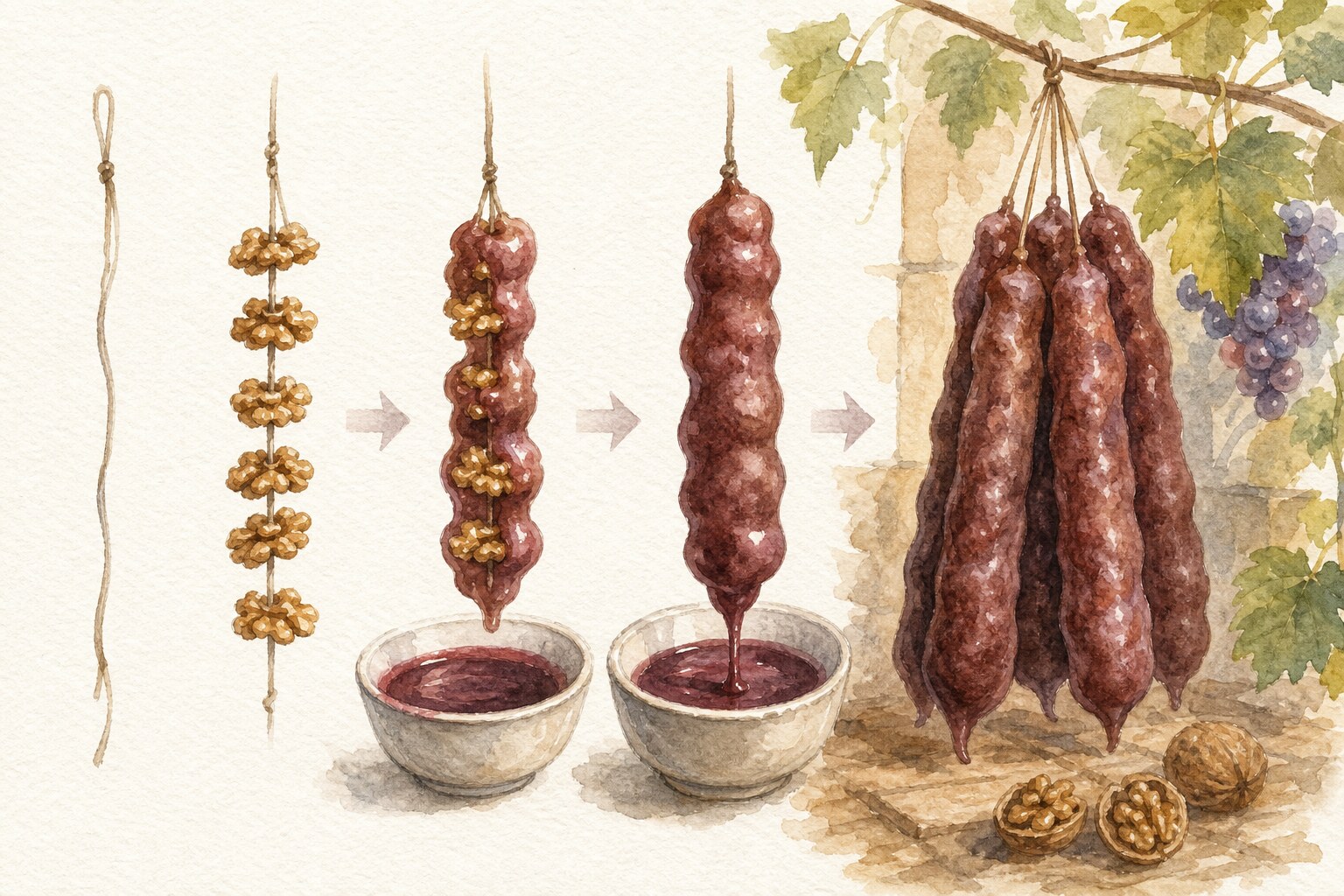
Churchkhela is a traditional Georgian candy made by threading walnut halves onto a string, dipping the string over and over in grape must thickened with flour, and hanging it up to dry. Each dip adds a layer, the way candles used to be made, and the finished shape shows it: a lumpy candle with walnuts where the wick should be.
It sits alongside khachapuri and khinkali as one of the first things people learn to recognize in Georgian food. Travel writers like to call it the Georgian Snickers: nuts in a chewy casing, a dense block of calories you can put in a pocket. The nickname is useful and it undersells the thing at the same time. Churchkhela has no chocolate and far less sugar than a candy bar. It also has a much longer history.
The standard story is that Georgian warriors carried churchkhela on campaign, because it satisfies hunger and keeps for months without any special storage. Whether or not the history is that tidy, that is still what churchkhela is built for.
What does churchkhela taste like?
Like grape, concentrated. The coating is chewy and faintly tart, with a tannic, wine-adjacent depth that changes with the grape underneath. White-grape churchkhela dries to amber and tastes lighter. Red-grape versions turn deep burgundy and taste darker and rounder. Then you hit the walnut, and the slight bitterness against the sweet coat is the whole point of the pairing.
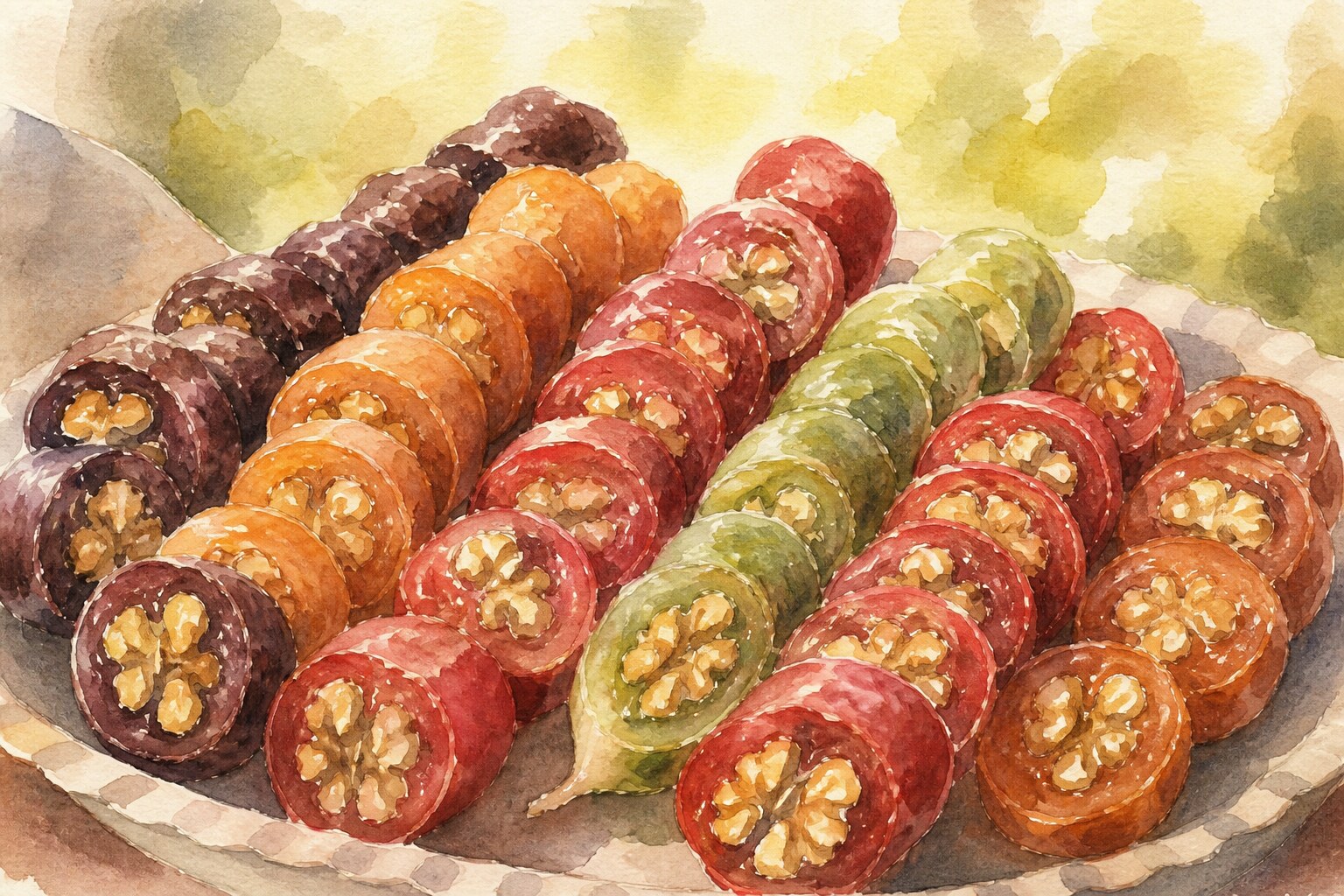
The first surprise for most people is that churchkhela is not very sweet. Traditionally nothing is added beyond the grape juice itself, so it lands closer to dried fruit than to candy. If you are expecting something in candy-bar territory, recalibrate before the first bite.
The second surprise is the range. Mulberry versions, hazelnut versions, and a modern rainbow of other fruit juices hang next to the classic grape ones at any big stall, which is why a market wall runs from near-black through red and purple to amber and beyond.
How churchkhela is made
Everything starts with the grape harvest. Churchkhela is made in September and October, right after rtveli, when the presses have run and fresh must is everywhere. It comes out of the same harvest that makes Georgian wine: juice for the qvevri, and a share of it boiled down for candy.
The base is badagi, grape must simmered in a cauldron until it concentrates. Wheat flour goes in, the mixture thickens into what eastern Georgians call tatara, and the dipping starts. Walnut halves have already been threaded onto strings.
Each string goes into the pot, comes out wearing a coat, dries, and goes back in. Two or three dips is typical. Then the strings hang in the sun for several days until the coating sets.
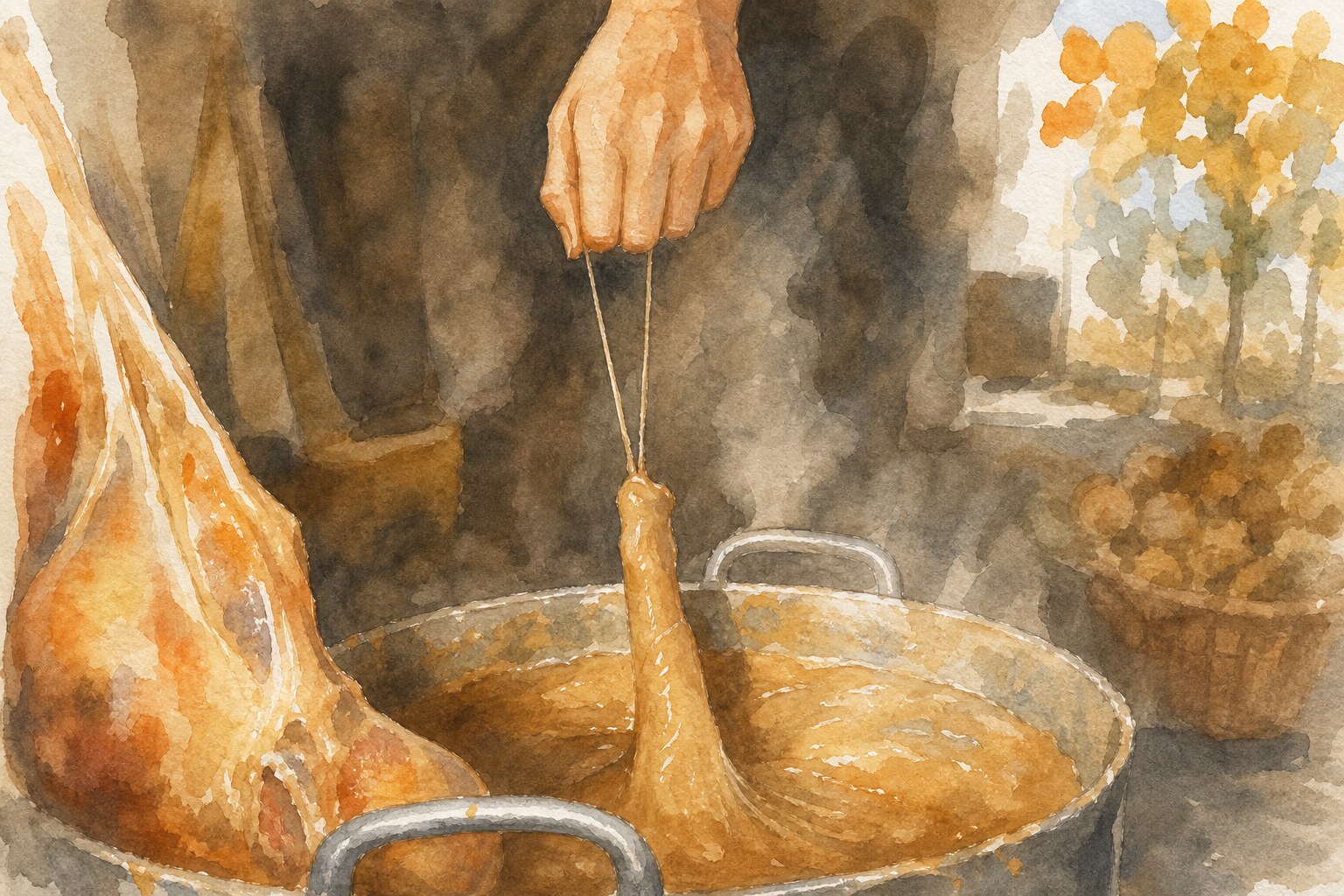
That is the Kakhetian version, the classic one with walnut halves and wheat flour. Western Georgia does it differently: corn flour instead of wheat, often hazelnuts instead of walnuts, and in places a different name, janjukha. The western corn-flour base is the same thing as pelamushi, the soft purple grape pudding you will run into at traditional restaurants.
Traditionally the finished strings are not eaten right away. Made in autumn, they are wrapped and kept, and by December the coating has firmed up, the sugars have begun to crystallize, and the churchkhela is ready for the holidays.
How to say churchkhela
In Georgian it is written ჩურჩხელა. The romanization, churchkhela, looks worse than it is, but it does contain the consonant cluster that trips everyone: chkh.
Break the word into syllables and it behaves: chur, chkhe, la. The ch is the one from church. Georgian also has a tighter, ejective ch letter (ჭ, written ch’ in romanization), but churchkhela does not use it, so there is nothing exotic to fight here.
The kh is the raspy sound from Scottish loch. In the middle syllable ch and kh sit back to back, with no vowel between them, and that is the whole trick. Say them separately, then speed up. Both are single letters in the Georgian alphabet, which is phonetic, so once you can read the script, every word tells you how to say itself.
Georgians are generous with anyone trying. Ask for churchkhela at a stall with even a passable chkh and you will usually be met with delight. If you would rather get sounds like these into your ear than off a page, the EasyGeorgian audio course (Speak Georgian in 50 Days) works exactly that way: you hear native speakers and get prompted to say things back, from the first lesson.
How to eat it, and how to spot a good one
There is a string in the middle, and it is not meant to be eaten. The usual move is to slice the churchkhela into rounds, which frees the thread and shows off the walnut cross-section. The other usual move is to bite pieces off and pull the thread out as you go, which works fine and looks less elegant.
Georgians treat churchkhela as a snack more than a dessert: a round or two with strong black tea in the afternoon. At a feast it shows up at the very end, next to fresh fruit, as the sweet close of a Georgian supra food spread.
At the stall, a few things are worth knowing. A white, dusty bloom on the surface is crystallized sugar working its way out as the churchkhela ages. Not mold, and not a defect, just the sign of a properly matured string. A good one feels firm but bends a little instead of cracking. A high-gloss shine usually means it is either very fresh or has been dipped in syrup to look prettier.
Where to buy churchkhela in Tbilisi
The short answer is everywhere. Supermarkets carry plastic-wrapped versions, souvenir shops in the old town sell them at a markup, and every produce market in the country has at least one stall draped in them.
The classic Tbilisi experience is the Dezerter Bazaar near the train station, where whole stall fronts disappear behind hanging curtains of churchkhela in every color. Expect to pay a few lari per string at a market, roughly 2 to 6 GEL depending on size and nut, and 2 or 3 times that in the tourist shops.
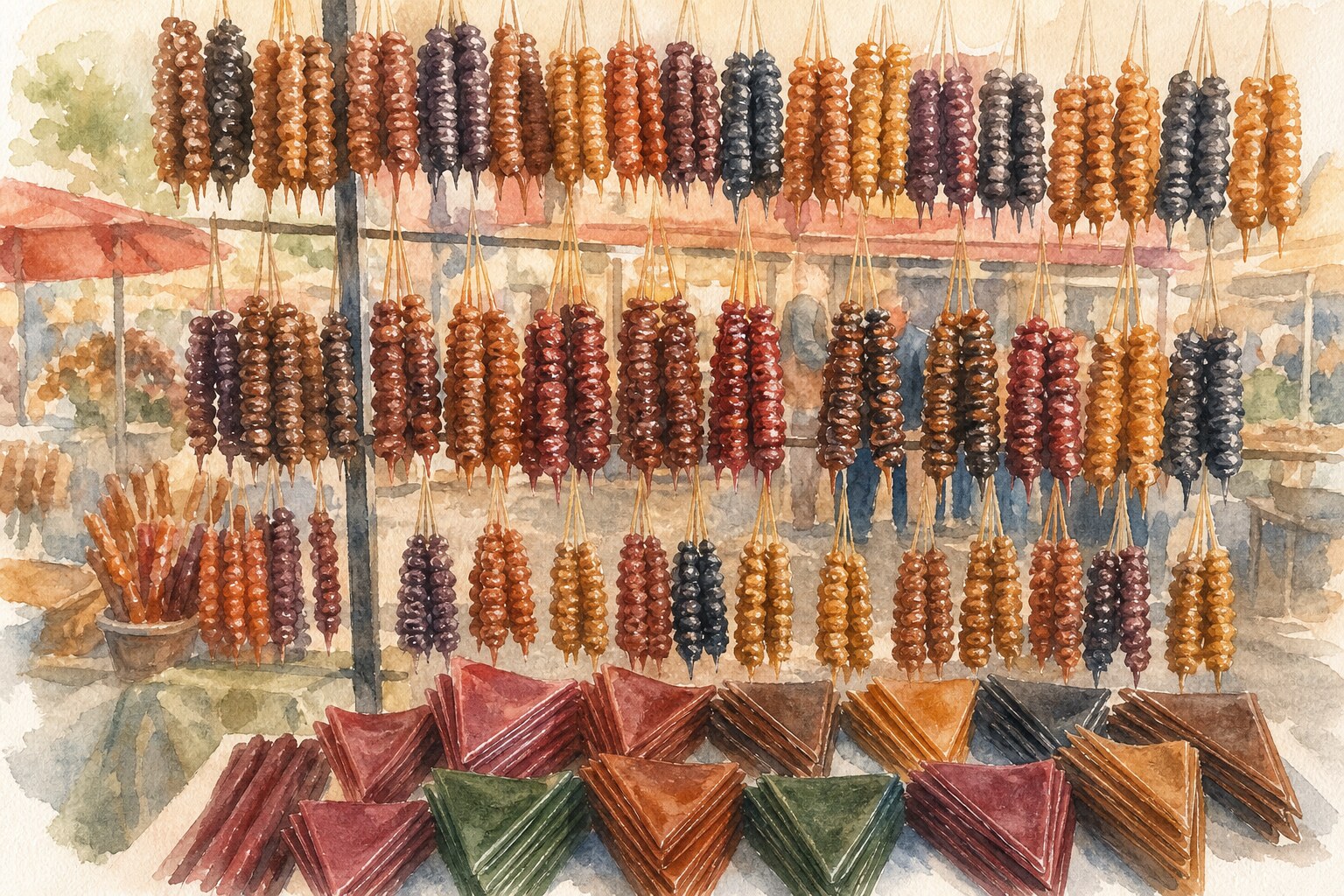
Outside the capital it gets better. Drive through Kakheti in the harvest weeks and the roadside tables sag with fresh strings of it. That is where I would go looking.
Churchkhela at New Year
Churchkhela is seasonal at its core. It is made when the grapes come in and it is built to last until winter, which is why it belongs on the New Year table. Across the long run of Georgian holidays from New Year’s Eve to Orthodox Christmas on January 7, churchkhela sits out alongside fruit, gozinaki, and the rest of the sweet table.
If you are in Georgia in December, watch the markets change. The strings made in October have darkened and grown their white bloom by then, and that, Georgians will tell you, is when they are exactly right.
The neighbors make it too
Georgia is not the only place that strings nuts and dips them in grape must. Turkey has cevizli sucuk. Armenia has sharots, also called sujukh. Cyprus has soutzoukos. Across the grape-growing belt from the Caucasus to the Aegean, people worked out long ago that walnuts plus concentrated grape juice equals portable winter food.
What makes churchkhela specifically Georgian is how tightly it is bound into the wine culture. It is a child of the harvest, made by winemaking families from the must they have just pressed, and the traditional Kakhetian technique is inscribed on Georgia’s national Intangible Cultural Heritage register. Ask anyone from any of those countries whose sweet it really is and you will get a confident answer. I live in Georgia, so you can guess mine.