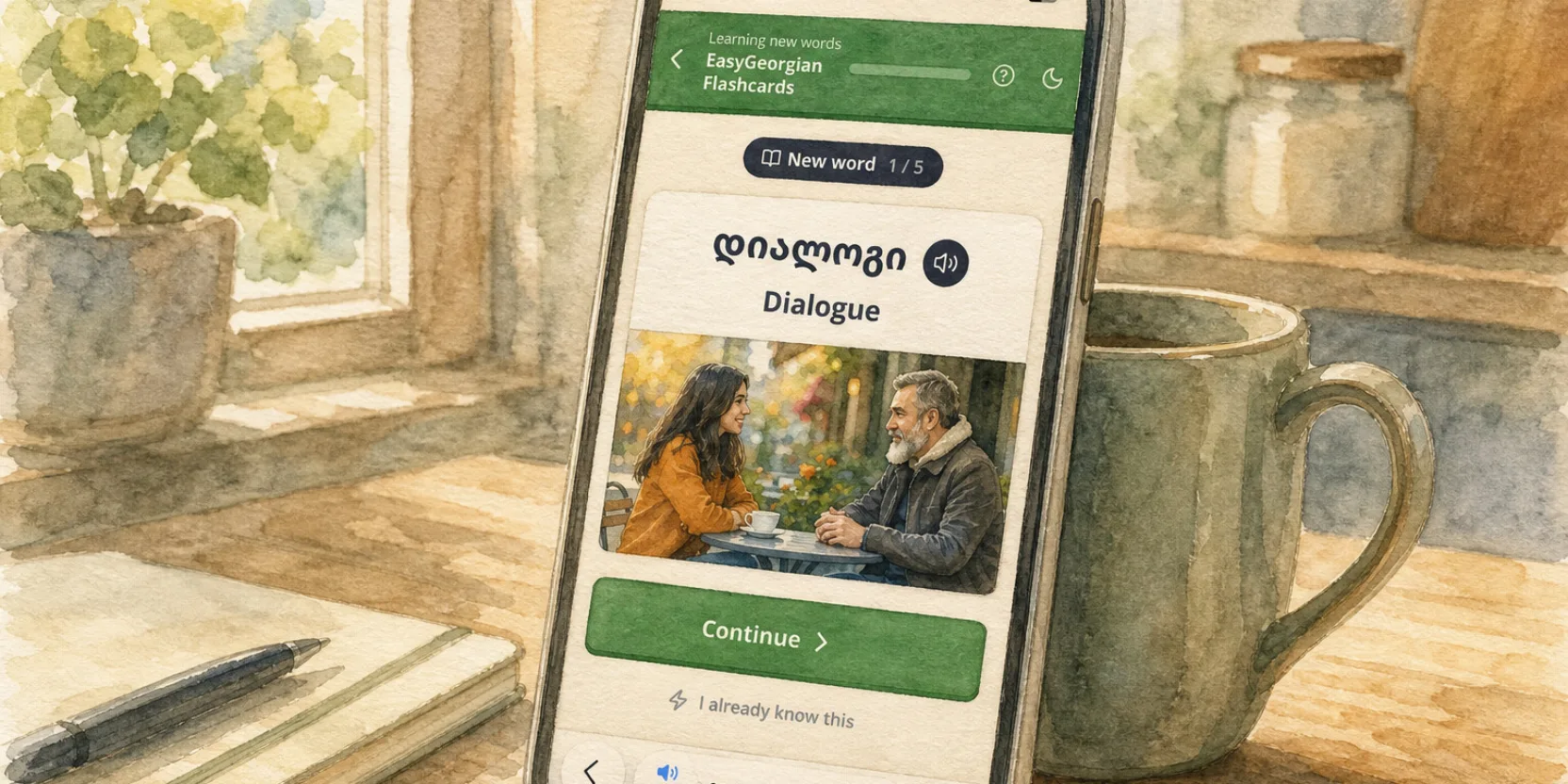

Nobody learns Georgian by accident. It is not on the apps, it is not a school requirement, and it will not pad a resume the way Spanish or Mandarin might. Every person who learns it chose to, for a reason that mattered to them. So the real question is not whether Georgian is useful in the abstract. It is whether one of these reasons is yours. If it is, our Georgian course is where I would start.
To actually live in Georgia, not float above it
This is the big one, and it is the reason I started. You can live in Tbilisi for years on English alone. Plenty of people do. The younger generation often speaks it, the menus have translations, the delivery apps work in English.
But there is a difference between getting by in a place and living in it. Without the language you are always slightly outside, dealing with the surface of things, missing the jokes, dependent on whoever happens to speak English. With even basic Georgian, the whole texture changes. The fruit seller remembers you. The taxi driver tells you about his village. The neighbor who only nods starts talking. Georgia is a country where effort with the language is met with disproportionate warmth, and that warmth is most of the reason people fall for the place.
I spent my first three years here barely speaking it, and the year I actually started learning was the year Georgia stopped feeling like somewhere I was staying and started feeling like home.
To connect with family
A huge share of Georgian learners are there because they love a Georgian. A partner, a spouse, and behind them a family that gathers around long tables and speaks fast, warm Georgian late into the night.
You can smile through a supra in English translation for a while. But the grandmother who does not speak a word of English, the uncle telling the story everyone is laughing at, the toast being made in your honor, these live entirely in Georgian. Learning the language is how you stop being the guest at the table and start being part of the family. For a lot of people that single reason is worth the whole effort.
To read a very old, very deep culture from the inside
Georgia has one of the oldest continuous literary traditions in the world, with texts going back to the 5th century in its own unique alphabet. It has a poetry tradition, a polyphonic singing tradition older than most nations, and a wine culture that is literally the oldest on earth, eight thousand years deep.
All of that has an English-language surface you can admire as a tourist. Underneath it is a Georgian-language world you can only enter through the language. For the kind of person who wants to understand a culture rather than visit it, that doorway is the reason.
Because the language itself is a rare world
Some people learn Georgian for the same reason others climb specific mountains. It is there, it is unusual, and almost nobody does it.
Georgian belongs to its own small language family, the Kartvelian family, unrelated to Russian, Turkish, or anything Indo-European. It has its own alphabet, used by essentially no other language. Its grammar does things English does not have words for. For a language enthusiast, that is not a downside. It is the entire draw. You are learning a self-contained world, not a variation on something you already half-know.
The honest case against, and who should skip it
I am not going to pretend it is for everyone. If you want a language that unlocks dozens of countries, learn a big one. If your goal is the maximum number of new conversations per hour of study, Georgian is a poor trade, four million speakers concentrated in one country. If you are only passing through Georgia for a two-week trip, a handful of phrases for travelers will serve you better than a real attempt at the language.
Georgian is a depth language, not a breadth one. It pays out enormously in one place and one culture, and almost nowhere else. If your reasons are tied to that place and that culture, it is one of the most rewarding things you can learn. If they are not, be honest with yourself and pick a different one.
If one of these is yours
The learners who succeed with Georgian are the ones with a concrete reason they actually feel, a home, a family, a genuine pull toward the culture. The ones who quit usually started on a vague someday.
So if a reason here landed, that is the thing to hold onto when the practice gets dull, which it will, the way all language practice does. The method matters too, and learning it by ear rather than by grammar chart is what makes it stick, which why audio-first works gets into. But the reason comes first. The first audio lesson is free, and the fastest way to find out if Georgian is for you is to spend twenty minutes actually speaking it.