





Your first real conversation in Georgian will probably not happen in a classroom. It will happen on a bus, in a shop, or at a table where someone has just noticed your accent. The good news is that a basic Georgian conversation with a stranger follows a script. The same dozen phrases come up almost every time, in almost the same order.
Learn those dozen, say them out loud until they come without thinking, and you can have that first exchange in Georgian instead of switching to English after one word. Every phrase below comes from the flashcard deck of our audio course, with the same native speaker’s recording you hear in the lessons.
The conversation you will actually have
Here is a typical first exchange between you and a Georgian you have just met. It runs on the polite form, because that is what you use with someone you do not know. Play each line, then say it back before you move on.
You, to get someone’s attention before you say anything else.
Both of you. The everyday hello, fine at any time of day and with anyone.
You. The most practical opening question there is, because the answer decides which language the rest of the conversation happens in.
Them, and more often once you leave the center of Tbilisi. This is the moment the conversation either ends or becomes Georgian.
You. Possibly the most valuable sentence in this post. It tells them your level, and it tells them you are trying.
Them. You will hear this after one sentence, whether or not it is true. Georgians are generous with learners, and the bar for this compliment is low.
You. Literally “big thanks”, the warm version of madloba.
Them. Where you are from is usually the next question, asked this way, as a guess.
You. K’i is yes, me var is I am. Swap in your own nationality once you know it in Georgian.
You. If you live here, say so. It changes how people talk to you, because you are no longer a tourist being polite.
Either of you, once names have been swapped.
Both of you. The goodbye that works with everyone.
That is the whole thing. Twelve lines, and a stranger on a bus has just had a conversation with you in Georgian. If you want more on the opening and the introductions, there are separate guides to how to say hello in Georgian and how to introduce yourself in Georgian.
The four phrases for when you get lost
You will get lost. Someone will answer tkven amerik’eli khart? with a story about their cousin in Chicago, at full speed, and you will catch the word Chicago. These four lines keep the conversation in Georgian instead of letting it collapse into English.
Put tu sheidzleba, please, after upro nela and it becomes a polite request. Say all four early and without apology. Georgians are patient with learners, and asking in Georgian is what keeps the conversation in Georgian.
Why every line ends the way it does
You may have noticed that several of the verbs above end in a t: lap’arak’obt, khart, gesmit. That t goes with tkven, the polite you. It is what you use with strangers, with anyone older than you, and with anyone in an official role. For many verbs the polite form simply adds the t, so khar becomes khart. For others the t replaces a final s, so gakvs, you have, becomes gakvt.
The informal shen is for friends and family. A Georgian who wants to switch will usually do it themselves, and when in doubt, staying polite is never the mistake. The full picture, including who gets which and when the switch happens, is in our post on formal and informal Georgian.
How to make the conversation stick
Reading these twelve lines is the easy part. The hard part, and the part that matters, is having them come out of your mouth when a real person is waiting for an answer.
That takes retrieval, not review. Cover the Georgian, look at the English, and say the Georgian out loud before you play the audio. Then play it and match the speaker’s rhythm. Do the whole conversation that way once a day for a week, and the lines start arriving on their own.
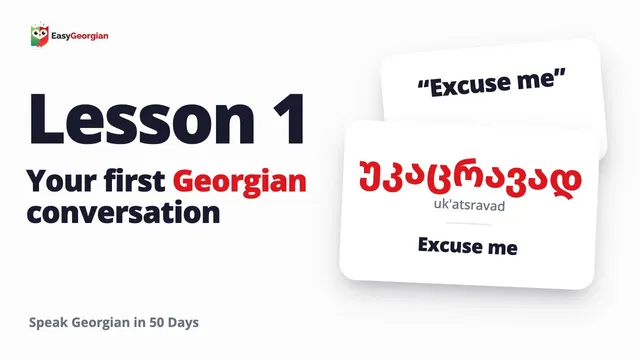
This is also exactly how our audio course works, and this conversation is no accident. Lesson 1 of Speak Georgian in 50 Days opens on a bus in Tbilisi with almost this exact exchange, which you cannot follow yet. Thirty minutes later you can take part in it, because the lesson has made you say every piece of it out loud, with a pause to answer before the native speaker does. The whole lesson is on our YouTube channel.
 30:42
From there the conversations get longer, one lesson at a time. But this one, the first one, is the one that changes how Georgia feels. After it, you are someone who speaks a little Georgian, and people treat you that way.