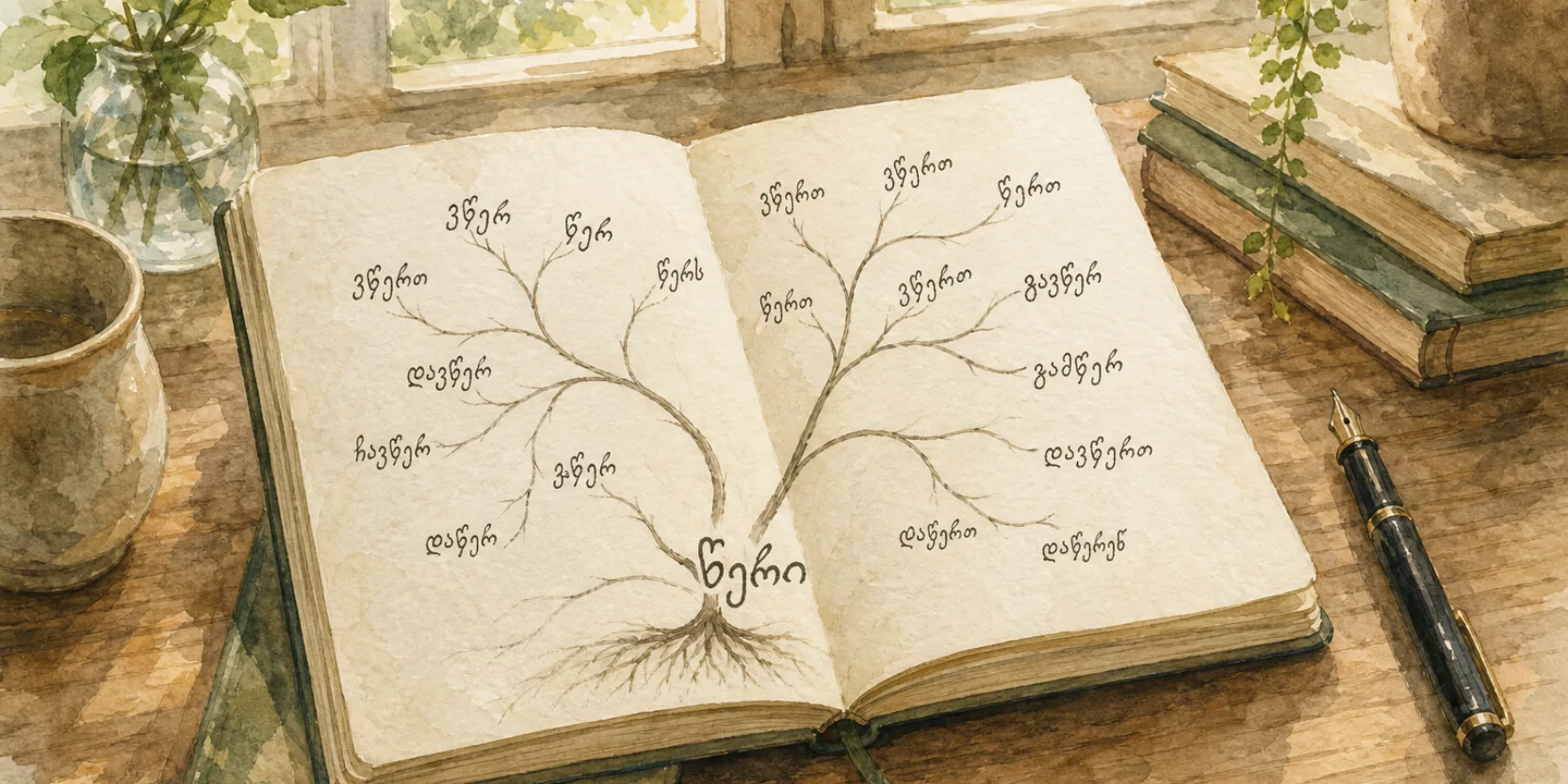




Verbs are where Georgian earns its reputation, and the reputation is fair. A Georgian verb can carry its subject, its object and its tense inside one word, and the grammar books respond with tables that run for pages. But the most common Georgian verbs are a much friendlier story. A small set of them does most of the work in everyday speech, and you can learn the forms that matter as phrases long before the tables mean anything.
We know which verbs those are because we counted. Our spoken frequency list ranks 10,000 Georgian words by how often they appear in the dialogue of 68 films and TV programs and in over 180,000 forum posts, two kinds of Georgian much closer to speech than the news and textbooks that word lists are usually built from. Here is what it says about verbs.
The 20 most common Georgian verbs
The list below is in order of frequency. Georgian dictionaries usually list a verb by a noun-like form, so most entries look like tkma, saying. A few common verbs are better known by the everyday form, minda, I want, and our list uses those.
| Rank | Verb | Say it | Meaning |
|---|---|---|---|
| 1 | ყოფნა | q’opna | to be |
| 2 | მაქვს | makvs | to have (a thing) |
| 3 | თქმა | tkma | to say, to tell |
| 4 | ვიცი | vitsi | to know |
| 5 | მინდა | minda | to want |
| 6 | შეძლება | shedzleba | to be possible |
| 7 | შემიძლია | shemidzlia | can, to be able |
| 8 | მოსვლა | mosvla | to come |
| 9 | გაკეთება | gak’eteba | to do, to make |
| 10 | ნახვა | nakhva | to see |
| 11 | მიღება | migheba | to receive, to get |
| 12 | წასვლა | ts’asvla | to go, to leave |
| 13 | ფიქრი | pikri | to think |
| 14 | მისვლა | misvla | to go (to a place) |
| 15 | მჭირდება | mch’irdeba | to need |
| 16 | კეთება | k’eteba | to do, to make (ongoing) |
| 17 | თხოვნა | tkhovna | to ask for, to request |
| 18 | გაგება | gageba | to understand, to find out |
| 19 | დაწყება | dats’q’eba | to start, to begin |
| 20 | კითხვა | k’itkhva | to read, to ask |
Those 20 verbs account for close to half of all the verb use in our film dialogue. The 40 most common account for well over half. That is the real shape of the job: a short list carries the bulk of what people say, and the long tail of the dictionary can wait.
What the list tells you
A few patterns jump out, and each one is a small lesson in how Georgian works.
To be comes first by a mile. As in most languages, q’opna is everywhere, mostly as aris, is. It also shrinks: in speech, aris often becomes a single -a stuck to the end of the previous word.
The everyday verbs are about transactions. Have, know, want, can, need. These are the verbs of a bakery counter and a phone call, which is a good argument for learning them first.
Direction is built into going. Coming, going to a place, going away and going out are four separate verbs here, all built on one root with a different prefix for the direction. Georgian cares a great deal about which way you are moving, and it says so at the front of the verb.
Some verbs come in pairs. Gak’eteba and k’eteba are the same “do”, once with the prefix that marks a finished or future action and once without it, for something ongoing. You will meet this pairing across the whole language.
Two of the top ten are hiding in words you already know. Tu sheidzleba, please, is literally “if it is possible”, built on shedzleba at number 6. And nakhvamdis, goodbye, is built on nakhva, to see, at number 10. It means something close to “until seeing”.
The verbs that work backwards
Nine of the 40 most common verbs share a habit that surprises every learner. In minda, I want, the person who wants is not treated as the one doing something. They are treated as the one receiving it. Minda is closer to “to me it is wanted” than to “I want”. The m- at the front means me.
Grammars call these indirect verbs, and the frequency list shows how central they are: makvs (have), minda (want), shemidzlia (can), mch’irdeba (need), mgonia (it seems to me), momts’ons (like), mq’avs (have, for people and animals), miq’vars (love) and makhsovs (remember) are all in the top 40. Mesmis, I understand, comes just after.
The useful consequence is a pattern you can hear. Swap the m- for a g-, and the verb is about you. Here are five pairs, each from the flashcard deck of our audio course with a native speaker’s recording.
Notice the polite forms also pick up a t at the end, the same t that goes with the polite tkven on almost every verb. The full explanation of these verbs runs deeper than this, and it is genuinely one of the harder parts of Georgian grammar. But the pattern above, m- for me and g- for you, gets a beginner through a very large number of real conversations.
Learn them as phrases, not tables
The worst way to learn these verbs is the one most textbooks start with: a full conjugation table, six persons across, several tenses down, memorized before you have said a single sentence. The table attaches to nothing, so it slides off.
The better way is to learn the forms you hear, inside phrases you can use today. Me minda, I want, plus whatever you want. Gakvt dro?, do you have time? Me ar mesmis, I don’t understand. Each one is a complete, correct piece of Georgian that you can say this afternoon, and each one carries the verb’s pattern into your ear without any effort on your part.
That is how our audio course handles verbs, and it is a deliberate choice. You say me minda and tkven gindat dozens of times in real sentences long before anyone shows you why they look the way they do. When the explanation does come, it names something you already know, and that moment, when a rule suddenly explains a hundred sentences you have been saying for weeks, is one of the best in learning Georgian.
When you want the full tables
Once the common forms are in your ear, the tables become useful rather than frightening. Our free Georgian verb conjugator has full tables for 147 common verbs, including most of the list above, with a reverse lookup that tells you what any form you meet actually is. Good starting points are unda (want), akvs (have) and aris (be).
For the wider picture of how the verb system fits together, the screeves and the prefixes and the famous ergative, our guide to Georgian verb conjugation is the next step. And if you want to see where these verbs sit among all the words Georgians use most, the research behind this list is in what Georgians actually say.