



Georgian learning resources used to be a short, sad list: a couple of textbooks, some user-made flashcard decks, and a teacher if you could find one. That has changed. There is now a resource worth using for almost every part of the job, and the problem has flipped from finding anything at all to knowing which tool does what.
So this is the map, sorted by job rather than by brand. One disclosure first: I built EasyGeorgian, so several of these are ours. I have tried to be exact about what each one does well and generous about the ones that are not ours. Judge the framing accordingly.
A structured course to start speaking
Every other resource on this list works better once you have a core of Georgian you can actually say. The tool that builds that core is a structured course, and for Georgian the strongest format is audio-first: you hear real conversations, build up the words a piece at a time, and answer out loud before the native speaker does.
That is what our audio course, Speak Georgian in 50 Days, does across 50 lessons of about half an hour each, for a one-off $79.95. The first lesson is free and needs no signup. It demands full attention, so it is a headphones-in-a-quiet-room habit, not background listening.
The free alternative is the Peace Corps beginner course, built for volunteers posted to Georgia and now in the public domain, with dialogues and recorded audio. Further along, Glossika’s sentence-repetition method has a real Georgian course for learners who already have a base. The full comparison is in our roundup of Georgian language courses, and the apps get their own post on the best apps to learn Georgian.
The alphabet
The Georgian alphabet is 33 letters, fully phonetic, with no capitals, and it is an afternoon’s work rather than a project. Three free ways in, all built on the same idea of learning letters inside words you already know:
- The alphabet tool on this site: ten short levels, real Tbilisi street signs, no signup. Start it here.
- The 56-minute alphabet video, free in the app for anyone who signs up.
- Our two-minute starter on YouTube, which teaches ten letters and has you read a real Tbilisi shop sign by the end.
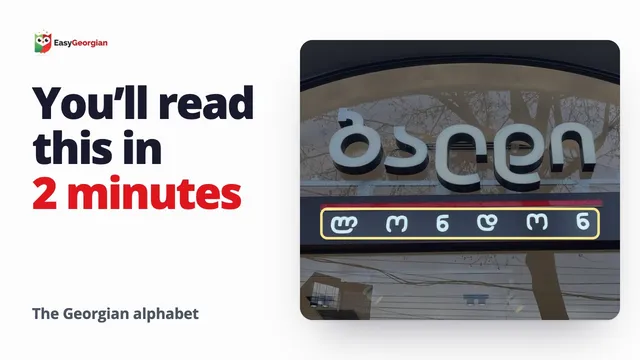 2:02
If you want the history and the three scripts, our Georgian alphabet guide has it.
Vocabulary
Georgian shares almost no vocabulary with English, so the order you learn words in matters more than usual. Start with frequency.
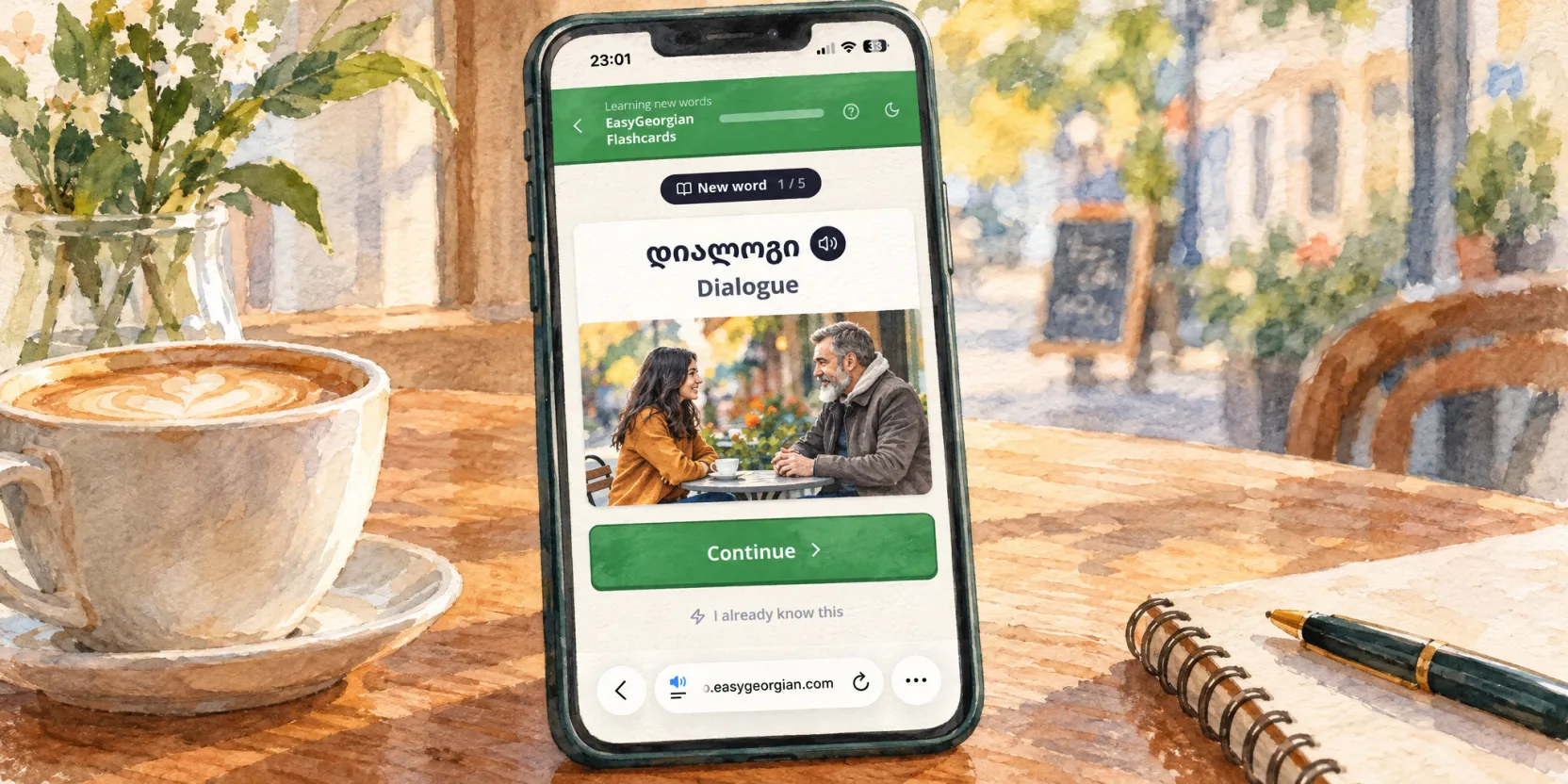
- Our flashcards, 9,000+ across the courses and decks, each with an image and audio, and three review modes including typed answers.
- The 5,000 most common Georgian words, a deck ordered by real frequency. The first 100 cards are free, and the full deck is $19.95 on its own.
- Anki is free and its spaced repetition is excellent, but the shared Georgian decks are mostly bare text with patchy audio. It works if you are willing to build and record your own deck.
- The Georgian word of the day, one word a morning by email, with an example sentence and audio.
How to use any of them well is a post of its own: how to learn Georgian vocabulary.
Listening
Listening only teaches when you follow most of what you hear, so the right resource depends on your level.
- Beginners: our free Georgian stories, short A1 videos with Buko the owl, told twice, first with English captions and then in Georgian only.
- After a beginner course: our podcast course, Advance to Georgian Mastery, 100 episodes of slow, clear Georgian with a full transcript. Episode 1 is free.
- Past the first thousand words: Georgian films with subtitles, sitcoms, and the share of public television that is online.
The level-by-level version is in our guide to Georgian listening practice.
Grammar and reference
Grammar works best as a lookup and a reveal, after you have heard the patterns, rather than as a wall of tables before you have said anything.
- Georgian: A Learner’s Grammar by George Hewitt is the reference most serious learners end up owning. Thorough, precise, and best read in pieces.
- Beginner’s Georgian by Dodona Kiziria is the friendliest textbook start, with free audio online for the 2021 edition.
- Our free verb conjugator has full tables for 147 common verbs and a reverse lookup that tells you what any verb form you meet actually is. Open it here.
- Our grammar overview walks through the cases, the postpositions and the verb system in plain English: Georgian grammar explained.
The full book list, including the Biliki series you can buy in Georgia, is in the best books to learn Georgian.
Dictionaries and translation
Different lookups need different tools:
| Tool | Best for |
|---|---|
| translate.ge | Quick lookups in both directions |
| lexicon.ge | Lookups with audio, plus Russian |
| Glosbe | Seeing a word in real sentences |
| ganmarteba.ge | Georgian definitions, once you are ready |
| PeaceBridge | Declensions and conjugations |
Two lookups no dictionary can do. A word written in Latin letters, the way Georgians often text, needs our free transliteration tool first, because a Latin t could be either of two Georgian letters. And machine translation is fine for the gist of a sign or a message and unreliable on grammar. Our Georgian AI benchmark measured where it goes wrong, and our post on the best Georgian dictionary goes through each tool.
Speaking practice
This is the job that needs a person, and the timing matters more than the choice.
- A tutor, online for roughly $10 to $35 an hour, or in person in Tbilisi for around 35 to 40 GEL. Worth far more around month three, when the lesson can stay mostly in Georgian, than in week one, when half of it is English.
- Our free Language Exchange, which introduces you by email to one Georgian who is learning English, so each of you practices half the time. How it works.
- EasyGeorgian Pro, an optional AI conversation tutor inside the app for learners who own a course and have finished five lessons, at $19.95 a month after a 14-day free trial.
For what to do before you have a person to talk to, see how to practice speaking Georgian.
Knowing your level
If you are not sure where to start, our free Georgian level test takes about eight minutes, needs no signup, and places you on the European A0 to B2+ scale, with a suggestion for where to begin.
What I would use, in order
If I were starting from zero tomorrow, the list above collapses to a short sequence:
- Day one: the alphabet tool, then lesson 1 of the audio course the same evening.
- The first two months: a structured audio lesson a day, flashcards for the words it introduces, and a Buko story when you want Georgian without effort.
- From month two: the slow podcast becomes the main listening, with the 5,000-word deck for vocabulary.
- From month three: a tutor or an exchange partner, now that you have something to say.
Everything else on this page is a tool for a specific moment. The course is the spine, and the rest hangs off it.