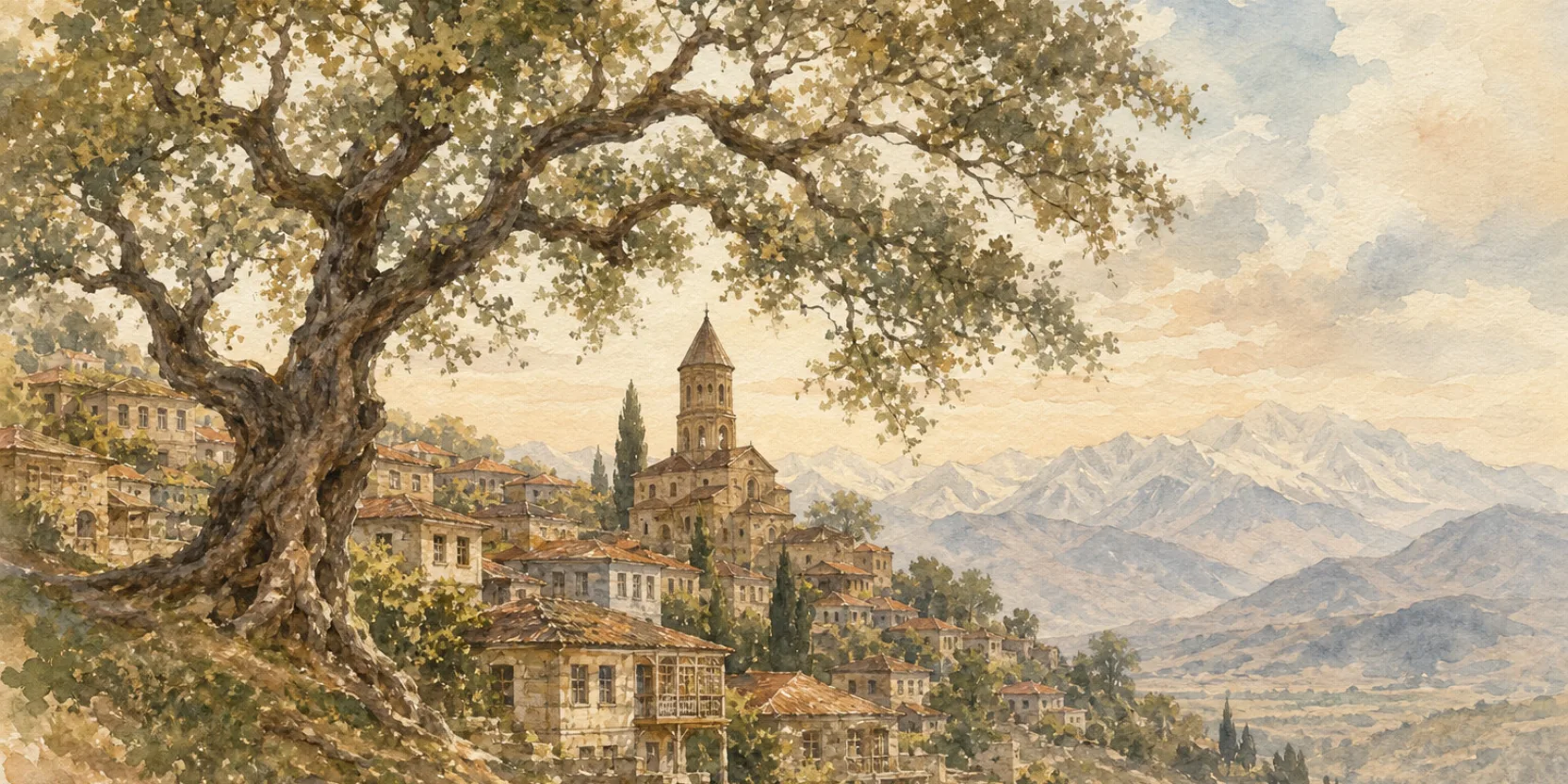




Spend a week in Georgia and the church is everywhere. Stone churches on hilltops above the towns. People crossing themselves as they pass one, even from a moving car. Candlelit interiors dense with icons. Monasteries in places that look impossible to build on. The Georgian Orthodox Church is not a background detail in this country. It is one of the threads the whole culture is woven from.
This is a guide to what it is, written for a visitor or a new resident who keeps encountering the church and wants to understand it. It sticks to history and culture, and to the practical question of how to step inside one of these buildings respectfully.
What the Georgian Orthodox Church is
The Georgian Orthodox Church is the main Christian church of Georgia and one of the oldest churches in the world. It belongs to the Eastern Orthodox communion, the same broad family as the Greek, Russian, Serbian, and other Orthodox churches.
Within that family it is independent. The word for this is autocephalous, which means self-headed: the church governs itself, under its own Patriarch, rather than answering to any other church. It has its own history, its own saints, its own deep tradition of music and architecture, and it worships in the Georgian language. Georgia is a majority Orthodox country, and the church is the dominant religious institution in national life.
A short history
Georgia’s Christian history is genuinely ancient, and a few landmarks are worth knowing.
By tradition, Christianity first reached the region through the apostle Andrew in the 1st century. Modern historians treat that account as a later tradition rather than documented history, but it tells you how far back Georgians locate their Christian roots.
The historical turning point is the 4th century and a woman named Saint Nino. Her mission led to the conversion of the king, Mirian III, and around the year 337 Christianity became the state religion of the kingdom of Kartli, in eastern Georgia. That makes Georgia one of the earliest states anywhere to adopt Christianity. The church was granted its self-governing status, its autocephaly, in the centuries that followed.
The medieval period, especially the 11th and 12th centuries, was a high point. It is the era of the great cathedrals and monasteries, of a flourishing of Georgian religious art, manuscripts, and hymnody. Then came centuries of invasion and pressure from larger empires, which the church endured through rather than escaped.
In the 19th century, after Georgia was absorbed into the Russian Empire, the Georgian church lost its independent self-governing status and was administered from outside. That autocephaly was restored in the early 20th century. The Soviet decades that followed were hard on religious life across the whole union, and the church came through them diminished. Since Georgia’s independence in 1991 there has been a marked revival, with churches restored, monasteries reopened, and the church returned to a central place in public life.
That is the history in broad strokes. It is a story of an institution far older than most countries, which has been interrupted many times and has each time continued.
Why the church matters to Georgian identity
For a visitor, the useful thing to understand is not the dates but why the church is so woven into Georgian identity.
For most of Georgian history, the country was small, mountainous, and surrounded by larger empires. Through long stretches when there was no independent Georgian state, the church was one of the things that carried Georgian identity forward: the language, the script, the calendar, the shared story. To be Georgian and to be Orthodox became, for many people, parts of the same fabric.
That history is why the church is not compartmentalized into Sundays. It shows up in the rhythm of the year, in name days and church holidays, in the icons in homes and shops and taxis, in the casual reflex of crossing oneself passing a church. You do not have to share the faith to see it. You just have to notice how much of ordinary Georgian life quietly runs alongside it.
You see the consequence of that history in small, everyday ways. A Georgian you meet may mention their name day, the feast of the saint they are named for, as naturally as a birthday. A new car or a new home may be blessed. The country’s oldest stories, its art, and a good deal of its music all run back through the church at some point. It is not a separate compartment of life here. It is part of the weave.
This is also why a respectful curiosity about the church goes a long way with Georgians. It is not a niche interest here. It is close to the center of how the country understands itself.
What you will see: churches, monasteries, and visual culture
The church is, for a visitor, intensely visual, and a little vocabulary for what you are looking at helps.
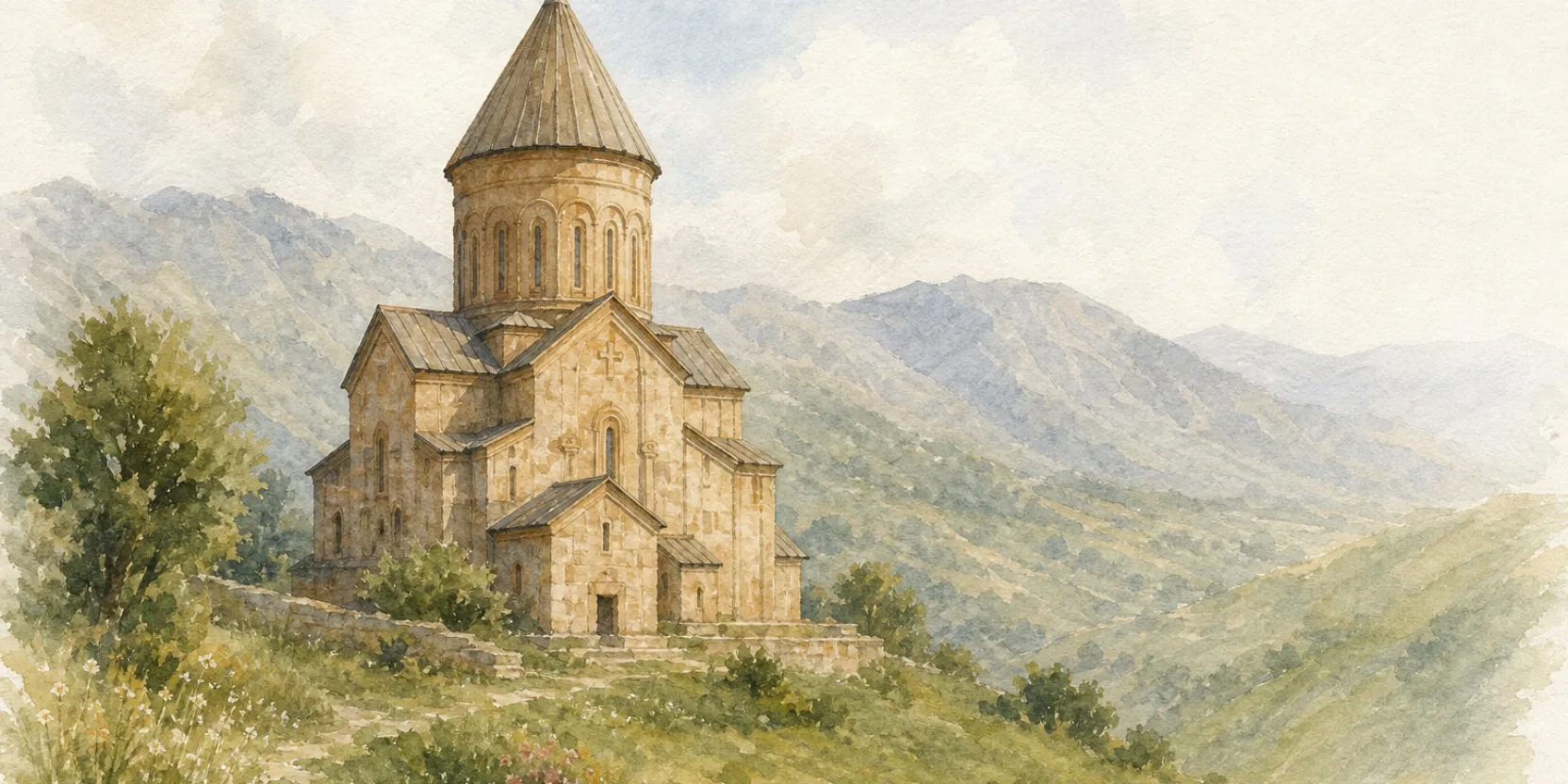
The buildings themselves are often stone, frequently old, and frequently placed high: on hilltops, ridgelines, and riverbends, in spots chosen to be seen and to see from. Many Georgian churches have a distinctive cone-shaped dome over a cross-shaped floor plan. Monasteries, often in dramatic and remote settings, are some of the most striking sights in the country.
Inside, a Georgian church is dim, candlelit, and dense with icons, painted images of Christ, the Mother of God, and the saints. There is usually no seating to speak of, because Orthodox worshippers traditionally stand. People light thin candles, kiss icons, and move quietly. The art is not decoration laid over the building. It is the point of the interior.
Some of these sites are destinations in their own right. Mtskheta, the old royal and spiritual capital just outside Tbilisi, holds Svetitskhoveli Cathedral, one of the most important churches in the country, with Jvari Monastery on the ridge above it. The Gergeti Trinity Church stands alone beneath Mount Kazbek in one of the most photographed views in Georgia. Elsewhere there are monasteries built into cliff faces and whole complexes hollowed out of rock. You do not need to seek the church out as a visitor. It is already on the itinerary of almost any trip around the country.
The church is also a keeper of older Georgian writing. Modern Georgian uses the Mkhedruli script, but the church preserves the two older scripts, Asomtavruli and Nuskhuri, in religious texts and iconography. If you want the full story of how Georgian has been written across its history, we cover it in our guide to Georgia’s older scripts.
The rhythm of the church year
Part of how the church stays woven into daily life is the calendar.
The Georgian church follows the older Julian calendar for its fixed feasts, which is why Orthodox Christmas in Georgia falls on January 7 rather than December 25. It is a quieter, more religious day than the Western Christmas, marked by church services and, in some places, a candlelit procession called Alilo.
Easter is the largest celebration of the year, larger than Christmas in the Orthodox tradition, with late-night services, red-dyed eggs, and family gatherings. Across the rest of the year there are many saints’ days and feast days. As a visitor you do not need to track any of this. It is enough to know that the Georgian year has a religious rhythm running under the civic one, and that a date that looks ordinary on your own calendar may be a significant day on the Georgian one.
Visiting a Georgian church respectfully
Churches and many monasteries are open to visitors, and stepping inside one is among the best ways to feel Georgian culture directly. A few norms make the visit comfortable for everyone.
Dress modestly. Shoulders and knees covered is the baseline. Women are usually expected to cover their heads and wear a skirt or a wrap, and at busier churches there is often a basket of scarves and wraps at the entrance to borrow. Men remove hats on the way in.
Be quiet and unobtrusive. Keep your voice low, move gently, and stay toward the edges, especially if a service is happening. A service is not a performance for visitors, so it is fine to observe respectfully from the back, but it is not the moment for photographs.
On photography, look for signs and follow them, and when in doubt, do not. Many churches allow photos of the building and forbid them of the interior, the icons, or the services. A quick look around at whether anyone else is taking pictures is usually answer enough.
None of this requires you to share the faith or to perform anything. You do not need to cross yourself or light a candle. Modest dress, a low voice, and a bit of attention to what the people around you are doing cover it. The same instinct that serves you at a Georgian supra, watch the room and follow it, serves you here.
A Georgian church is one of the quietest, oldest-feeling places you can stand in this country. Understanding a little of what it is, and how it has carried Georgian identity through a long and interrupted history, makes the visit land deeper. If that history makes you want to understand the country from the inside, the language of Georgia is the next thread to pull, and our guide on learning Georgian is where that starts.