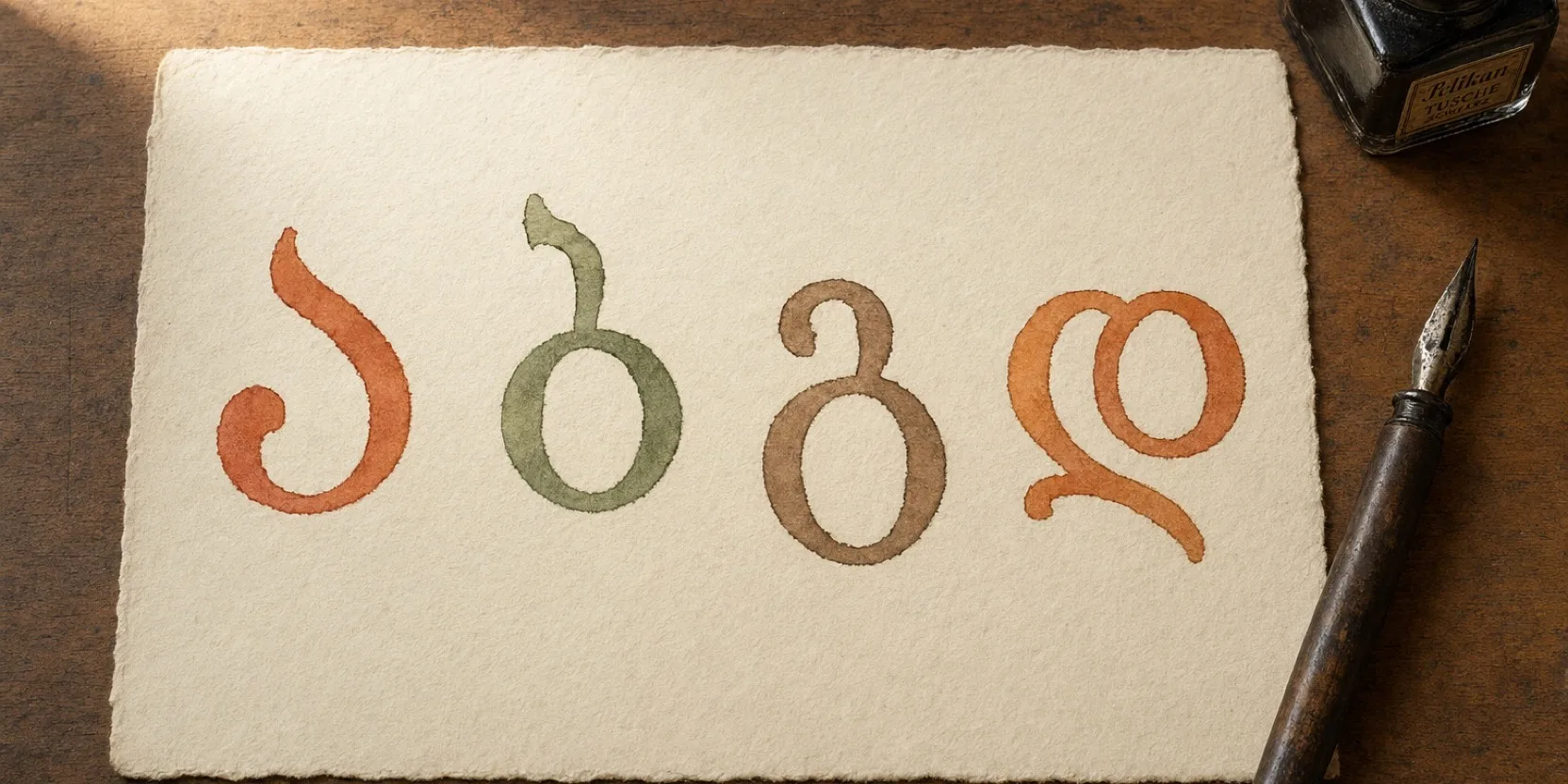




You decide to learn the Georgian alphabet, you start reading about it, and within a few minutes you hit a fact that sounds like bad news: Georgian does not have one alphabet, it has three. Asomtavruli, Nuskhuri, Mkhedruli. For a moment it looks like the job just tripled.
It did not. Georgian has three historical scripts, but a learner only needs one of them. This post explains what the three Georgian scripts are, why there are three, and which one actually matters for you, which is the question the encyclopedia entries never quite get around to answering.
How many Georgian scripts are there?
Three. Over its long history, Georgian has been written in three scripts: Asomtavruli, Nuskhuri, and Mkhedruli.
The important thing to understand up front is that these are not three different alphabets in the sense of three different sets of letters to memorize. They are three ways of drawing the same alphabet. The scripts share the same letter names, the same sounds, and the same order. A letter is the same letter in all three. What changes is the shape, the way that letter is written.
Think of it loosely the way the Latin alphabet has very different-looking historical and stylistic forms while still being the same alphabet underneath. Georgian’s three scripts are a similar story, spread across more than fifteen centuries.
Here is the full alphabet, all 33 letters, in each of the three scripts. Read across any row and you are looking at a single letter in its three historical forms. The names down the left, ani, bani, gani, stay the same in every script, and so do the order and the sound. Only the shape changed.
| Letter | Asomtavruli | Nuskhuri | Mkhedruli |
|---|---|---|---|
| ani · a | Ⴀ | ⴀ | ა |
| bani · b | Ⴁ | ⴁ | ბ |
| gani · g | Ⴂ | ⴂ | გ |
| doni · d | Ⴃ | ⴃ | დ |
| eni · e | Ⴄ | ⴄ | ე |
| vini · v | Ⴅ | ⴅ | ვ |
| zeni · z | Ⴆ | ⴆ | ზ |
| tani · t | Ⴇ | ⴇ | თ |
| ini · i | Ⴈ | ⴈ | ი |
| k'ani · k' | Ⴉ | ⴉ | კ |
| lasi · l | Ⴊ | ⴊ | ლ |
| mani · m | Ⴋ | ⴋ | მ |
| nari · n | Ⴌ | ⴌ | ნ |
| oni · o | Ⴍ | ⴍ | ო |
| p'ari · p' | Ⴎ | ⴎ | პ |
| zhani · zh | Ⴏ | ⴏ | ჟ |
| rae · r | Ⴐ | ⴐ | რ |
| sani · s | Ⴑ | ⴑ | ს |
| t'ari · t' | Ⴒ | ⴒ | ტ |
| uni · u | Ⴓ | ⴓ | უ |
| pari · p | Ⴔ | ⴔ | ფ |
| kani · k | Ⴕ | ⴕ | ქ |
| ghani · gh | Ⴖ | ⴖ | ღ |
| q'ari · q' | Ⴗ | ⴗ | ყ |
| shini · sh | Ⴘ | ⴘ | შ |
| chini · ch | Ⴙ | ⴙ | ჩ |
| tsani · ts | Ⴚ | ⴚ | ც |
| dzili · dz | Ⴛ | ⴛ | ძ |
| ts'ili · ts' | Ⴜ | ⴜ | წ |
| ch'ari · ch' | Ⴝ | ⴝ | ჭ |
| khani · kh | Ⴞ | ⴞ | ხ |
| jani · j | Ⴟ | ⴟ | ჯ |
| hae · h | Ⴠ | ⴠ | ჰ |
Where the Georgian script came from
Before the three scripts, there is the question of where Georgian writing began at all, and the honest answer is part history and part tradition.
By one old tradition, a Georgian script existed far back in the pre-Christian era, credited to an early king. Most modern scholars do not find firm evidence for that, and place the creation of the script later, around the time Georgia adopted Christianity. The script most likely took shape between the conversion of the Georgian kingdom in the 4th century and the oldest inscriptions that survive, which date to the 5th. Those early inscriptions, some carved in stone and some found as far away as the Holy Land, are the first hard evidence of Georgian being written down.
What is not in doubt is that the script is genuinely Georgian. It was not borrowed wholesale from a neighboring alphabet. It was built for the Georgian language, which is part of why it fits the language so cleanly, one letter to one sound, and why Georgians regard their script as their own in a way that runs deeper than most countries feel about their writing.
Asomtavruli: the oldest
Asomtavruli is the oldest of the three, the original form of the Georgian script, in use from around the 5th century.
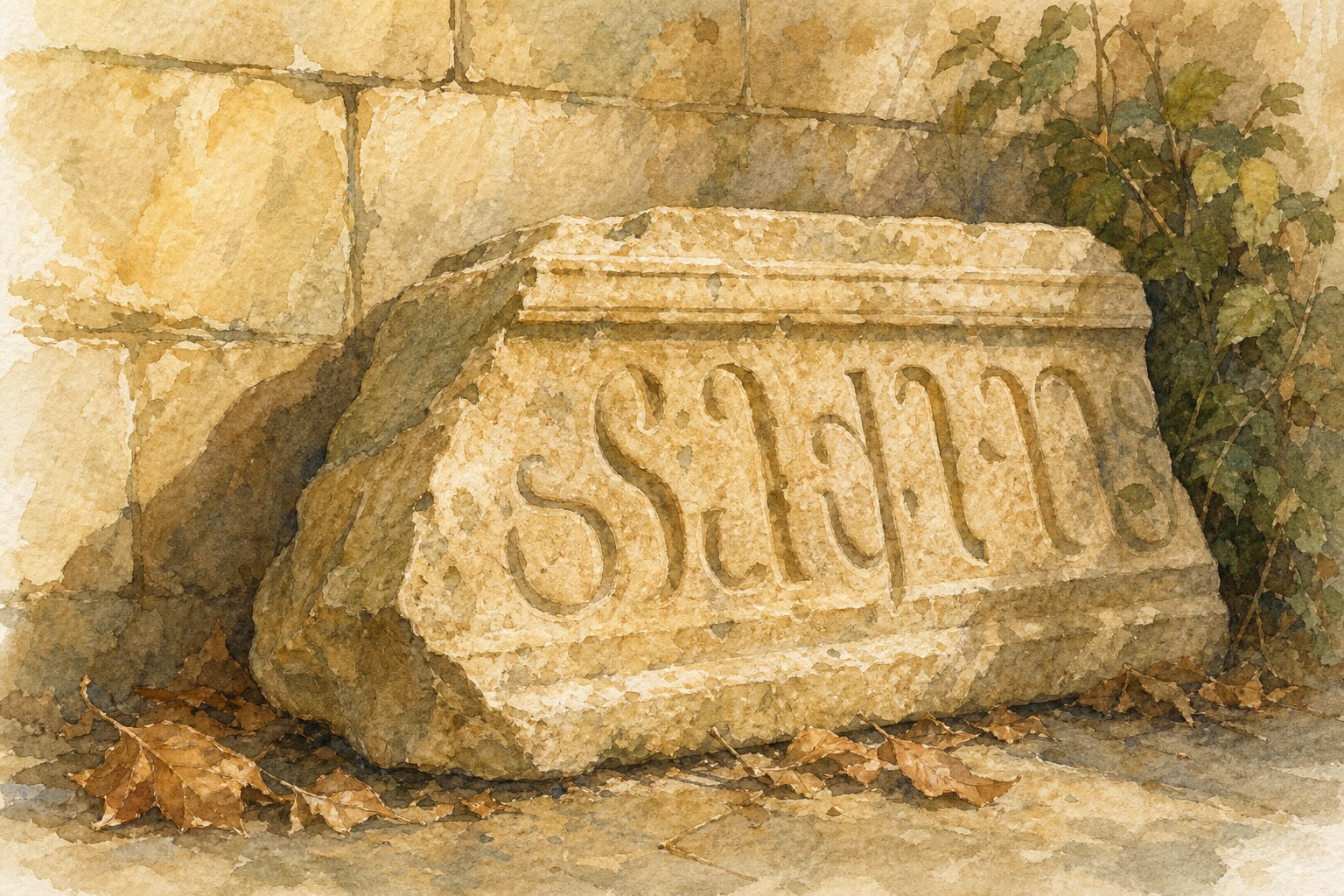
The name means something close to “capital letters,” and it is also known as Mrgvlovani, “rounded,” which describes it well: it is a rounded, even, monumental script. It is the script of the earliest Georgian inscriptions, the kind carved into stone and built for permanence rather than speed. Its creation is generally linked to the Christianization of the Georgian kingdom, which puts the birth of written Georgian very early in the country’s Christian history.
Some of the oldest surviving examples of written Georgian are in Asomtavruli, and standing in front of one of those inscriptions is a quietly striking thing. It is the same alphabet a learner studies today, in its first and oldest dress, more than fifteen centuries on. The letters are recognizably the ancestors of the ones on a modern street sign.
For a modern learner, Asomtavruli is history. You will see it in old inscriptions, in church contexts, and as decorative capitals. You will not need to write it.
Nuskhuri and the church
Nuskhuri came next, developing around the 9th century. Where Asomtavruli is rounded and monumental, Nuskhuri is angular and more compact, a script shaped by the practical need to write faster and to produce more books.
Nuskhuri did not simply replace Asomtavruli. For centuries the two were used together as a paired system, sometimes called Khutsuri, “church” script: Asomtavruli for titles and capitals, Nuskhuri for the running text beneath them. That pairing lived in the religious manuscripts of the Georgian church.
That pairing is why Nuskhuri carries the feel of the manuscript and the monastery rather than the public square. It is a working script, made for scribes filling pages, and it looks the part: tighter, more slanted, more economical than the rounded Asomtavruli above it.
Like Asomtavruli, Nuskhuri today belongs mainly to the Georgian Orthodox Church, which preserves both older scripts in its religious texts and iconography. It is part of why a Georgian church can feel like a place where older versions of the country are kept intact.
Mkhedruli: the one you will learn
Mkhedruli is the third script, and it is the one that matters for you. It first appears around the 10th century and, over time, became the standard.
The name is usually translated as something like “military” or “secular,” and from early on Mkhedruli was the script of non-religious life: royal charters, historical records, ordinary writing. Its shapes are the most fluid and the fastest to write of the three, which is a large part of why it won. It is rounded, flowing, and well suited to a pen moving quickly.
Today, Mkhedruli is simply Georgian writing. Every book, every newspaper, every street sign, every restaurant menu, every text message, every website in Georgian is in Mkhedruli. It has 33 letters, it is fully phonetic, and it has no separate capital letters. When we talk about learning to read Georgian, in our Georgian alphabet guide or anywhere else, we mean Mkhedruli.
Why three scripts still matters today
If only one script is in daily use, why know about the other two at all?
Partly because you will see them. Spend time in Georgia and the old scripts appear: carved into a church wall, lettering an icon, heading an old manuscript in a museum. Knowing that the beautiful, unfamiliar lettering in a church is Asomtavruli or Nuskhuri, and not some lost language, makes the country read more clearly.
Partly because it is a genuine point of Georgian pride. The living culture of the three Georgian writing systems is recognized by UNESCO as Intangible Cultural Heritage. Few languages have carried three of their own scripts intact across this much time, and Georgians know it.
And partly because it explains the shape of the language’s history. The three scripts track Georgia’s path from early Christian inscriptions, through the manuscript culture of the church, to a secular everyday script, each one a response to how people in that era actually needed to write.
Which script should a learner focus on?
Mkhedruli. Only Mkhedruli. That is the entire practical answer.
If your goal is to read, speak, and live in modern Georgian, you will never need to write Asomtavruli or Nuskhuri. The old scripts are worth recognizing, the way you might recognize an old style of lettering in your own language, but recognizing is not learning, and you do not need to learn them.
So if the three-scripts fact gave you a moment of doubt, let it go. It is a wonderful piece of Georgian history and not a single extra hour of work for you. The script you actually learn, Mkhedruli, is 33 phonetic letters and takes an afternoon, not a project. The three scripts are a reason Georgian is interesting, not a reason it is hard. If you are ready to start, our Georgian alphabet guide teaches the one script you need, and our guide on learning Georgian covers what comes after it.