


Someone’s birthday is today and they’re Georgian. Maybe Facebook reminded you, maybe your partner did. Happy birthday in Georgian is gilotsav dabadebis dghes (გილოცავ დაბადების დღეს), literally “I congratulate you on your birth day.” Say it out loud to the birthday person and watch what happens. Georgians don’t expect foreigners to try, which means even a wobbly version lands as a small gift.
Below: how to pronounce it, what the three words are actually doing, the formal version for your partner’s mother, the wishes Georgians stack on top, what to write in a message, and the answer to the birthday song question.
The phrase
Break the sound into pieces and it stops looking intimidating: gi-lo-tsav da-ba-de-bis dghes. The ts is the ts in cats. The only part that needs practice is dghes, a d running straight into gh, the soft gargled sound English doesn’t have. It’s the ch of Scottish loch with the voice switched on, and it’s the same sound that starts ghvino, the Georgian word for wine, so you’ll be making it a lot anyway. Said at full speed by a Georgian the phrase compresses, the way happy birthday does in English. Taking it one careful syllable at a time is fine. You’ll still be understood.
If it comes out closer to “dgess,” say it anyway. The reward is out of all proportion to the effort. A taxi driver will praise a single halfway-broken sentence. The person whose birthday you just acknowledged in their own language will remember it.
What the three words are doing
Gilotsav is a complete sentence on its own: “I congratulate you.” Georgian verbs carry their pronouns inside them, the same trick that makes I love you in Georgian a single word. The g near the front is the “you.” And because the verb already says who is congratulating whom, Georgians use gilotsav by itself the way English uses “congratulations,” for any occasion worth congratulating. Add words after it and you’re just naming the occasion. Happy New Year, for instance, is the same verb with a different object: gilotsav akhal ts’els.
Dabadebis is dabadeba, birth, wearing the ending that means “of.”
Dghes is dghe, day, with the -s ending Georgian uses to mark the object of the verb, the occasion you’re congratulating. The same little word doubles as “today.”
Put together: “I congratulate you on the day of birth.” Notice there’s no “happy” anywhere in it. Georgian doesn’t wish you a happy day, it congratulates you on the day itself. There’s one more layer underneath. The verb is built on the same root as lotsva, the Georgian word for prayer, so the phrase has a faint blessing folded into it.
Word order, incidentally, is relaxed. You’ll also see dabadebis dghes gilotsav, same words, same meaning.
Formal or informal: gilotsav vs gilotsavt
Georgian politeness runs through its verbs. To a friend, a partner, a colleague your own age, anyone you’d call shen (the informal you): gilotsav dabadebis dghes.
To your boss, an older neighbor, your partner’s parents, anyone you address as tkven (the formal you):
The whole difference is the final -t. It makes the verb plural, and Georgian uses the plural you for politeness, roughly the way French uses vous. That also makes gilotsavt the form for congratulating a couple or a whole family at once.
If you’ve spent time in Georgia, you’ve met this -t before, tacked onto gamarjoba as gamarjobat. On a greeting like that it’s a colloquial habit. On gilotsavt it’s grammar working as designed, because gilotsav is a verb and the -t belongs there.
If you’re unsure which register you’re in, use gilotsavt. Nobody minds extra politeness.
The wishes Georgians add
A bare congratulation is fine, but Georgian birthday messages usually stack a wish or two on top. These are the ones worth knowing.
Gisurveb, “I wish you,” is the workhorse. Whatever you name after it becomes the wish, taking the same -s object ending you saw on dghes. For someone formal, the -t lands here too: gisurvebt.
Short enough for a comment thread.
The most Georgian wish of the set, literally something like “may you be present at many,” where the many means many more birthdays. Georgians often stack it right after the congratulation. The form above carries the polite -t you already know from gilotsavt, which is how you’ll most often hear and write it. With a close friend the informal mravals daests’ari works the same way.
A long-life blessing that is also the name of a song, more on which below.
You don’t need the whole list. One congratulation plus one wish, meant sincerely, beats a recited parade of all four.
What to write in a message

For a friend, the message can be exactly what you’d say out loud: gilotsav dabadebis dghes. Add a wish if you want it to breathe a little:
Write it in Georgian script if you can. The Georgian alphabet has 33 letters and no capital forms, so the phrase looks the same wherever it lands in a sentence. And if typing Georgian is beyond your keyboard today, copy and paste it. The warmth survives the shortcut.
Two things you’ll notice once Georgian birthdays start crossing your feed. First, the shorthand: gilotsav dabdghes, where dabdghe compresses dabadebis dghe into the Georgian equivalent of “b-day.” Friendly, informal, everywhere among younger Georgians online. Second, the poems: there are entire Georgian websites of ready-made rhyming birthday texts that people copy into comment threads. One plain sentence you mean, in either alphabet, reads warmer than a borrowed verse.
For someone you’d address formally, the same upgrade as before, and the polite -t rides on both verbs if you add a wish: გილოცავთ დაბადების დღეს, გისურვებთ ბედნიერებას და ჯანმრთელობას (gilotsavt dabadebis dghes, gisurvebt bednierebas da janmrtelobas).
If it’s your birthday
Flip the situation and the vocabulary comes with you.
It’s a great beginner sentence, four words with dghe working both ends, as “today” at the front and “day” at the back.
When the gilotsav messages start arriving, the reply is a word you may already have: madloba, thanks, or didi madloba, thanks a lot.
Do Georgians sing the happy birthday song?
Yes, and the version you’ll hear at most parties is the one you already know. The international happy-birthday tune gets sung with gilotsav dabadebis dghes where “happy birthday to you” goes, the birthday person’s name dropped in where names go. If you can hum the English one, you can join the Georgian one from the second line.
The older, deeper song is mravalzhamieri, “many years.” It’s less a birthday song than a blessing in song form, a polyphonic table song wishing long life, sung in regional variants at feasts across Georgia.
If you’re invited to the party

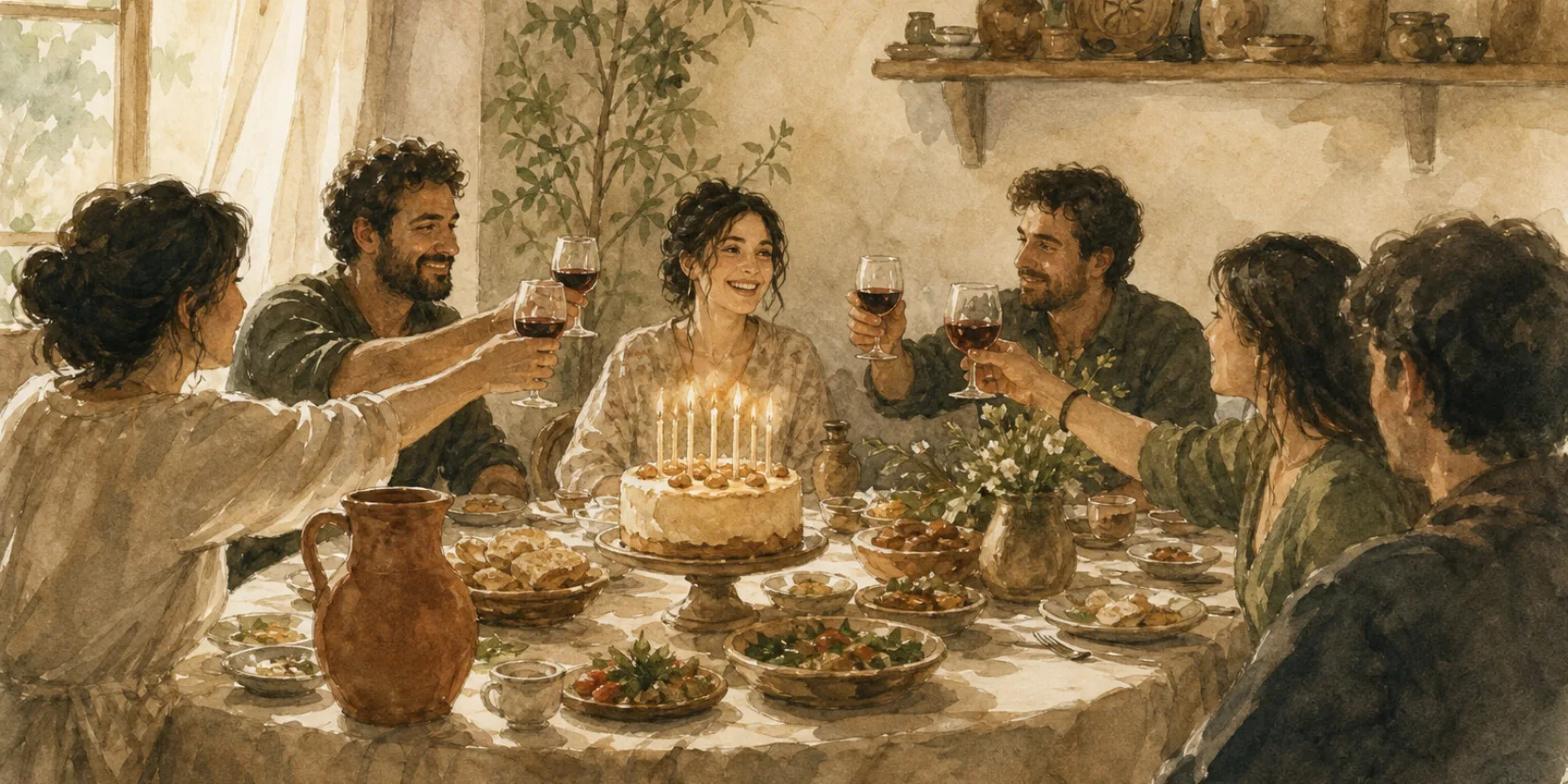
A Georgian birthday, especially a round number or a family occasion, often takes the shape of a supra: the long table, the dishes arriving in waves, the toasts running through the evening. Someone, often an older relative, will hold the table as tamada, the toastmaster, and somewhere in the sequence the glasses turn toward the birthday person.
Picture the specific version of this that brought you to this post. The birthday belongs to your partner’s mother, the table is set for twenty, and the evening is happening in a language you’re two phrases into. You’ve probably done the smiling-and-nodding version of this dinner before, the one where the evening happens around you.
Two phrases go further than you’d think. Gaumarjos is the collective cheer that ends every toast, your ticket to drinking along with the table. And gilotsavt is yours to say when the glasses point at the birthday person, the one word in the room that’s unmistakably meant from you.
If the tamada hands you the floor, don’t reach for something grand. I’ve given a lot of toasts at Georgian supras over the years, and the short sincere ones beat the rehearsed ones every time. Raise the glass, say one true thing about the birthday person, finish with gilotsavt dabadebis dghes, gaumarjos. The full craft, including the toasts you should never clink to, is in our guide to Georgian toasts.
If the birthday is tonight, you have what you need. Write gilotsav dabadebis dghes under the post, say it out loud at the table, and when the singing starts, come in from the second line. You already know the tune. And if saying one phrase in someone’s own language feels as good as I think it will, the first lesson of the audio course is free, no signup needed.