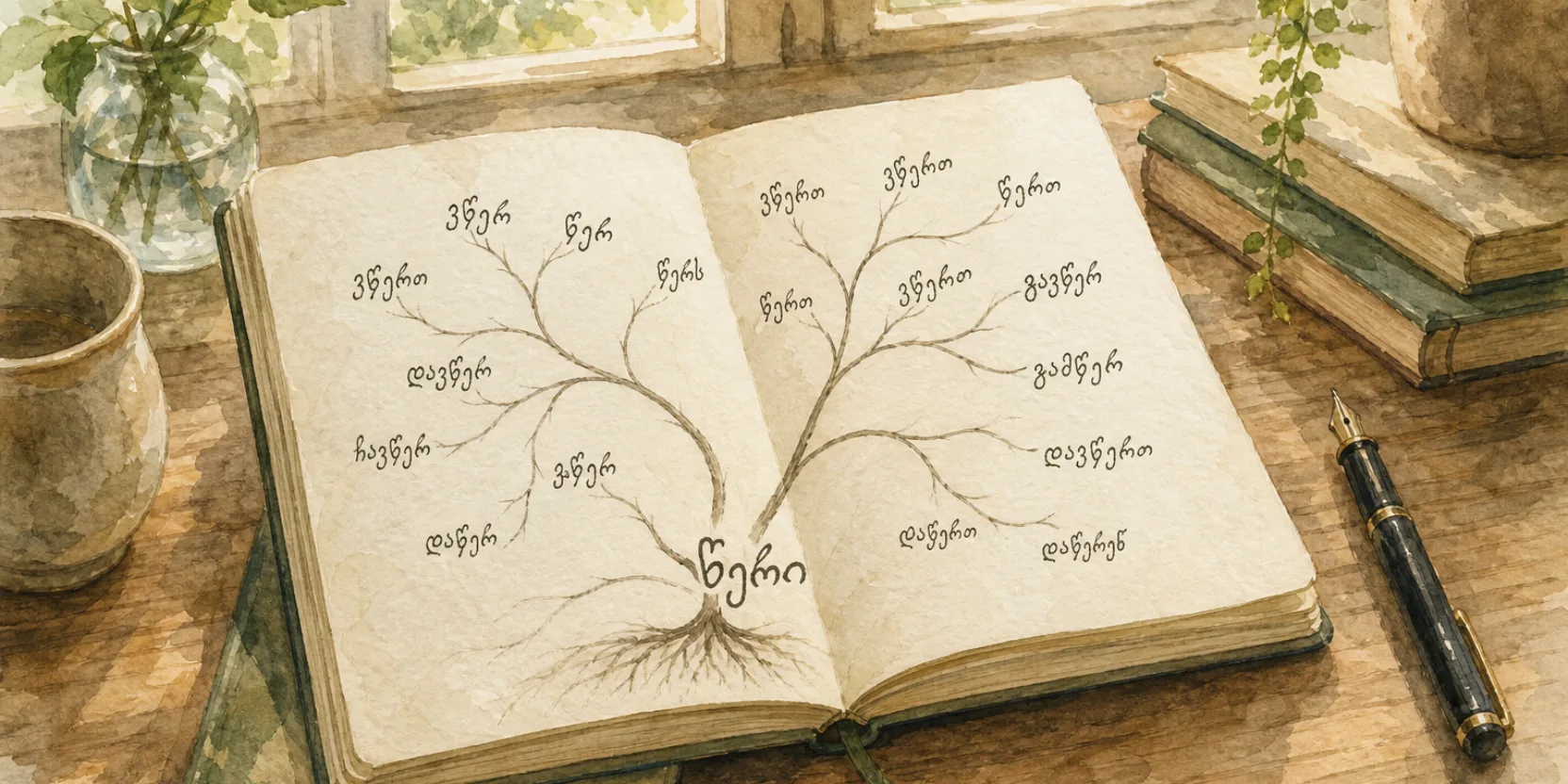

You learn your first Georgian verb. It is ts’ers, წერს, “he writes”. You feel good about it. Then a Georgian friend texts you დავწერე, and you cannot find that word in any dictionary, because dictionaries do not file Georgian verbs under the forms people actually say. Welcome to Georgian verb conjugation, the part of the language with the fiercest reputation and the least helpful explanations.
This post explains how the system works in plain English, and then hands you a shortcut we built: a free Georgian verb conjugator with full tables for 147 common verbs, where you can paste any form you meet, დავწერე included, and get told what verb it is, what tense group it belongs to, and who is doing the writing.
Why Georgian verbs have a reputation
Three things make Georgian verbs genuinely different from what most learners have seen before.
First, a Georgian verb can carry its whole sentence. It agrees with the subject and can mark the object at the same time, so მოგწერ means “I will write to you” in one word. Compact for Georgians, disorienting for beginners.
Second, verbs travel with preverbs, little prefixes like და-, გა-, or მი- that attach in some tense groups and drop off in others. That is why დავწერე does not look like წერს even though they are the same verb. The front of the word changes, and alphabetical dictionary order stops helping you.
Third, in the simple past the subject changes case. The person doing the action picks up the ending -მა or -მ, and the learner briefly suspects the whole language has rearranged itself overnight. It has not. It is one rule, and it lives in one tense group, which we will get to.
None of this makes Georgian unlearnable. It makes it different, and different is mostly a description problem. The grammars describing the system were written for linguists. You are not required to learn it the way they describe it.
Georgian does not have tenses. It has screeves.
The word linguists use for a Georgian tense is screeve, from the Georgian mts’k’rivi, meaning row. A screeve is a row of six forms of one verb, one for each person: I, you, he or she, we, you all, they. Each screeve packages tense, aspect, and mood together, which is why “tense” is the wrong frame. One screeve can mean “was doing”, another “did”, another “has apparently done”.
Georgian has 11 screeves. That number sounds alarming until you notice two things. The screeves come in families that share their logic, and several of them are rare in daily speech. You will meet maybe six of them constantly, and the rest occasionally.
The four tense groups, in plain English
The easiest way to think about the 11 screeves is as four everyday groups. Here is what each one is actually for.
| Group | Screeves | What it does |
|---|---|---|
| Present group | present, imperfect, present subjunctive | What happens or is happening. “I write, I was writing.” |
| Future group | future, conditional, future subjunctive | What will happen. Usually the present plus a preverb. |
| Aorist group | aorist, optative | What happened, wishes, and “should”. The subject takes -მა or -მ here. |
| Perfect group | perfect, pluperfect, perfect subjunctive | ”Apparently he did it”. Reported and evidential past. |
Grammar books bundle these four groups into 3 series, and you will meet that term if you read further: the present and future groups together are Series 1, the aorist group is Series 2, and the perfect group is Series 3. Same 11 screeves, different bookkeeping. Commands do not even need a screeve of their own. Georgian mostly borrows the aorist form for them, which is why დაწერე is both “you wrote it” and “write it!”
The pattern worth noticing: the future group is very often just the present group wearing a preverb. ვწერ, “I write”, becomes დავწერ, “I will write”. Learn which preverb a verb takes and you get its entire future group nearly free.
One verb, wall to wall
Here is წერს, “to write”, walked through the forms you will actually meet. Listen to how regular the changes sound.
Look at what stays stable. The root -წერ- is in every single form. The person marker ვ- for “I” is there in four of the five. The preverb და- shows up exactly where the tense groups predict it. Georgian conjugation is not chaos. It is a small set of parts that snap together in predictable positions, and once your ear knows the parts, new verbs stop being new problems.
For the full table of წერს, covering all 11 screeves, the conjugator has it laid out with transliteration on every form.
The form you met does not look like the verb you learned
This is the practical problem that made us build a tool. Georgian dictionaries cite verbs by the masdar, a verbal noun like წერა, “writing”, or by the third person present, წერს. But the Georgian you meet in real life arrives conjugated. A friend texts დაწერე, “write it”. A child announces მინდა, “I want”. Changed fronts, changed endings, and no dictionary that files these forms anywhere.
So the EasyGeorgian verb conjugator works in both directions. It has full conjugation tables for 147 of the most common Georgian verbs, every screeve, with transliteration on every single form. And it has a reverse lookup: paste in any of the 8,918 forms in its tables, in Georgian script or transliteration, and it tells you the verb, the screeve, and the person.
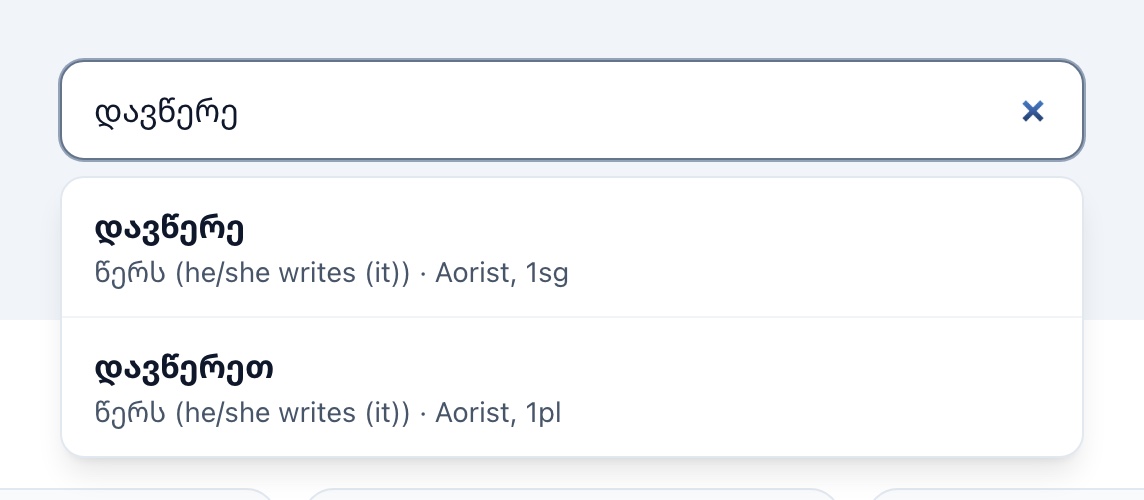
It is free, no signup, and it stays free. Georgian has never had a proper conjugation reference online in English, the kind Spanish and French learners take for granted, and we wanted the gap closed.
The verbs that work backwards
One more thing the tables will show you, because you will trip over it in your first week either way. Some of the most common Georgian verbs are built backwards from a learner’s point of view. Wanting, having, fearing, remembering: for these, Georgian marks the person who feels as an object, not a subject.
Take მინდა, “I want”. The მ- at the front is the same “me” marker you would find in “he sees me”. Literally the structure is closer to “it is wanted to me”. Same story with მაქვს, “I have”, and მეშინია, “I am afraid”. Linguists call these indirect verbs, and they include some of the first verbs you will ever need.
Two practical consequences. Their tables look different from წერს-style verbs, with the person changing at the front instead of the usual places. And they are too common to postpone: want, have, like, know, and fear all live in this class. When one of them confuses you, the conjugator has their full tables too, including the defective ones that simply skip certain tense groups. A verb missing a screeve in our tables is not a gap in the data. Some Georgian verbs genuinely do not have all eleven, and pretending otherwise is how textbooks manufacture confusion.
What should you actually learn first?
If you are staring at 11 screeves wondering where to start, the honest ranking from daily Tbilisi life:
- Present group first. “I write, I work, I want.” The bulk of beginner conversation lives here.
- Future group second, and it is nearly free. Present plus the verb’s preverb: ვწერ becomes დავწერ. One new fact per verb, not one new table.
- Aorist group third. Simple past, “I wrote”. This is where the subject picks up -მა or -მ, the famous case switch. One tense group, one rule, survivable.
- Perfect group last. “Apparently he wrote it.” Georgians use it constantly for reported events, but you can understand and be understood for months before producing it well.
The imperative you learn for free from being told what to do. დაწერე, “write it”, ისწავლე, “study”. Nobody ever needed a table for the forms people say directly at them.
Do you have to memorize these tables?
No. And we would go further: memorizing conjugation tables is close to the worst use of your study time.
Here is the thing the tables cannot show you. Every form in them follows patterns your brain is extremely good at absorbing from examples. Hear ვწერ, ვხატავ, ვმუშაობ enough times, “I write”, “I paint”, “I work”, and the ვ- for “I” installs itself without a chart anywhere in sight. Hear დავწერე and გავაკეთე and the shape of “I did” settles in the same way. This is how you learned your own language’s irregularities, none of which you ever saw in a table.
That is the approach our audio course takes from lesson one: real sentences, active recall, the patterns arriving through your ears at a pace your memory can keep up with. The tables then become what tables are good at, a reference. You met a form, you look it up, you move on. If you want to go deeper into how the whole grammar hangs together, the Georgian grammar overview covers the cases and word order side, and the Georgian alphabet takes an afternoon if you have not done it yet.
We are also building something between the two: a Verbs Mastery course that teaches the conjugation patterns directly, drills included, built on the same verified data as the conjugator. If verbs are your current wall, the conjugator is the reference for today and the course is coming for the practice.
The first audio lesson is free. And the next time a Georgian texts you a verb form you have never seen, you know where to paste it.